37BOC Smootharc Multi 180/200 Operating manual
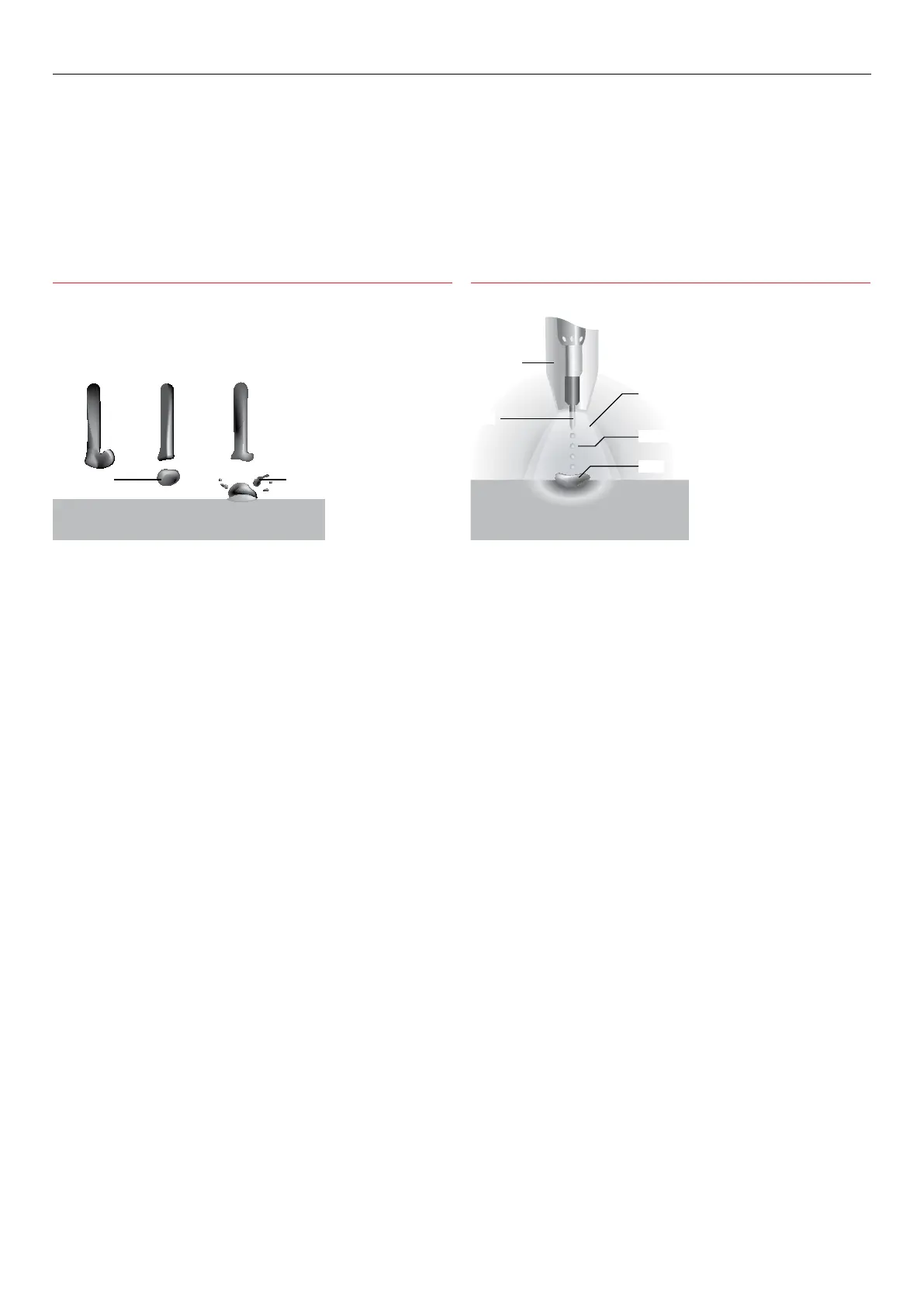
Spray transfer
In spray transfer, metal is projected by an electromagnetic force from
the wire tip in the form of a continuous stream of discrete droplets
approximately the same size as the wire diameter. High deposition
rates are possible and weld appearance and reliability are good. Most
metals can be welded, but the technique is limited generally to plate
thicknesses greater than 6 mm. Spray transfer, due to the tendency of
the large weld pool to spill over, cannot normally be used for positional
welding. The main exception is aluminium and its alloys where, primarily
because of its low density and high thermal conductivity, spray transfer
in position can be carried out.
The current ows continuously because of the high voltage maintaining
a long arc and short-circuiting cannot take place. It occurs best with
argon-based gases.
In solid wire MIG/MAG, as the current is increased, dip transfer passes
into spray transfer via a transitional globular transfer mode. With metal-
cored wires there is virtually a direct transition from dip transfer to spray
transfer as the current is increased.
For metal cored wire spray transfer occurs as the current density
increases and an arc is formed at the end of the ller wire, producing
a stream of small metal droplets. Often the outside sheath of the wire
will melt rst and the powder in the centre ows as a stream of smaller
droplet into the weld pool. This eect seems to give much better transfer
of alloying elements into the weld.
In spray transfer, as the current density increases, an arc is formed at
the end of the ller wire, producing a stream of small metal droplets. In
solid wire MIG/MAG this transfer mode occurs at higher currents. Flux-
cored wires do not achieve a completely true spray transfer mode but a
transfer mode that is almost true spray may occur at higher currents and
can occur at relatively low currents depending on the composition of
theux.
Rutile ux-cored wires will operate in this almost-spray transfer mode, at
all practicable current levels. They are also able to operate in this mode
for positional welding too. Basic ux-cored and self-shielded ux-cored
wires do not operate in anything approaching true spray transfer mode.
Pulsed transfer
Pulsed arc welding is a controlled method of spray transfer, using
currents lower than those possible with the spray transfer technique,
thereby extending the applications of MIG/MAG welding into the range
of material thickness where dip transfer is not entirely suitable. The
pulsed arc equipment eectively combines two power sources into one
integrated unit. One side of the power source supplies a background
current which keeps the tip of the wire molten. The other side produces
pulses of a higher current that detach and accelerate the droplets of
metal into the weld pool. The transfer frequency of these droplets is
regulated primarily by the relationship between the two currents. Pulsed
arc welding occurs between ±50-220A, 23–35 arc volts and only with
argon and argon-based gases. It enables welding to be carried out in
allpositions.
Large droplet
Splatter
Workpiece
Gas shroud
Wire
Shielding gas
Droplets
Weld
Workpiece
Schematic of globular transfer Schematic of spray transfer




 To Next Page