35BOC Smootharc Multi 180/200 Operating manual
If no external gas shield is required, then the ux ll must provide
sucient gas to protect the molten pool and to provide de-oxidisers and
nitride formers to cope with atmospheric contamination. This leaves less
scope to address performance, arc stabilisation, and process tolerance,
so these tend to suer when compared with gas shielded types.
Wire eciencies are also lower, at about 65%, in this mode of operation
than with gas-shielded wires. However, the wires do have a distinct
advantage when it comes to site work in terms of wind tolerance, as
there is no external gas shield to be disrupted.
When using self-shielded wires, external gas supply is not required and,
therefore, the gas shroud is not necessary. However, an extension nozzle
is often used to support and direct the long electrode extensions that
are needed to obtain high deposition rates.
Metal Cored Arc Welding (MCAW)
Metal-cored arc welding (MCAW) uses the heat generated by a DC
electric arc to fuse metal in the joint area, the arc being struck between
a continuously fed consumable ller wire and the workpiece, melting
both the ller wire and the workpiece in the immediate vicinity. The
entire arc area is covered by a shielding gas, which protects the molten
weld pool from the atmosphere.
As MCAW is a variant of the MIG/MAG welding process there are many
common features between the two processes, but there are also several
fundamental dierences.
As with MIG/MAG, direct current power sources with constant voltage
output characteristics are normally employed to supply the welding
current. With metal-cored wires the terminal the ller wire is connected
to depends on the specic product being used, some wires designed to
run on electrode positive, others preferring electrode negative, and some
which will run on either. The work return lead is then connected to the
opposite terminal. Electrode negative operation will usually give better
positional welding characteristics. The output characteristics of the
power source can have an eect on the quality of the weldsproduced.
The wire feed unit takes the ller wire from a spool or bulk pack, and
feeds it through the welding torch, to the arc at a predetermined and
accurately controlled speed. Normally, special knurled feed rolls are
used with metal-cored wires to assist feeding and to prevent crushing
theconsumable.
Unlike MIG/MAG, which uses a solid consumable ller wire, the
consumable used in MCAW is of tubular construction, an outer metal
sheath being lled entirely with metal powder except for a small amount
of non-metallic compounds. These are added to provide some arc
stability and de-oxidation.
MCAW consumables always require an auxiliary gas shield in the
same way that solid MIG/MAG wires do. Wires are normally designed
to operate in argon-carbon dioxide or argon-carbon dioxide-oxygen
mixtures or carbon dioxide. Argon rich mixtures tend to produce lower
fume levels than carbon dioxide.
As with MIG/MAG, the consumable ller wire and the shielding gas are
directed into the arc area by the welding torch. In the head of the torch,
the welding current is transferred to the wire by means of a copper alloy
contact tip, and a gas diuser distributes the shielding gas evenly around
a shroud which then allows the gas to ow over the weld area. The
position of the contact tip relative to the gas shroud may be adjusted to
limit the minimum electrode extension.
Modes of metal transfer with MCAW are very similar to those obtained
in MIG/MAG welding, the process being operable in both ‘dip transfer’
and ‘spray transfer’ modes. Metal-cored wires may also be used in
pulse transfer mode at low mean currents, but this has not been
widelyexploited.
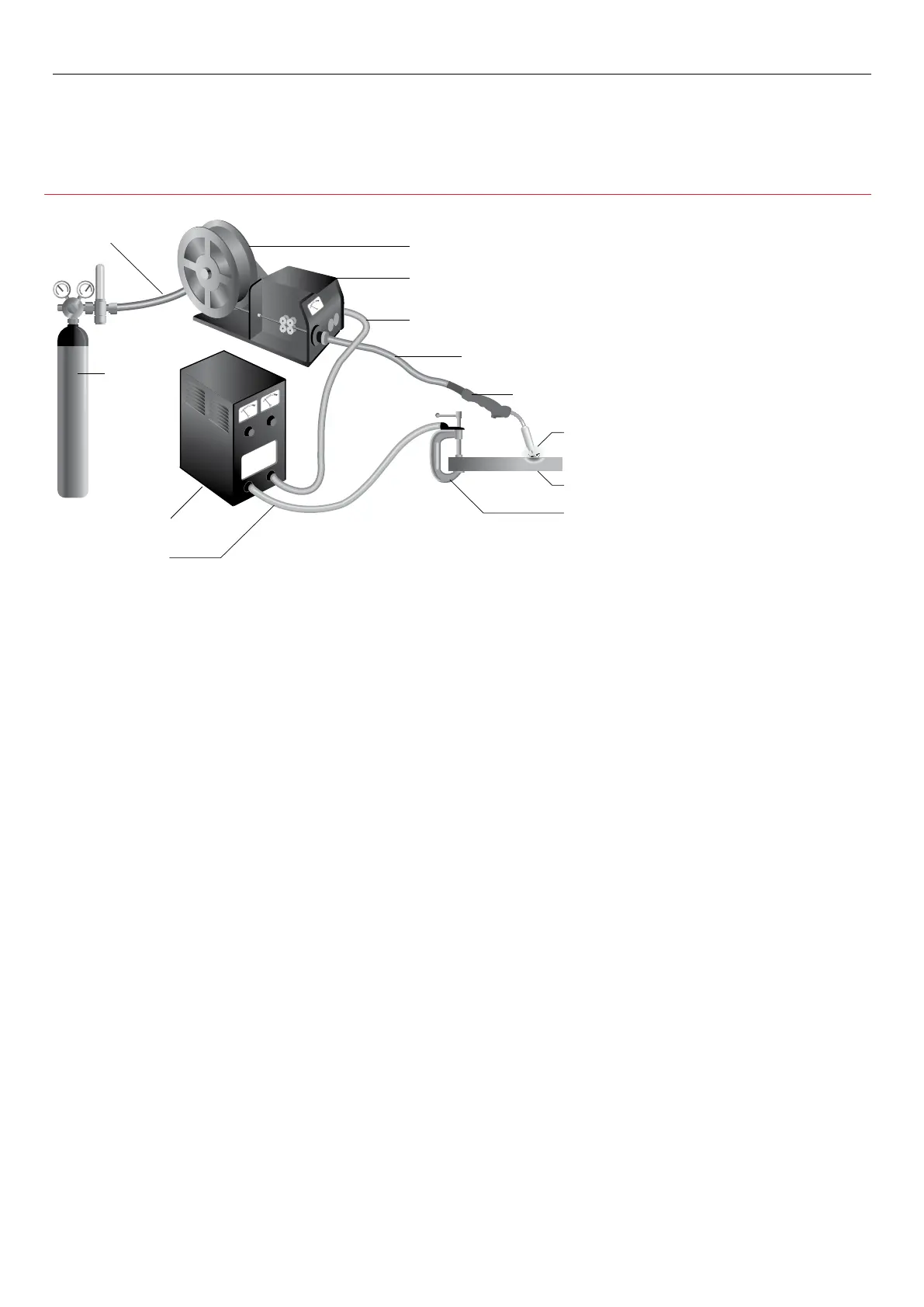
Gas hose
Gas cylinder
Power source
Return cable
Continuous wire
Wire feed unit
Power cable
Torch conduit
Welding torch
Workpiece
Arc
Earth clamp
Process schematic diagram for MIG/MAG, FCAW and MCAW






 To Next Page