36
BOC Smootharc Multi 180/200 Operating manual
Metal transfer modes
The mode or type of metal transfer in MIG/MAG and MCAW welding
depends upon the current, arc voltage, electrode diameter and type of
shielding gas used. In general, there are four modes of metal transfer.
Modes of metal transfer with FCAW are similar to those obtained in MIG/
MAG welding, but here the mode of transfer is heavily dependent on the
composition of the ux ll, as well as on current and voltage.
The most common modes of transfer in FCAW are:
→ Dip transfer
→ Globular transfer
→ Spray transfer
→ Pulsed arc transfer operation has been applied to ux-cored wires
but, as yet, is not widely used because the other transfer modes are
giving users what they require, in most cases.
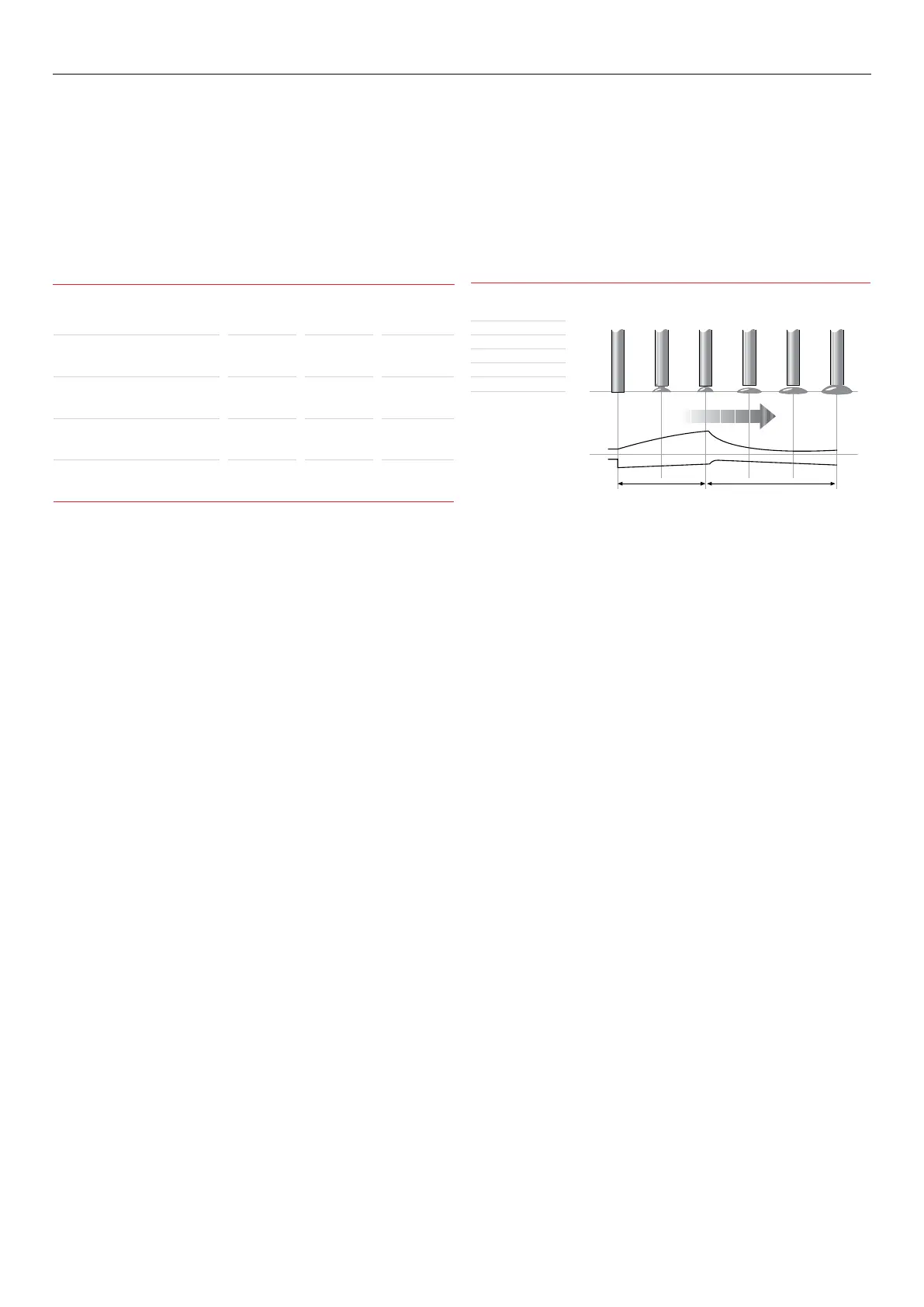
Dip transfer
Also known as short-circuiting arc or short-arc, this is an all-positional
process, using low heat input. The use of relatively low current and arc
voltage settings cause the electrode to intermittently short-circuit with
the weld pool at a controlled frequency. Metal is transferred by the wire
tip actually dipping into the weld pool and the short-circuit current is
sucient to allow the arc to be re-established. This short-circuiting mode
of metal transfer eectively extends the range of MIG/MAG welding to
lower currents so thin sheet material can readily be welded. The low
heat input makes this technique well-suited to the positional welding
of root runs on thick plate, butt welds for bridging over large gaps and
for certain dicult materials where heat input is critical. Each short-
circuit causes the current to rise and the metal fuses o the end of the
electrode. A high short-circuiting frequency gives low heat input. Dip
transfer occurs between ±70-220A, 14–23 arc volts. It is achieved using
shielding gases based on carbon dioxide and argon.
Metal-cored wires transfer metal in dip mode at low currents just like
solid MIG/MAG wires. This transfer mode is used for all positional work
with these types of wire.
Globular transfer
Metal transfer is controlled by slow ejection resulting in large,
irregularly-shaped ‘globs’ falling into the weld pool under the action
of gravity. Carbon dioxide gas drops are dispersed haphazardly. With
argon-based gases, the drops are not as large and are transferred in
a more axial direction. There is a lot of spatter, especially in carbon
dioxide, resulting in greater wire consumption, poor penetration and
poor appearance. Globular transfer occurs between the dip and spray
ranges. This mode of transfer is not recommended for normal welding
applications and may be corrected when encountered by either
decreasing the arc voltage or increasing the amperage. Globular transfer
can take place with any electrode diameter.
Basic ux-cored wires tend to operate in a globular mode or in a
globular-spray transfer mode where larger than normal spray droplets
are propelled across the arc, but they never achieve a true spray
transfer mode. This transfer mode is sometimes referred to as non-axial
globulartransfer.
Self-shielded ux-cored wires operate in a predominantly globular
transfer mode although at high currents the wire often ‘explodes’ across
the arc.
1 2 63 4 5
Time
Short circuit cycle Arcing cycle
Current (A)
Voltage (V)
1 Short circuit
2 Necking
3 Arc re-ignition
4 Arc established
5 Arc gap shortens
6 Short circuit
Schematic of dip transfer
Typical metal transfer mode
Process
Dip
Transfer
Globular
Transfer
Spray
Transfer
Metal Inert Gas (MIG)
Metal Active Gas (MAG)
✓ ✘ ✓
Flux Cored (Gas Shielded)
✓ ✓ ✓*
Flux Cored (Self Shielded)
✓ ✓ ✘
Metal Cored
✓ ✘ ✓
* Not True Spray




 To Next Page