58
BOC Smootharc Multi 180/200 Operating manual
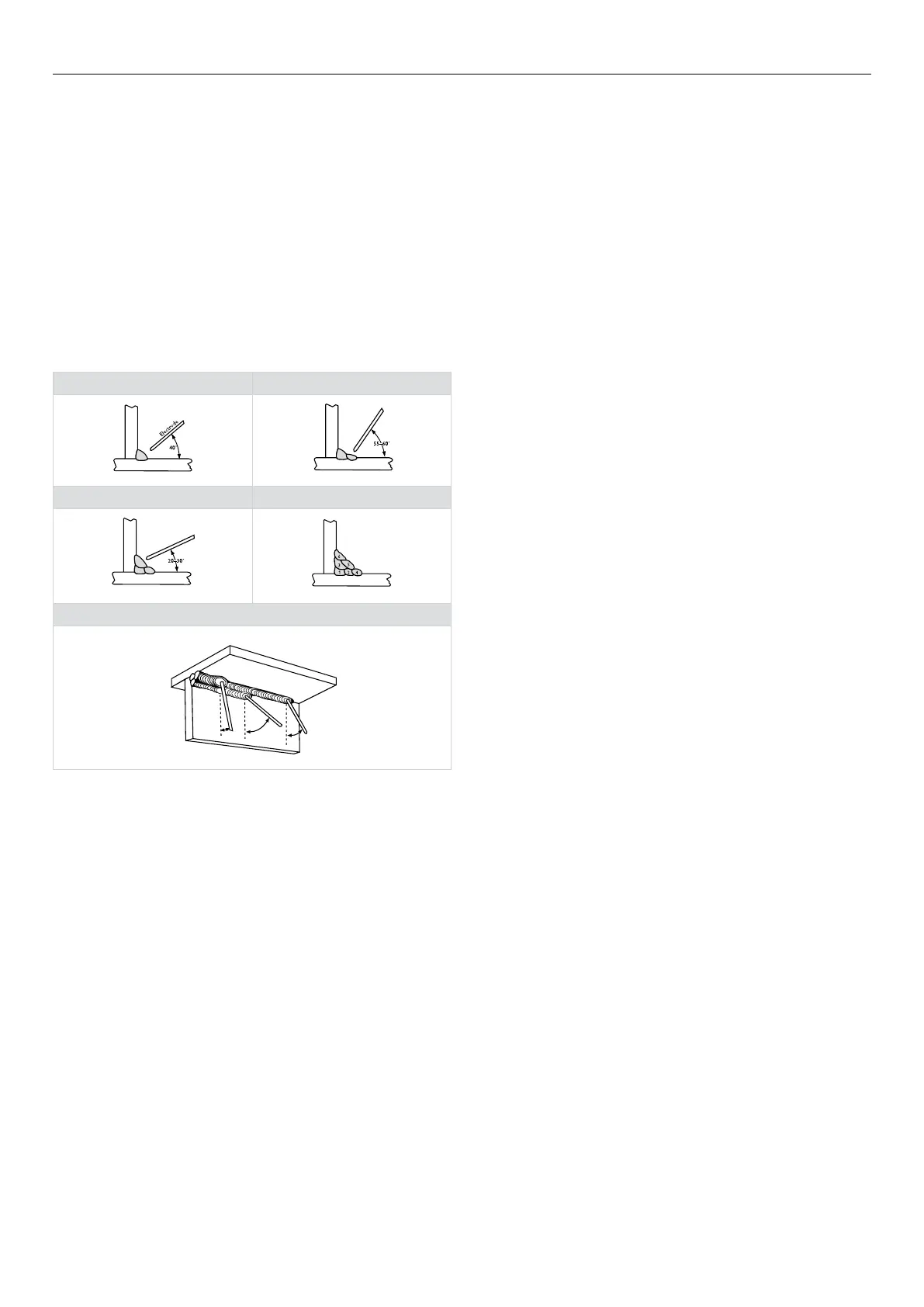
Recommended electrode angles for llet welds
1st Run 2nd Run
3rd Run Multi-run Fillet
Overhead
30˚
15˚
45˚
Multi-run horizontal llets have each run made using the same run
lengths (run length per electrode table). Each run is made in the same
direction, and care should be taken with the shape of each, so that it has
equal leg lengths and the contour of the completed llet weld
is slightly convex with no hollows in the face.
Vertical llet welds can be carried out using the upwards or downwards
technique. The characteristics of each are: upwards – current used is low,
penetration is good, surface is slightly convex and irregular. For multiple
run llets large single pass weaving runs can be used. Downwards –
current used is medium, penetration is poor, each run is small, concave
and smooth (only BOC Smootharc 13 is suitable for this position).
The downwards method should be used for making welds on thin
material only. Electrodes larger than 4.0 mm are not recommended
for vertical down welding. All strength joints in vertical plates 10.0
mm thick or more should be welded using the upward technique. This
method is used because of its good penetration and weld metal quality.
The rst run of a vertical up llet weld should be a straight sealing run
made with 3.15 mm or 4.0 mm diameter electrode. Subsequent runs
for large llets may be either numerous straight runs or several wide
weaving runs.
Correct selection of electrodes is important for vertical welding. In
overhead llet welds, careful attention to technique is necessary to
obtain a sound weld of good prole. Medium current is required for
best results. High current will cause undercutting and bad shape of
the weld, while low current will cause slag inclusions. To produce a
weld having good penetration and of good prole, a short arc length is
necessary. Angle of electrode for overhead llets is illustrated above.




 To Next Page