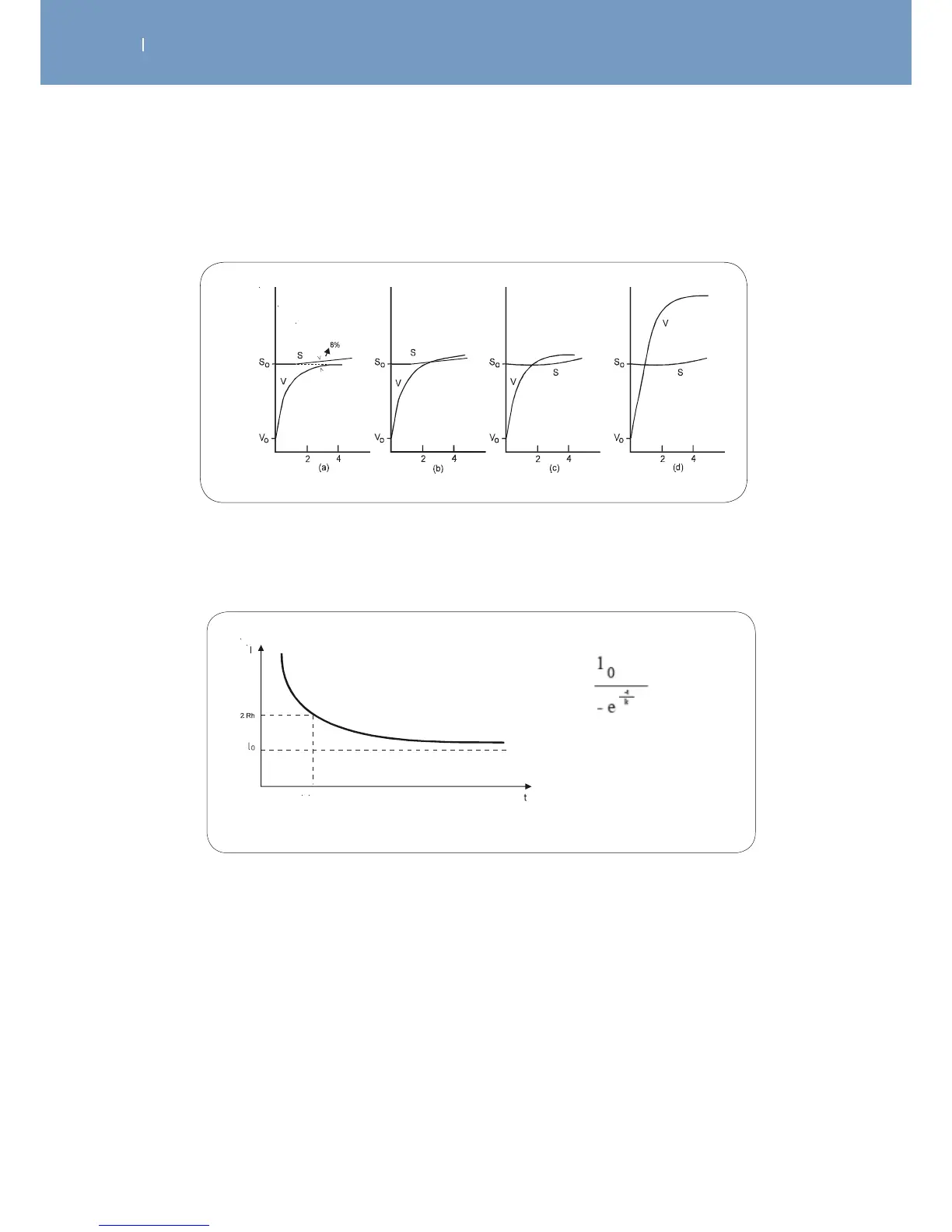
We can therefore see the intensity-duration relationship appear, which gives the time at which
V
passes
S
for dierent current intensities. The useful times are even shorter when the current is more intense (Fig. ).
In Figure 2c, a stronger current with a value of 1.2 is applied and 𝑉 passes the threshold after 1.85 ms. In
Figure 2d, an even stronger current (value = 2) is applied and 𝑉 = 𝑆 after 0.7 ms.
With lo = rheobase and
k = excitation constant
Chronaxy
Fig. 3
This relationship applies to currents that are very short compared to the accommodation constant.
Accommodation can be disregarded and excitation appears when V = So. This is why, in the intensity-
duration relationship, only the excitation constant k occurs, as the duration of currents used have values
close to k (from 0.2 ms to 3 ms).


 To Next Page