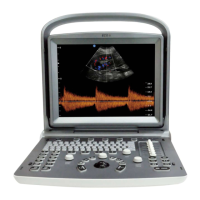
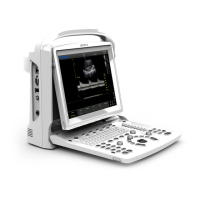
ECO 3 EXPERT Ultrasound Diagnostic System
Page 17 / 191
tissue temperature by 1°C (Wdeg), TI = W.3/Wdeg.
Three TIs corresponding to soft tissue (TIS) for abdominal; bone (TIB) for fetal and neonatal
cephalic; and cranial bone (TIC) for pediatric and adult cephalic, have been developed for
applications in different exams.
An estimate of the acoustic power in milli-watts necessary to produce a 1°C temperature elevation
in soft tissue is:
Wdeg = 210/fc,for model 1 to 4, where fc is the center frequency in MHz.
Wdeg = 40 K Dfor model 5 and 6, where K (beam shape factor) is 1.0, D is the aperture diameter
in cm at the depth of interest.
MI:
Cavitation is more likely to occur at high pressures and low frequencies in pulse ultrasound wave
in the tissue, which contains the bubble or air pocket (for instance, the lung, intestine, or scan with
gas contrast agents). The threshold under optimum conditions of pulsed ultrasound is predicted by
the ration of the peak pressure to the square root of the frequency.
MI = Pr’ / sqrt(fc)
Pr’ is the de-rated (0.3) peak rare-fractional pressure in Mpa at the point where PII is the maximum,
and fc is the center frequency in MHz. PII is the Pulse Intensity Integral that the total energy per
unit area carried by the wave during the time duration of the pulse. The peak rare- fractional
pressure is measured in hydrophone maximum negative voltage normalized by the hydrophone
calibration parameter.
Display Guideline:
For different operation modes, different indices must be displayed. However, only one index needs
to be shown at a time. Display is not required if maximum MI is less than 1.0 for any setting of the
operating mode, or if maximum TI is less than 1.0 for any setting of the operating mode. For TI, if
the TIS and TIB are both greater than 1.0, the scanners need not be capable of displaying both
indices simultaneously. If the index falls below 0.4, no display is needed. The display increments
are no greater than 0.2 for index value less than one and no greater than 1.0 for index values
greater than one (e.g. 0.4, 0.6, 0.8, 1, 2, and 3).



 To Next Page