Self-test and Troubleshooting
7-1
7. Self-test and Troubleshooting
7.1 General
This section describes the self-test steps and suggested troubleshooting procedures when
AC Source is not functioning normally. If the problem cannot be solved using the information
given here, consult with the distributor whom you purchased the unit.
7.2 Self-test
The AC Source performs a series of self-tests at power-on. First, it does the memory, data
and communication self-test. There are three items: DISPLAY, WAVEFORM, and REMOTE.
If any failure is detected on a certain item, an “error code” will be shown at the right side of
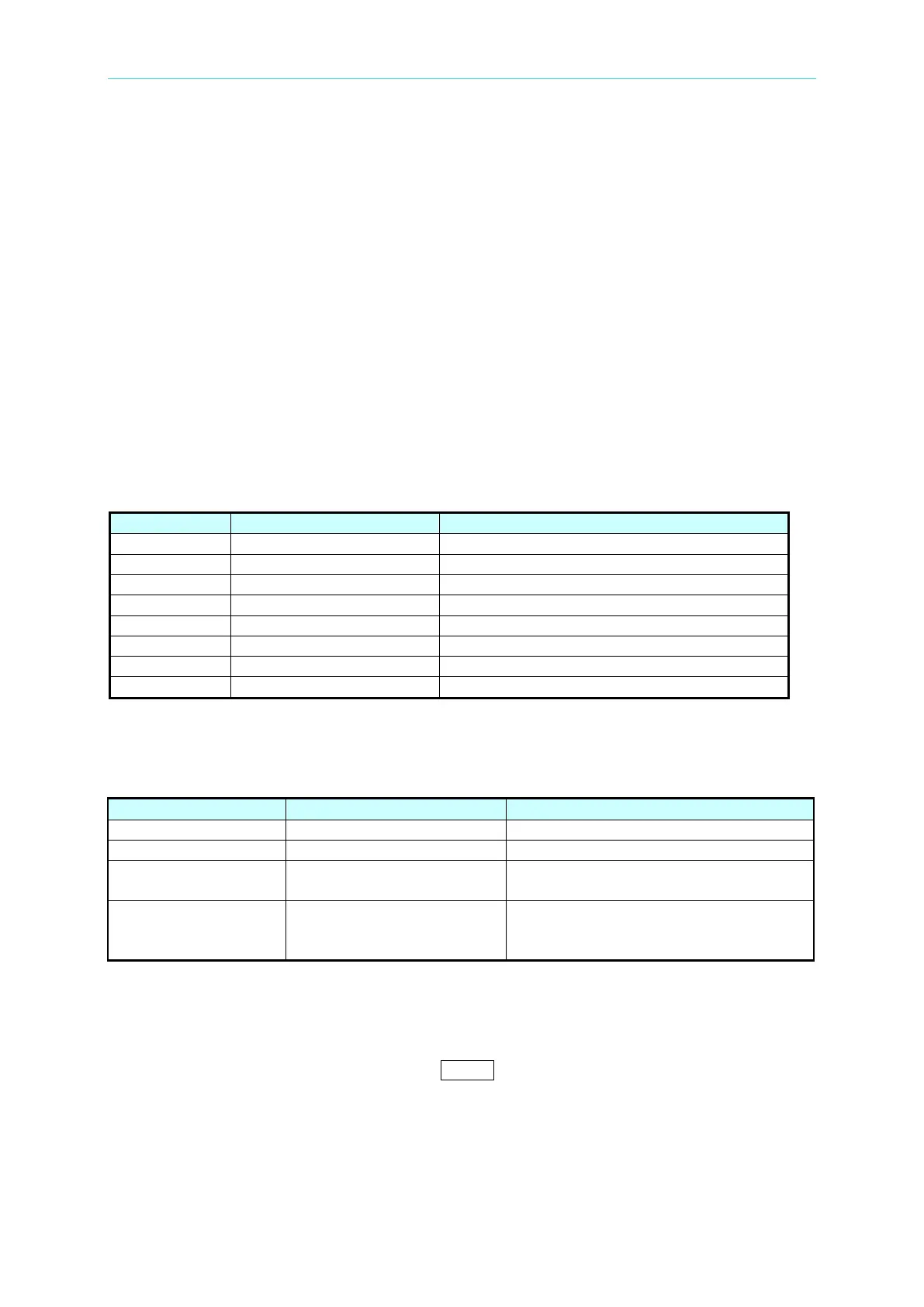
that item. The following table shows all of the error messages:
Example: If an error code shows “ERROR = 05”, the error code is “00000101” in binary.
The bit 0 and bit 2 are “1”. So “ERROR = 05” means SRAM error and DATA error
occurs.
Consult your dealer for assistance.
Consult your dealer for assistance.
Data in Flash or EEPROM
test fail
Consult your dealer for assistance.
1. Power off the AC Source and wait for
three seconds to power it on again.
2. Consult your dealer for assistance.
After the self-test of memory, data and communication, the AC Source performs the power
output self-test. In this procedure, the output relays are OFF to ensure the load connecting
on output terminal is not harmed. Then, the AC Source will check if there is any protection
signal sent from the hardware. If it does, the display shows "Output self test <NG>". It
means the AC Source is abnormal. Press
ENTER to see what type of protection it is. If
there is no protection signal, the AC Source will program 300Vac and measure the voltage.
If the measured voltage is over 300V±5V, the power self-test is failed, and the display shows "
Output self test <NG> ". Probably AC Source has not been calibrated (updated the software
especially). Users can do the following steps to reassure it.


 To Next Page