Remote Operation
8-5
Headers
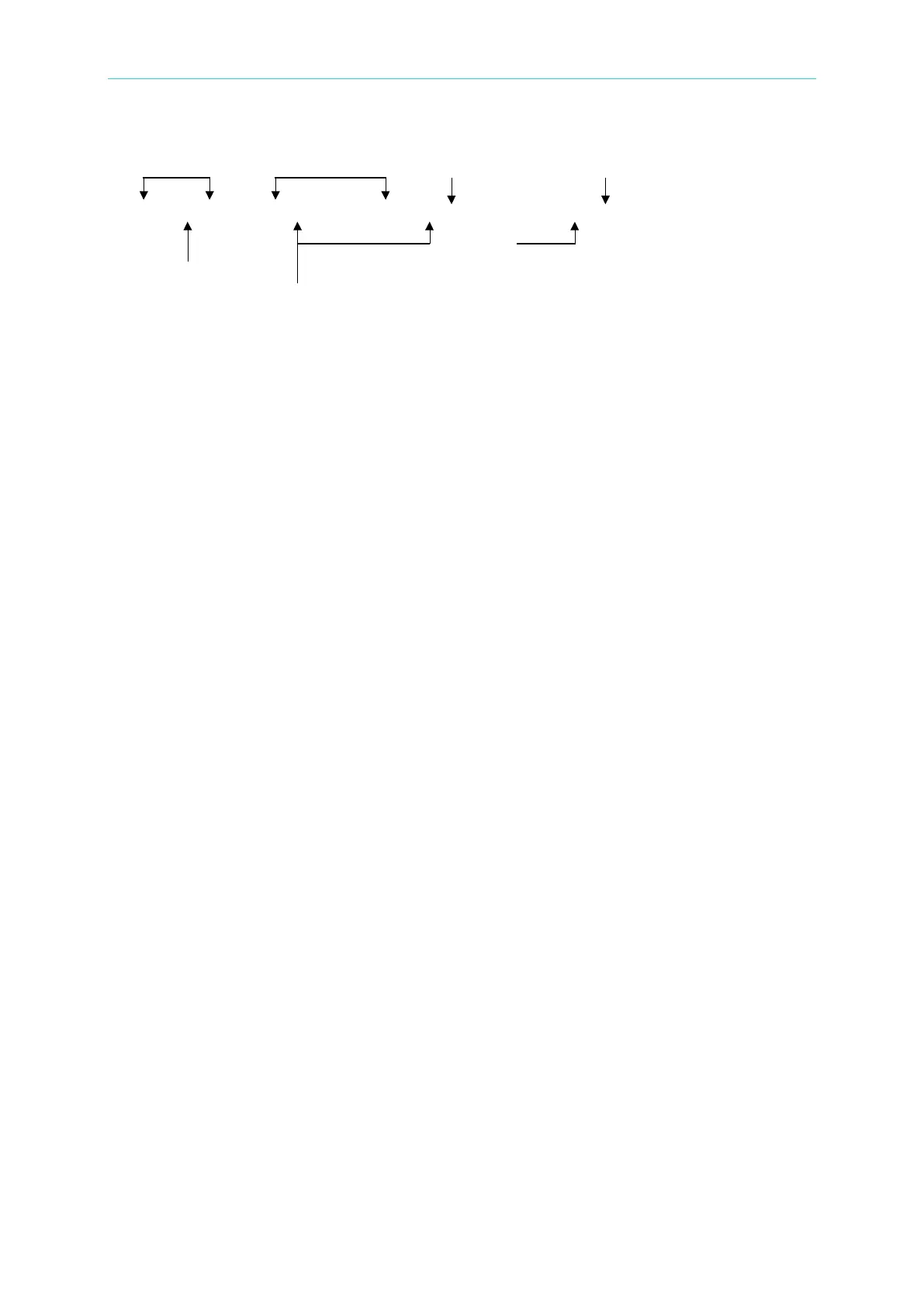
VOLT
:
AMPL
Data
100 ; RANG HIGH
;
Root Specifier
: MEAS : CURR ? <NL>
Message Terminator
Head Separator
Message Unit Separators
Query Header
Figure 8-1 The Structure of Command Message
8.4 Traversal of the Command Tree
Multiple program message unit elements can be sent in a program message. The first
command is always referred to the root node. Subsequent commands are referred to the
same tree level as the previous command in a program message. A colon preceding a
program message unit changes the header path to the root level.
Example:
OUTPut : PROTection : CLEar All colons are header separators.
: OUTPut : PROTection : CLEar Only the first colon is a specific root.
OUTPut : PROTection : CLEar; : VOLT : AC 100 Only the third colon is a specific root.
8.5 The Execution Order
The AC Source executes program messages by the order received. Program message units
except coupled commands are executed in order of reception. The execution of coupled
commands is deferred until program message terminator is received. A coupled command
sets parameters which are affected by the setting of other commands. Problems may arise,
because the prior state of the AC Source will affect the response of a coupled parameter to its
programming.
For example, assume that the current output voltage range is LOW, a new state is desired
with output voltage range HIGH, and amplify 220 Volt. If the commands
VOLTage : AC 220<PMT>
VOLTage : RANGe HIGH<PMT>
are sent, data out of range error will be produced. Reversing the order, or sending the
commands in one program message can avoid such kind of error. For the above example,
the program message
VOLTage : AC 220 ; VOLTage : RANGe HIGH<PMT>
can be sent without error.


 To Next Page