EasyManua.ls Logo

Cisco C20 User Manual

Cisco C20
54 pages
To Next Page IconTo Next Page
To Previous Page IconTo Previous Page
Page #8 background image
8
D14582.15R1 (Rev.1 Nov 2013) User guide Prole Series, Codec C Series, Quick Set C20, SX20 Quick Set,
MX200, MX300. All contents are copyright © 2010–2013 Cisco Systems, Inc. Version TC6.2, 06.2013. English
Cisco TelePresence System Prole Series, Codec C Series, Quick Set C20, SX20 Quick Set, MX200, MX300 User guide
www.cisco.com
Adding a camera preset
Most Cisco TelePresence systems let you create
predened zoom and camera pointing directions (also
known as pan). Use these to zoom into the person
speaking, if appropriate. Do not forget to zoom out
again afterwards.
This means that if you want to create one or more
zoom-in presets you should also create a zoom-out
(overview) preset to conveniently switch back to
overview mode.
If you use more than one camera
Some of our video systems support the use of more
than one camera. In this way you may, for example,
have one camera providing an overview of the
participants and another showing the whiteboard.
Note that when you dene a camera preset, the
current pan and zoom of every camera will be saved
as part of that preset. Consequently, you should make
sure that every camera has been set to the required
position before you save the camera positions as a
new preset.
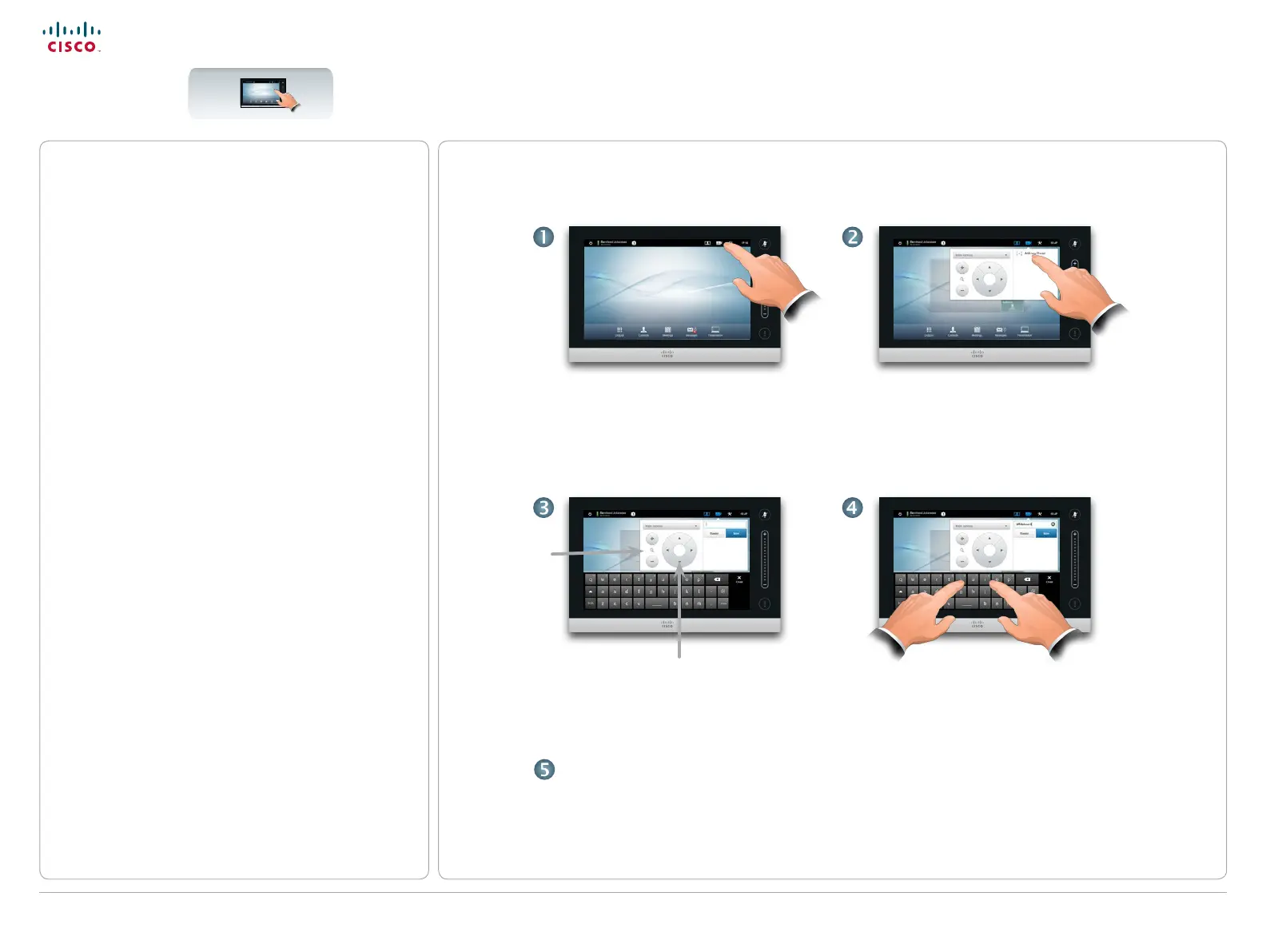
Tap Camera to invoke
the Camera menu.
Then tap Add new Preset, as
outlined. Any camera presets
already existing will appear in the
list, as outlined.
Adjust zoom
in and out
here
Use these controls to
dene the direction
in which the camera
shall point (also known
as Pan control).
Type in a descriptive name and tap
Save to put changes into eect.
Tap anywhere outside the menus to exit the menu.

Table of Contents

Other manuals for Cisco C20

Question and Answer IconNeed help?

Do you have a question about the Cisco C20 and is the answer not in the manual?

Cisco C20 Specifications

General IconGeneral
EncryptionAES
Frame RateUp to 30 fps
Firewall TraversalYes
ConnectivityWired
Video StandardsH.264
Audio StandardsG.711, G.722
Network Interfaces10/100/1000 Ethernet
Content SharingYes
Product TypeVideo conferencing system
Network ProtocolsH.323, SIP
InterfacesEthernet
Video Resolution720p

Summary

Getting started

Best practices

A tour of the Touch pad

Basic operating principles

Calling someone by keying in their name or number

Touch tones (DTMF) in a call

Swapping calls

Transferring a call

Shared lines/Barge in

Layout control in a call

Selecting a different layout

Allows users to choose a preferred screen layout during a call by tapping the Layout option.

Adding a self-view PiP

Enables adding a Picture-in-Picture (PiP) of the user's own view to the screen during a call.

Moving the self-view PiP

Allows repositioning of the self-view PiP by dragging it after it turns blue.

Layout control in a conference

Invoking a list of participants

Displays a list of participants, showing who is presenting or speaking.

Lock as speaker

Locks the current speaker to prevent automatic switching based on voice activity.

Drop

Allows a participant to disconnect another participant from the conference.

Camera presets in a call

Near end camera control

Far end camera control

Sharing content-conducting presentations

Sharing content

Connects a presentation source to share content in a call or local meeting room.

Changing the layout

Allows users to select different layout options during a presentation.

Full screen presentations

Sets up the system for full screen presentation with presenter PiP view.

Parallel meetings

Extending an ongoing meeting

Managing Contacts

History

Directory

Favorites

Searching in a list

Clearing History

The Settings

About the Settings

Ringtone & Sound Settings

Camera Control

Main Source Selection

Language

Date, Time & Location

System Information

Call Status

Diagnostics

Restart

Call Details

Provisioning

Multipoint mode

IP Settings

SIP Settings

H323 Settings

EMC Resilience Mode

Web Snapshots

Reset

Related product manuals