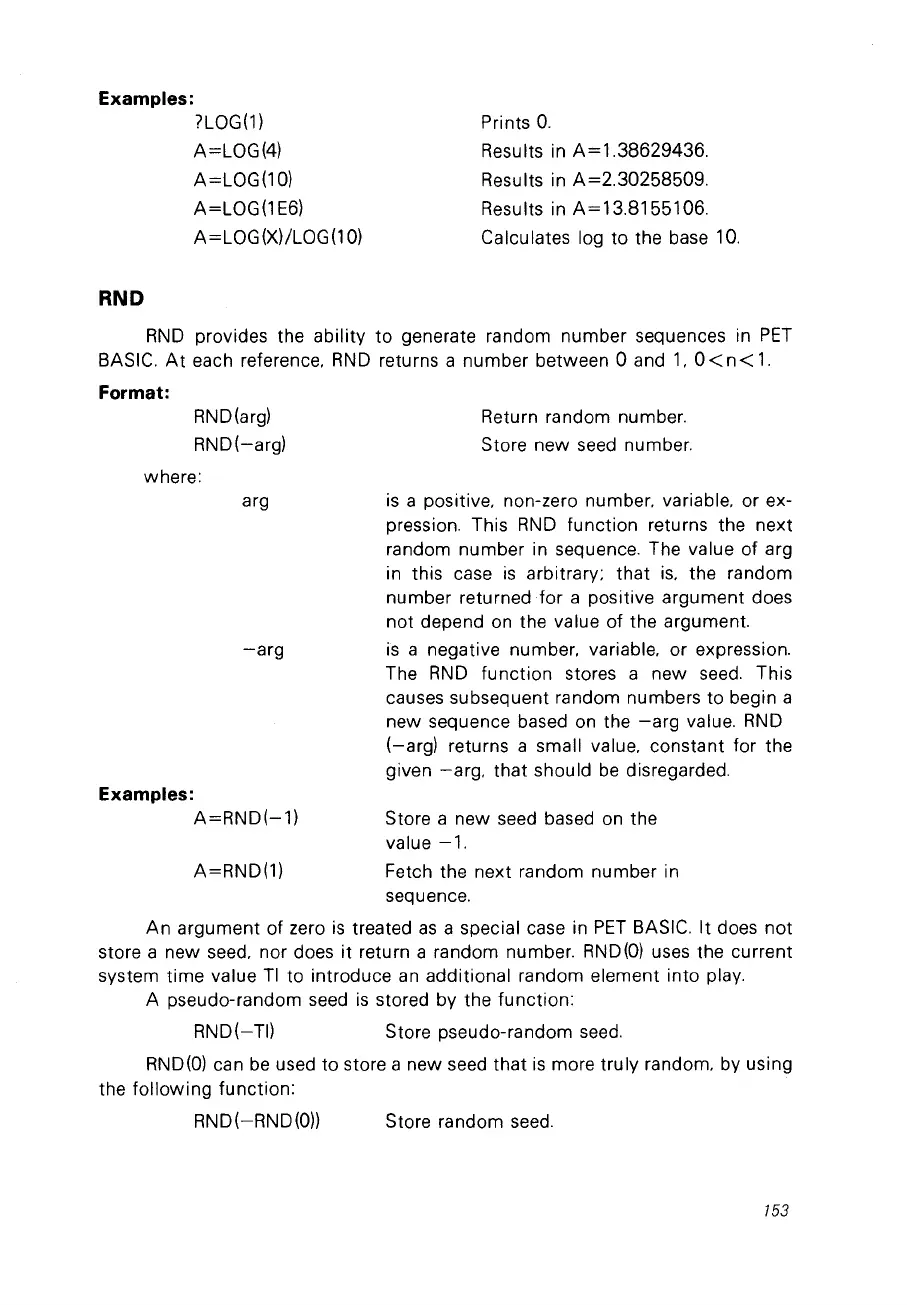
Examples:
?LOG(1)
A=LOG(4)
A=LOG(10)
A=LOG(1
E6)
A=LOG(X)/LOG(10)
RND
Prints
O.
Results in
A=1.38629436.
Results in
A=2.30258509.
Results in
A=13.8155106.
Calculates log
to
the base
10.
RND
provides the ability
to
generate random number sequences in
PET
BASIC.
At
each reference.
RND
returns a number between 0 and
1.
0<n<1.
Format:
RND(arg)
RND(-arg)
where:
arg
-arg
Return random number.
Store new seed number.
is
a positive. non-zero number. variable, or ex-
pression. This
RND
function returns the next
random number in sequence. The value of arg
in this case
is
arbitrary;
that
is,
the random
number
returnedfor
a positive argument does
not depend on the value of the argument.
is
a negative number. variable, or expression.
The
RND
function
stores a new seed. This
causes subsequent random numbers to begin a
new sequence based on the
-arg
value.
RND
(-arg)
returns a small value. constant for the
given
-arg,
that
should
be
disregarded.
A=RND(1)
Examples:
A=RND(-1)
Store a new seed based on the
value
-1.
Fetch the next random number in
sequence.
An
argument of zero
is
treated
as
a special case in
PET
BASIC.
It
does
not
store a new seed. nor does
it
return a random number.
RND(O)
uses the current
system time value
TI
to introduce
an
additional random element into play.
A pseudo-random seed
is
stored by the function:
RND(-
TI)
Store pseudo-random seed.
RND(O)
can
be
used
to
store a new seed
that
is
more truly random, by using
the
following
function:
RND(-RND(O))
Store random seed.
153



 To Next Page