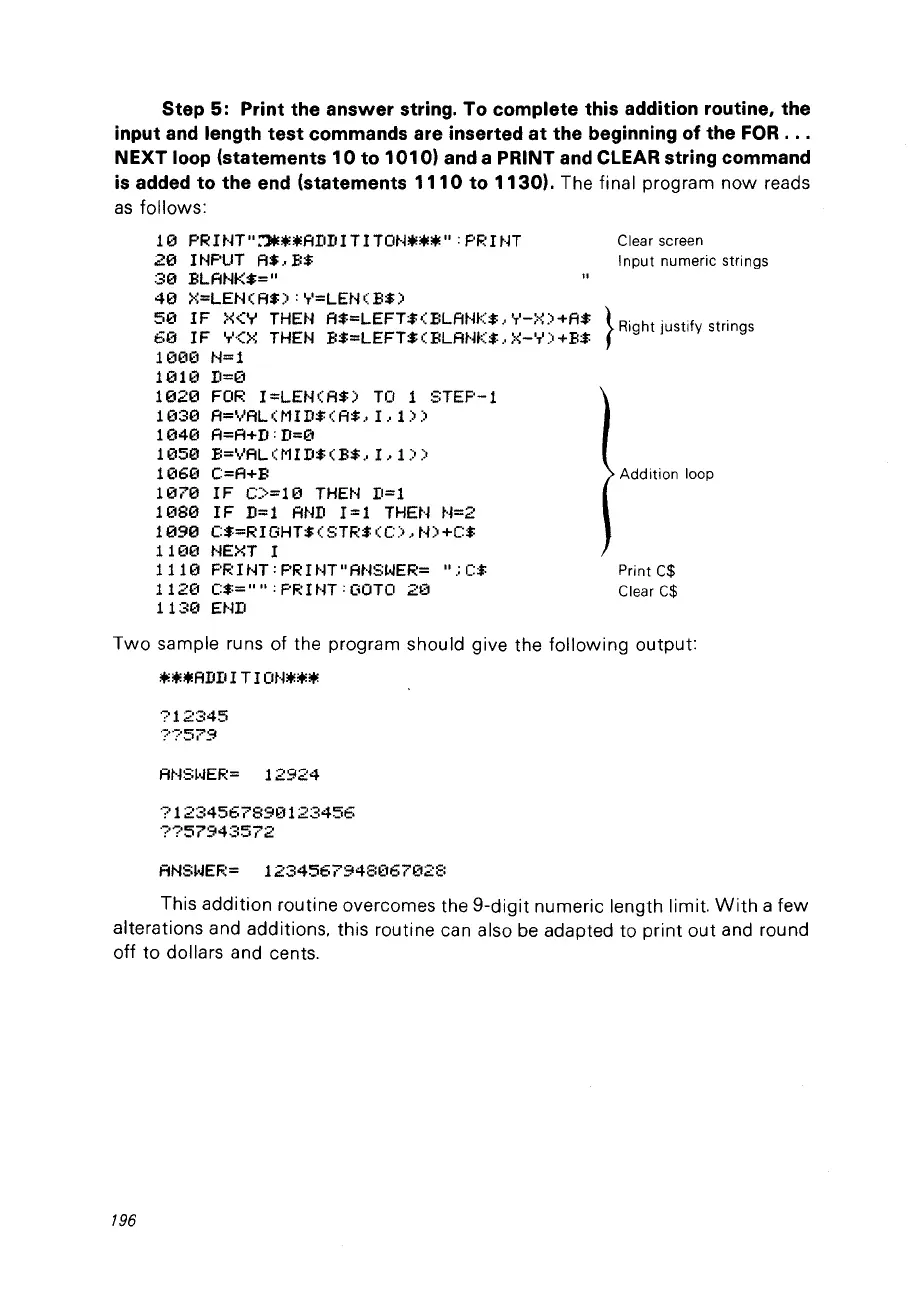
Step 5: Print the answer string. To complete this addition routine, the
input
and
length test commands are inserted
at
the beginning of the
fOR
.
..
NEXT loop (statements
10
to
1010)
and a PRINT
and
CLEAR string command
is
added to the end (statements
1110
to
1130).
The final program
now
reads
as
follows:
Addition loop
Print C$
Clear
C$
Clear screen
Input
numeric strings
} Right
justify
strings
10
PR
l
NT"
;:')IeiUiAIID
l Tl
TONltii4EliE"
:
PF:
l
NT
20
INPUT
A$
..
E$
:30
ELANK$="
40
X=LEN(A$):Y=LEN(E$)
50
IF
X<Y
THEN
A$=LEFT$(ELANK$,Y-X)+A$
60
IF
Y<X
THEN
E$=LEFT$(ELANK$,X-Y)+B$
1001::1
N=l
1010
D="::1
1020
FOR
I=LEN(A$)
TO
1
STEP-l
1030
A=VAL(MID$(A$,I,l»
1
€140
A=A+
D:
D=€1
1050
E=VAL(MID$(B$,
1,1»
1€160
C=A+B
1070
IF
(:>=10
THEN
D=l
1080
IF
D=l
AND
1=1
THEN
N=2
1090
C$=RIGHT$(STR$(C),N)+C$
1100
NEXT
l
1110
PR
l
NT
:
PR
l
NT"
ANS~oJER=
".:
C$
112€1
(:$="":
PRI~H:
GOTO
20
1130
END
Two
sample runs of the program should give the following output:
?12::::45
??579
ANS~oJEF:=
12924
?1234567890123456
'-;:'?5794::::572
ANS~oJEF~=
123456794E:€167028
This addition routine overcomes the
9-digit
numeric length limit.
With
a few
alterations and additions. this routine can also
be
adapted to print
out
and round
off to dollars and cents.
196


 To Next Page