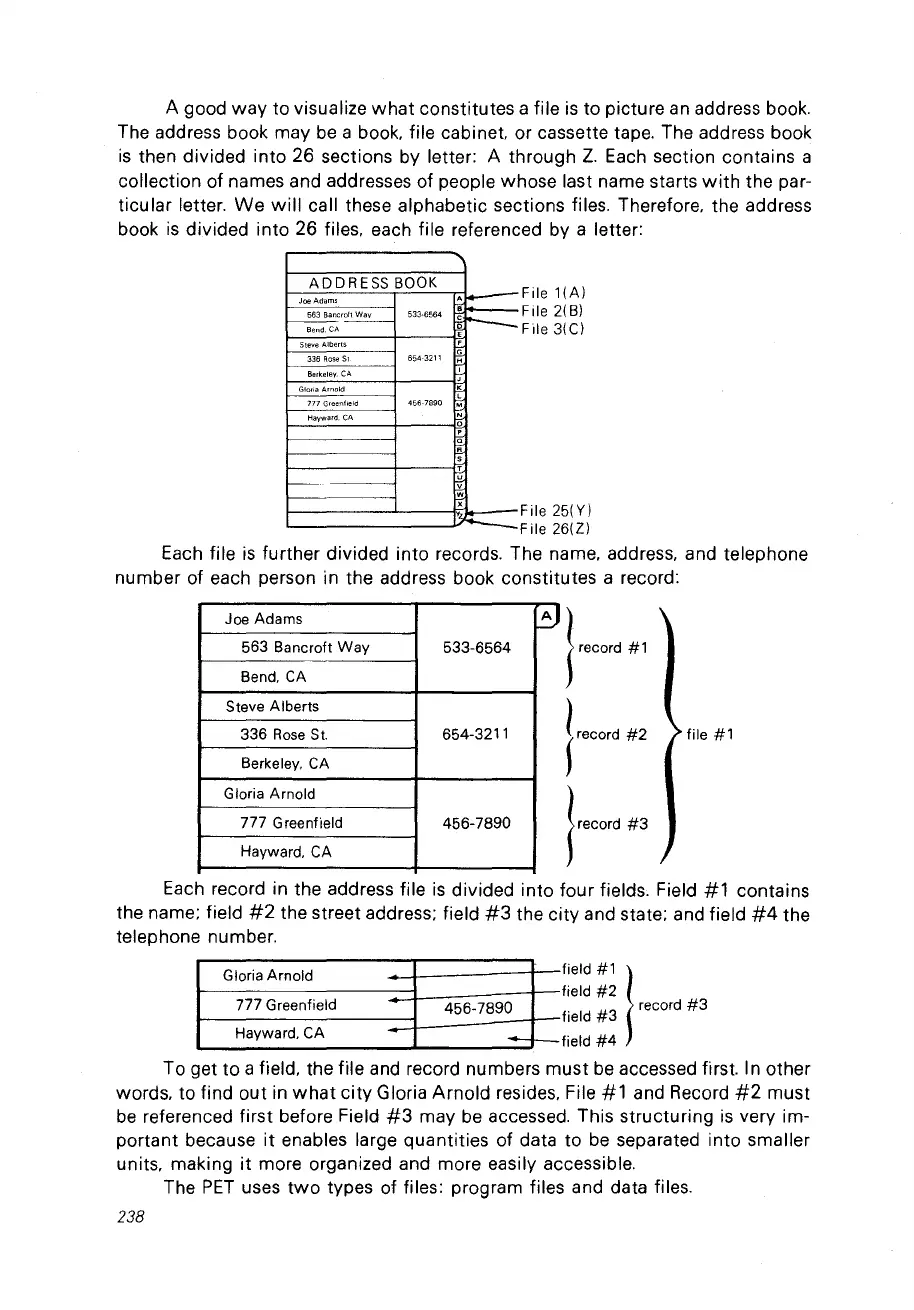
A good
way
to visualize
what
constitutes a file
is
to picture
an
address book.
The address book may
be
a book, file cabinet. or cassette tape. The address book
is
then divided into 26 sections by letter: A through
Z.
Each
section contains a
collection of names and addresses of people whose last
na
me starts
with
the par-
ticular letter.
We
will
cali these alphabetic sections files. Therefore, the address
book
is
divided into 26 files, each file referenced by a letter:
Berkeley. CA
Steve Alberts
336
Rose
51
654-3211
I--,-Ac.:::0c.:0:...;R..:.;E=-S::.:S:..,Br:-0=-O.:....-K
--r:~~_-
Fil
e 1(A )
JoeAdams
A~
533-6564
~~.f4Io---
File
2(
B)
~
-File
3(C)
,
G
H
,
,
Gloria
Amold
777 Greenfield 456·7890
Hayward.
CA
K
,
M
N
o
u
V
W
x:::::-
File
25(Y)
'---------
~F
ile
26(Z)
Each file
is
further divided into records. The
na
me,
address, and telephone
number of each person in the address book constitutes a record:
1",,,,
#2
l,,,,,,
#3
Joe
Adams
~
563
Bancroft
Way
533-6564
Bend,
CA
Steve
Alberts
336
Rose St.
654-3211
Berkeley,
CA
Gloria
Arnold
777
Greenfield
456-7B90
Hayward,
CA
}
"",'
#1
file
#1
Each
record in the address file
is
divided into four fields. Field
#1
contains
the name; field
#2
the street address; field
#3
the city and state; and field
#4
the
telephone number.
Gloria
Arnold
777
Greenfield
456-7890
Hayward.
CA
--
-
~
field
#1
}
field
#2
#3
record
#3
field
field
#4
To get
to
a field, the file
and
record numbers must
be
accessed first. In other
words, to find out in
what
city Gloria Arnold resides, File
#1
and Record
#2
must
be
referenced first before Field
#3
may
be
accessed. This structuring
is
very
im-
portant because
it
enables large quantities of data to
be
separated into smaller
units, making
it
more organized and more easily accessible.
The
PET
uses
two
types of files: program files and data files.
238



 To Next Page