5 PRINT"::FEAL TIME":PRINT:PRINT;
10
~T=TI
15
T$=TIME$
20
H=INT(J/21600)
30
IF
H<>0
THEN
3=3-H~21600
40
M=INT(3/3600)
50
IF
M<>0
THEN
3=3-M~3600
61:::1
S=INT<3/60)
70
H$=RIGHT$(STR$(H),2)
80
M$=RIGHT$(STR$(M),2)
g~
S$=RIGHT$(STR$(S),2)
100
PRIt-lT"H;
t'1:
S;
".;
H$.;
" :".;
t'1$.;
": ";
S$., "TIt'1E$;
".;
T$
110
PRINT"i:8:mtll".; :GOT010
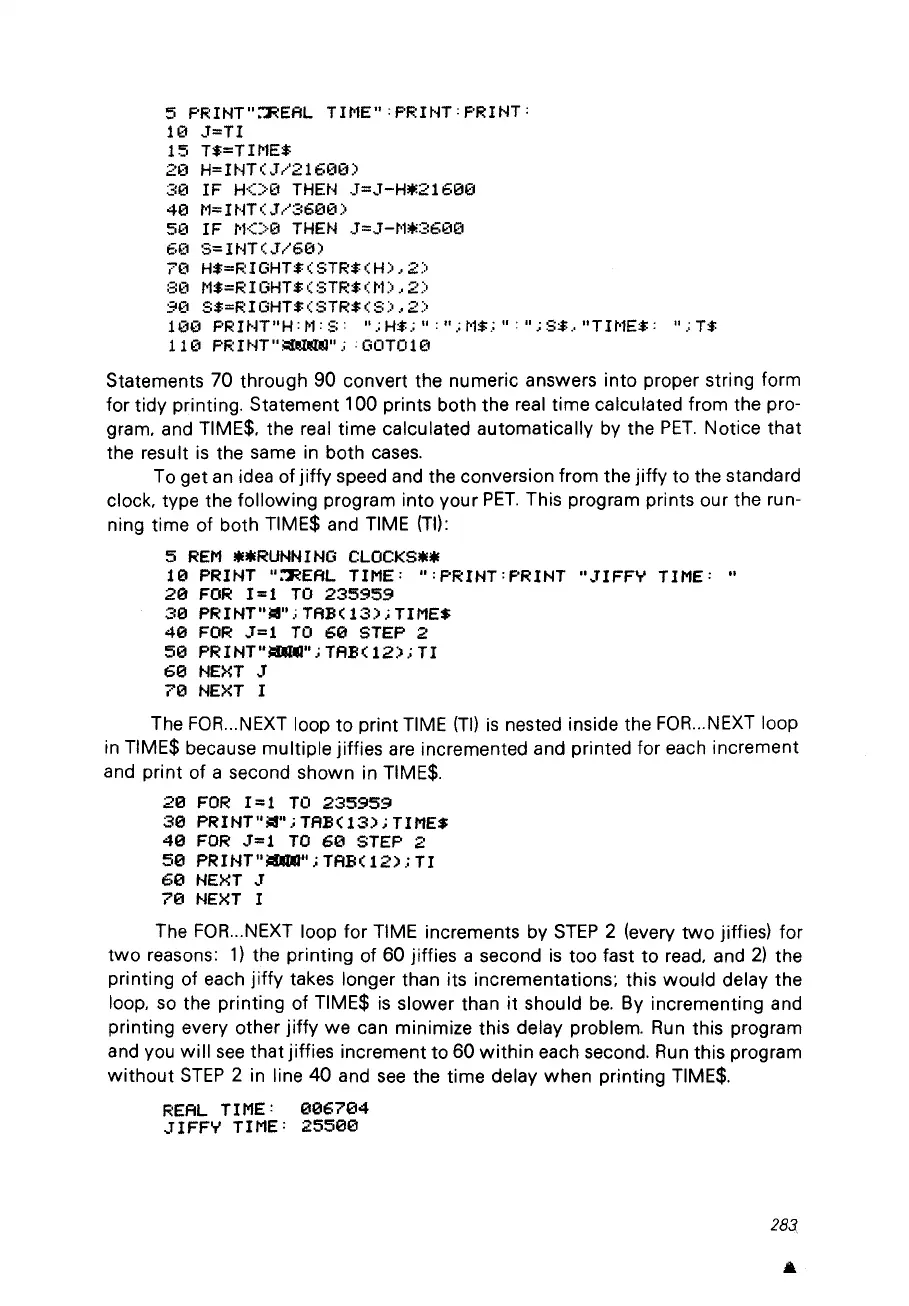
Statements 70 through 90 convert the numeric answers into proper string form
for tidy printing. Statement 100 prints both the real time calculated from the pro-
gram, and TIME$, the real time calculated automatically by the
PET.
Notice that
the result
is
the same
in
both
cases.
To get
an
idea of jiffy speed and the conversion from the jiffy to the standard
clock. type the following program into your
PET.
This program prints our the run-
ning time of both TIME$ and TIME
(TI):
5
REM
**RUNNING
CLOCKS**
10
PRINT
u::FEAL
TIME: u;PRINT:PRINT u3IFFY TIME: U
20
FOR
1=1
TO
235959
30
PRINT
u
l:8";
TAB(
13);
TIME$
40
FOR
3=1
TO
60
STEP 2
50
PR
1
NTul:iIlIOO"
;
TAB(
12);
TI
60
NEXT
J
70
NEXT
1
The
FOR
...
NEXT
loop
to
print TIME
(TI)
is
nested inside the
FOR
...
NEXT
loop
in
TIME$ because multiple jiffies
are
incremented and printed for each increment
and print of a second shown in TIME$.
20
FOR
1=1
TO
235959
30
PRINT
u
l:8";
TAB(
13);
TIME$
40
FOR
3=1
TO
60
STEP 2
50
PR
1
NT
"l:i1l1OO
U
;
TAB
(
12)
.;
TI
60
NEXT
3
70
NEXT
1
The
FOR.
..
NEXT
loop for TIME increments by
STEP
2 (every
two
jiffies) for
two
reasons:
1)
the printing of 60 jiffies a second
is
too fast
to
read.
and
2)
the
printing of each
jiffy
takes longer than its incrementations; this would delay the
loop.
so
the printing of TIME$
is
slower than
it
should
be.
By incrementing and
printing every other jiffy we can minimize this delay problem.
Run
this program
and vou
will
see
that jiffies increment to 60
within
each second.
Run
this program
without
STEP
2
in
line 40 and
see
the time delay when printing TIME$.
REAL
TIME:
006704
3IFFY
TIME;
25500
283



 To Next Page