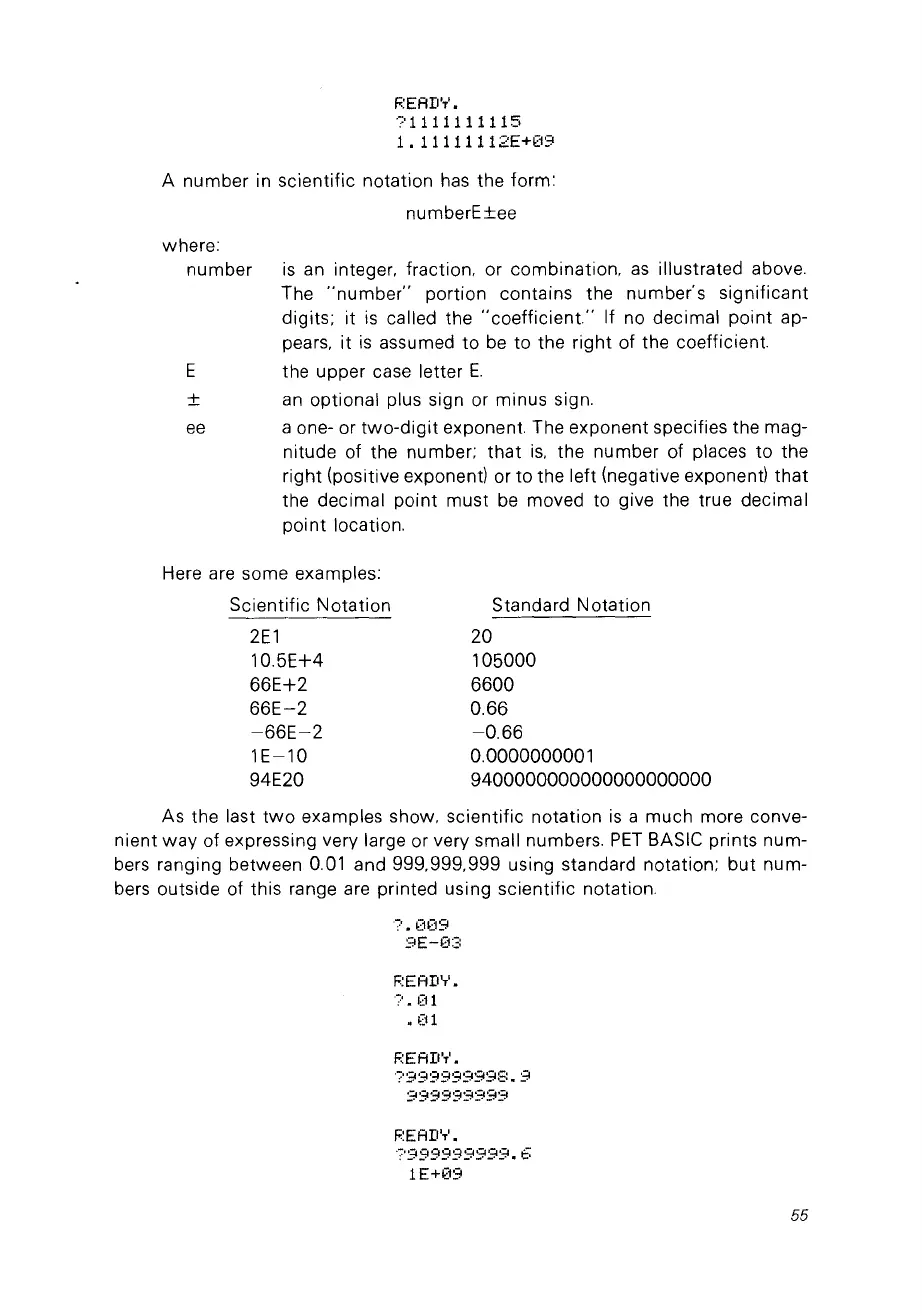
F.:EAD'T'.
·?1111111115
1 •
11111112E
+(19
A number in scientific notation
has
the form:
numberE±ee
where:
number
E
±
ee
is
an
integer, fraction, or combination,
as
illustrated above.
The
"number"
portion contains the number's significant
digits; it
is
called the
"coefficient."
If no decimal
point
ap-
pears, it
is
assumed
to
be
to the
right
of the coefficient.
the upper case letter
E.
an
optional plus sign or minus sign.
a one- or
two-digit
exponent. The exponent specifies the mag-
nitude of the number;
that
is,
the number of places
to
the
right (positive exponent) or
to
the left (negative exponent)
that
the decimal point must
be
moved to give the true decimal
point
location.
Here are some examples:
Scientific
Notation
2El
10.5E+4
66E+2
66E-2
-66E-2
1
E-l0
94E20
Standard Notation
20
105000
6600
0.66
-0.66
0.0000000001
9400000000000000000000
As the last
two
examples show, scientific notation
is
a much more conve-
nient
way
of expressing very large or very small numbers.
PET
BASIC prints num-
bers ranging between 0.01 and 999,999,999 using standard notation;
but
num-
bers outside of this range are printed using scientific notation.
?009
9E-0::::
F.:EAD'T'.
~'.
01
.01
F:EAD'T'.
'7-'999999998.9
999999999
PEAD'T'.
?999999999.6
1E+(19
55



 To Next Page