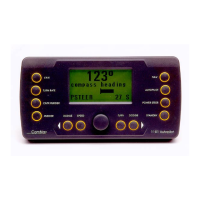
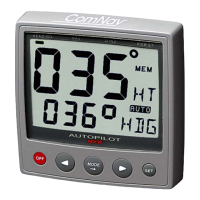
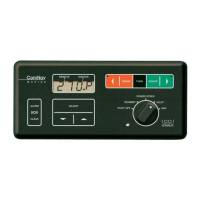
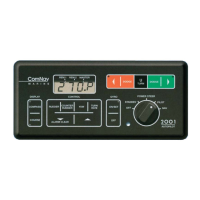
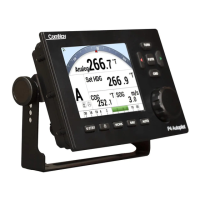
ComNav Marine 1420 Autopilot System
8. Refill your steering system from the
highest reservoir.
9. Adjust the bleeding screws so that
the cylinder will be bled when the rod
is extended in the original direction.
Generally, you close the bleeding
screw or nipple closest to the now
retracted rod. Open the bleeding
screw closest to the rod that is now
extended.
10. Use the Control Head to fully extend
the cylinder rod to the other side.
11. Refill the highest reservoir.
12. Repeat Steps 6 to 11 at least 10
times.
13. Close all bleeding screws or nipples.
Clean up any oil spills and wipe
fittings clean. Remove any buckets
or equipment a short distance from
the cylinders and fittings.
14. Use the Control Head to extend the
rod fully in one direction and then the
other.
15. Check for leaks by looking for spilled
hydraulic fluid on or near fittings and
cylinders.
16. Check that a hard-over to hard-over
time of 10 - 15 seconds can be
attained with your drive system.
17. Return to Step 9 of the Autopilot
Setup Routine.
**** IMPORTANT ****
If you have installed a reversing motor pump, a constant running pump or an engine
driven-pump, there are several checks that must be done during the first several weeks of
usage, in order to prevent poor – or even possibly-dangerous – steering performance.
As a general rule, you should always regularly monitor the oil level of the reservoir, or in
the highest helm pump, in your steering system, and add oil as required. But this is
especially important following the initial installation and bleeding of your system.
Residual air in your steering system
Some residual air may remain suspended in the hydraulic fluid. During the first few weeks,
this air will gradually bleed out through the header tank, or the highest helm pump, and as
a result the oil level may go down. Check several times and add more oil as required.
Leaking fittings or equipment
If the oil level continues to go down, even after a few weeks (when all the residual air
should have it been expelled), it may be an indication of leakage in your steering system.
Carefully check all hydraulic steering fittings and equipment for leakage.
Document PN 29010012 V1.3
32


 To Next Page