EasyManua.ls Logo

Cray CRAY-1 - Page 122

Default Icon
216 pages
Print Icon
To Next Page IconTo Next Page
To Previous Page IconTo Previous Page
Loading...
The
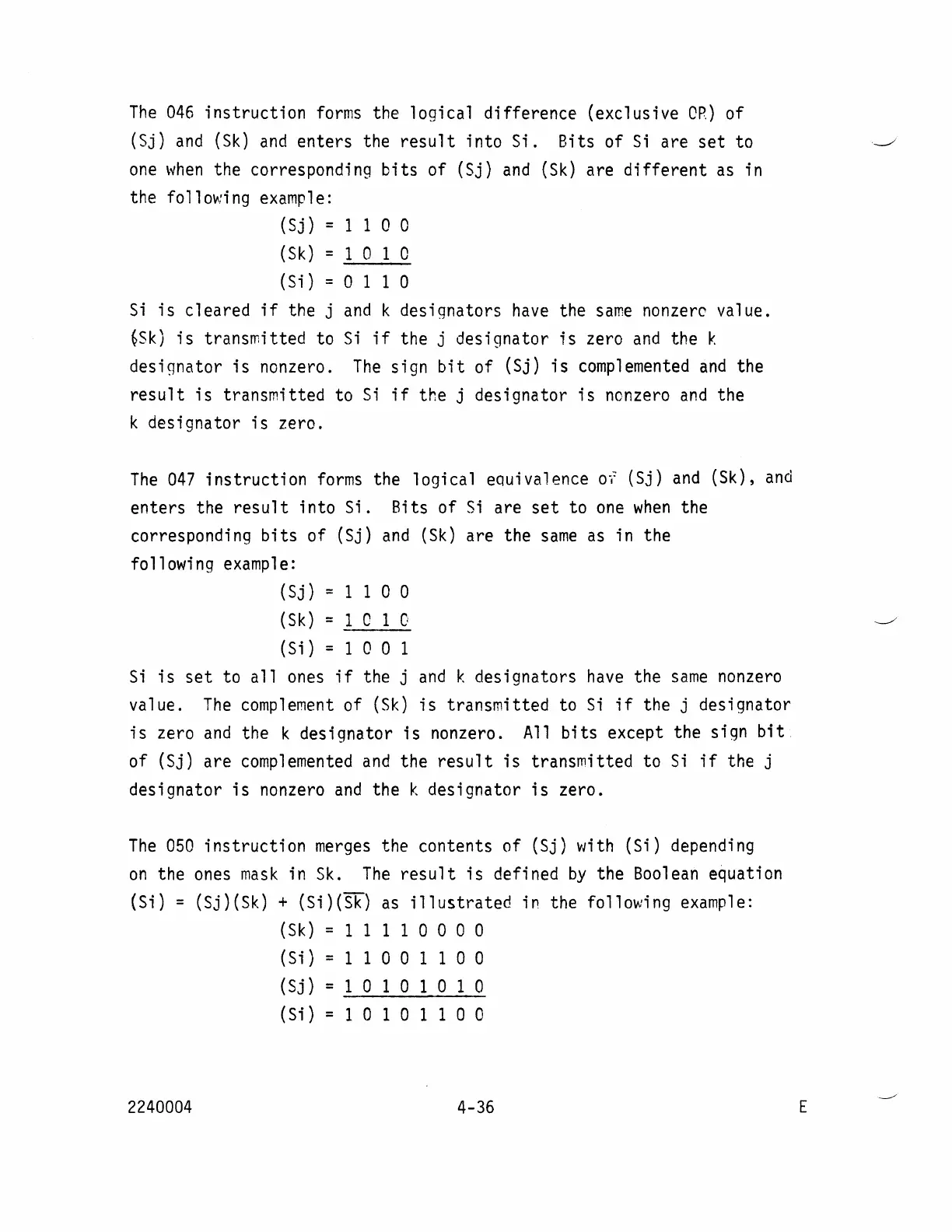
046
instruction
forms
the logical difference (exclusive
OR)
of
(Sj)
and
(Sk)
and
enters the
result
into Si. Bits of
Si
are
set
to
one
when
the corresponding
bits
of (Sj)
and
(Sk)
are
different
as
in
the following
example:
(Sj) = 1 1 0 0
(Sk)
= 1 0 1 0
(Si) = 0 1 1 0
Si
is
cleared
if
the j
and
k designators
have
the
same
nonzerc value.
~Sk)
is
transmitted to
Si
if
the j designator
is
zero
and
the k
designator
is
nonzero.
The
sign
bit
of (Sj)
;s
complemented
and
the
result
is
transmitted to
Si
if
the j designator
is
nonzero
and
the
k designator
is
zero.
The
047
instruction
forms
the logical equivalence
of
(Sj)
and
(Sk),
and
enters the
result
into Si. Bits of
Si
are
set
to
one
when
the
corresponding
bits
of (Sj)
and
(Sk)
are the
same
as
in the
following
example:
(Sj) = 1 1 0 0
(Sk)
= 1 0 1 0
(Si) =
100
1
Si
is
set
to
all
ones
if
the j
and
k designators
have
the
same
nonzero
value.
The
complement
of
(Sk)
is
transmitted to
Si
if
the j designator
is
zero
and
the k designator
is
nonzero.
All
bits
except the sign
bit.
of (Sj) are
complemented
and
the
result
is
transmitted to
Si
if
the j
designator
is
nonzero
and
the k designator
is
zero.
The
050
instruction
merges
the contents of (Sj) with (Si) depending
on
the
ones
mask
in
Sk.
The
result
is
defined
by
the
Boolean
equation
(Si) = (Sj)(Sk) + (Si)(Sk)
as
illustrated
in the following
example:
2240004
(Sk)
= 1 1 1 1 0 0 0 0
(Si)
= 1 1 0 0 1 1 0 0
(Sj)
= 1 0 1 0 1 0 1 0
(Si) = 1 0 1 0 1 1 0 0
4-36
E

Table of Contents