FLOATING
POINT
ARITHMETIC
Floating point
numbers
are represented in a standard format throughout
the
CPU.
This format
is
a
packed
representation of a binary
coefficient
and
an
exponent or
power
of
two.
The
coefficient
is
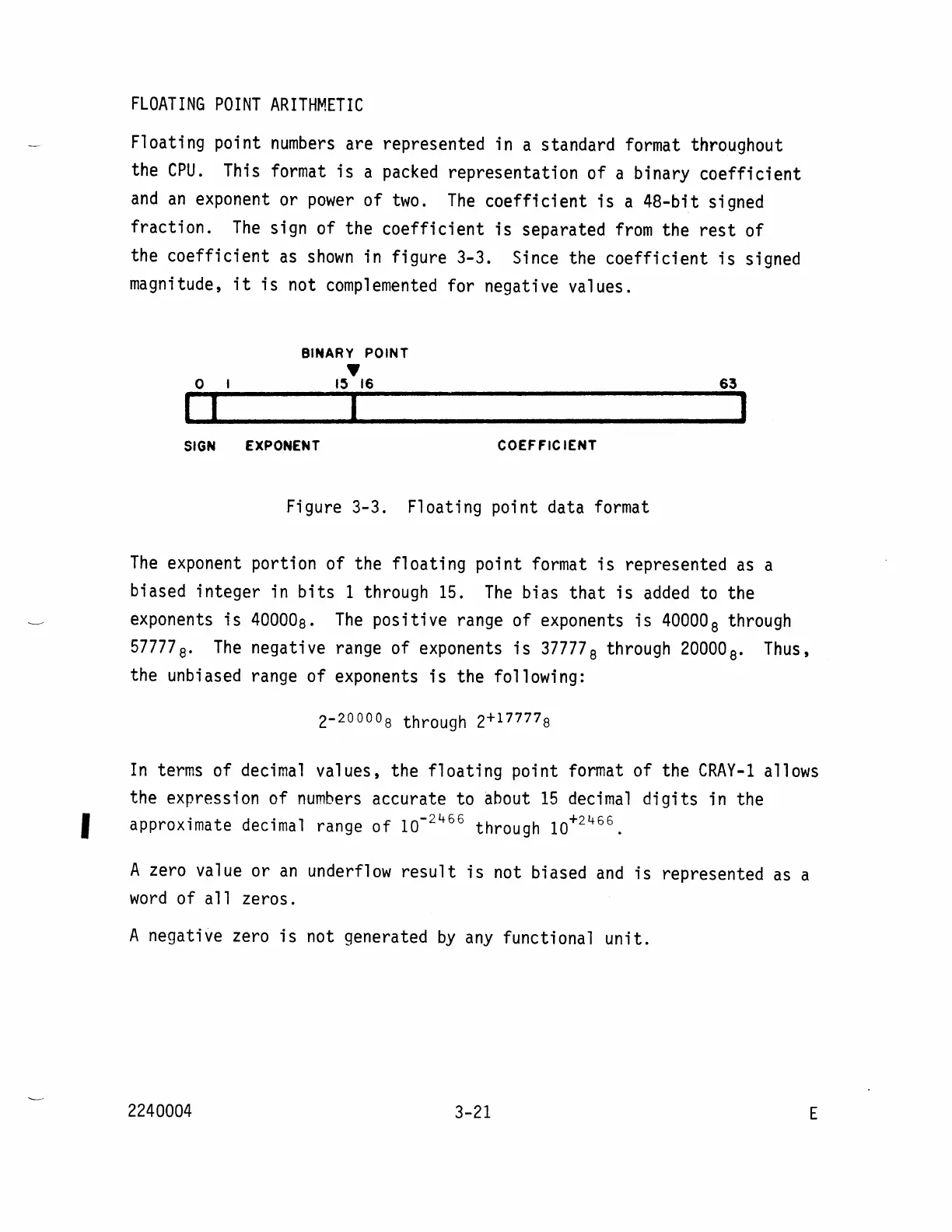
a 48-bit signed
fraction.
The
sign of the
coefficient
is
separated
from
the
rest
of
the
coefficient
as
shown
in figure 3-3. Since the
coefficient
is
signed
magnitude,
it
is
not
complemented
for negative values.
o
I I
BINARY POINT
•
I~
16
I
SIGN
EXPONENT
COEF FIC
lENT
Figure 3-3. Floating point data format
63
I
The
exponent portion of the floating point format
is
represented
as
a
biased integer in
bits
1 through
15.
The
bias
that
is
added
to the
exponents
is
400008.
The
positive range of exponents
is
40000
8
through
5777780
The
negative range of exponents
is
377778
through
20000
8
,
Thus,
the unbiased range of exponents
is
the following:
2-200008
through
2+177778
In
terms of decimal values, the
floating
point format of the
CRAY-l
allows
the expression of
numbers
accurate to about
15
decimal
digits
in the
I approximate
decimal
range of
10-
2466
through
10+
2466
•
A zero value or
an
underflow
result
is
not biased
and
is
represented
as
a
word
of
all
zeros.
A negative zero
is
not generated
by
any
functional
unit.
2240004
3-21
E



 To Next Page