EasyManua.ls Logo

Cray CRAY-1 - Page 138

Default Icon
216 pages
Print Icon
To Next Page IconTo Next Page
To Previous Page IconTo Previous Page
Loading...
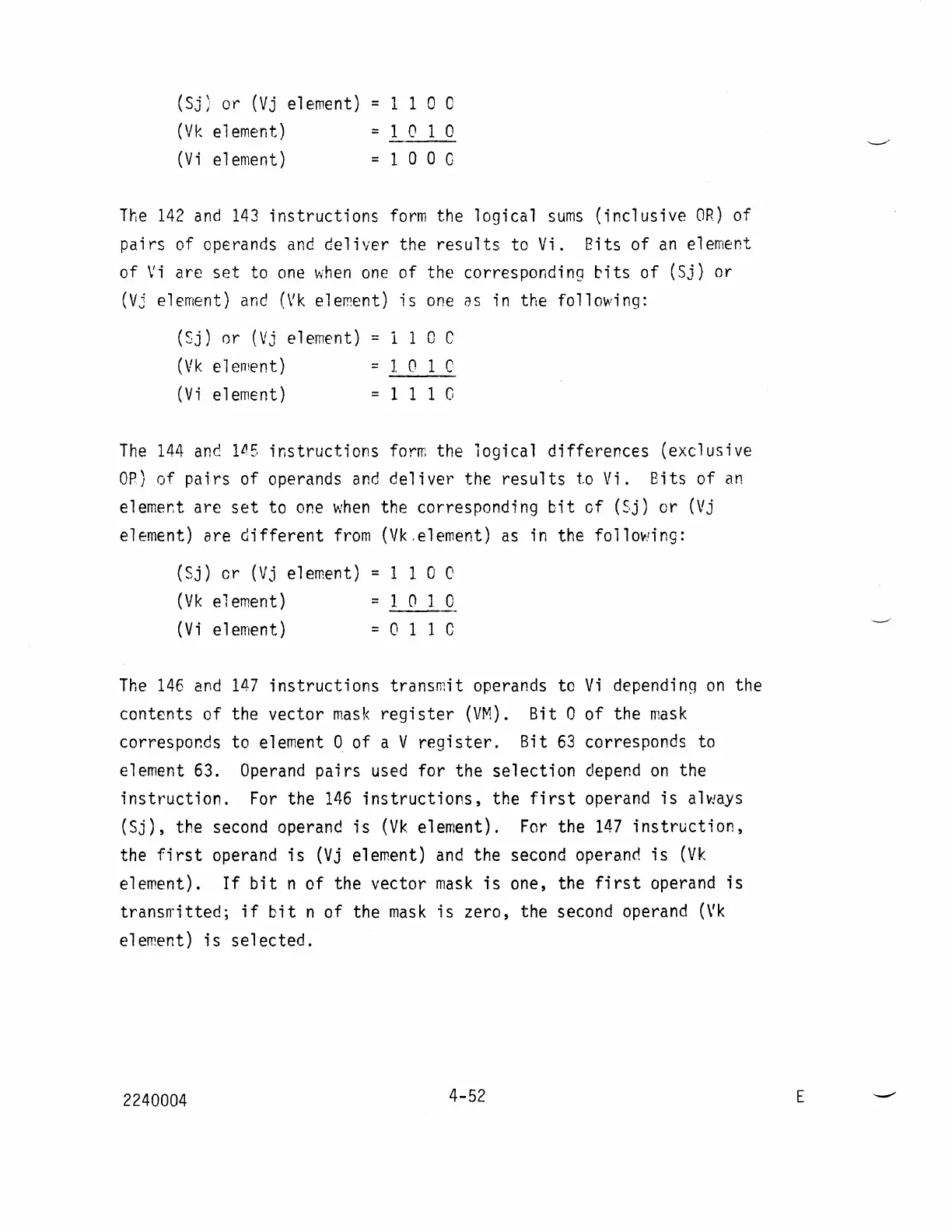
(Sj)
or
(Vj
element) =
1
100
(Vk
element)
(Vi
element)
= 1 0 1 0
= 1 0 0 C
The
142
and
143
instructions
form
the logical
sums
(inclusive
OR)
of
pairs of operands
and
deliver
the
results
to Vi. Bits of
an
element
of
Vi
are
set
to
one
when
one
of the corresponding
bits
of (Sj) or
(Vj
element)
and
(Vk
element)
is
one
as
in the following:
(Sj)
or
(Vi
element)
=
1 1
0
C
",I
(Vk
e'1
el11ent)
=
1 0 1 C
(Vi
element)
=
1 1 1 0
The
144
and
145
instructions
form
the logical differences (exclusive
OP)
of pairs of operands
and
deliver
the
results
to Vi. Bits of
an
element are
set
to
one
when
the corresponding
bit
of (Sj) or
(Vj
element) are
different
from
(Vk,element)
as
in the following:
(Sj) or
(Vj
element) = 1 1 0 0
(Vk
element) = 1 0 1 0
(Vi
element) = 0
lIe
The
146
and
147
instructions
transmit operands to
Vi
depending
on
the
contents of the vector
mask
register
(VM).
Bit 0 of the
mask
corresponds to element 0 of a V
register.
Bit
63
corresponds to
element
63.
Operand
pairs
used
for the
selection
depend
on
the
instruction.
For
the 146
instructions,
the
first
operand
is
al~Jays
(Sj),
the second operand
is
(Vk
element).
For
the
147
instruction,
the
first
operand
is
(Vj
element)
and
the second operand
is
(Vk
element).
If
bit
n of the vector
mask
is
one, the
first
operand
is
transwitted;
if
bit
n of the
mask
is
zero, the second operand
(Vk
element)
is
selected.
2240004
4-52
E

Table of Contents