incrementing until the
first
result
arrives
from
the functional unit
at
functional unit time + 2
CPo
This counter then begins to
advance
by
one
each
clock period.
Note
that
until
f.u.
+ 2, the
initial
contents of
element zero of the operand/result
register
are repeatedly sent to the
functional
unit.
The
element counter for the other operand
register,
however,
immediately begins advancing
by
one
on
each
successive clock period
thus sending the contents of elements
0, 1, 2,
...
on
successive clock
periods. Thus, the
first
f.u.
+ 2 elements of the operand/result
register
contain
results
based
on
the contents of element 0 of the operand/result
register
and
on
successive elements of the other operand
register.
These
f.u.
+ 2 elements then provide
one
of the operands
used
in calculating
the
results
for the next
f.u.
+ 2 elements.
The
third
group
of
f.u.
+ 2
elements of the operand/result
register
contains
results
based
on
the
results
delivered to the
second
group
of
f.u.
+ 2 elements,
and
so
on
until
the final
group
of
f.u.
+ 2 elements
is
generated
as
determined
by
the
vector length.
As
an
example, consider the
summation
of a vector of floating point
numbers
wherp
the
initial
conditions for the vector operation are the following:
-
All
elements of
register
VI
contain floating point values.
- Register
V2
will provide
one
set
of operands
and
will receive
the
results.
Element
0 of
this
register
contains a 0 value.
-
The
vector length
register
(VL)
contains
64.
A floating point
add
instruction
(171212)
is
then executed using
register
VI
for
one
operand
and
using
register
V2
as
an
operand/result
register.
This instruction uses the floating point
add
unit
which
has
a functional
unit time of 6
CP
causing
sums
to
be
generated in groups of eight
(f.u.
+
2 = 8).
The
final eight
partial
sums
of the
64
elements of
VI
are contained
in elements
56
through
63
of
V2.
Specifically,
elements of
V2
contain the
following
sums:
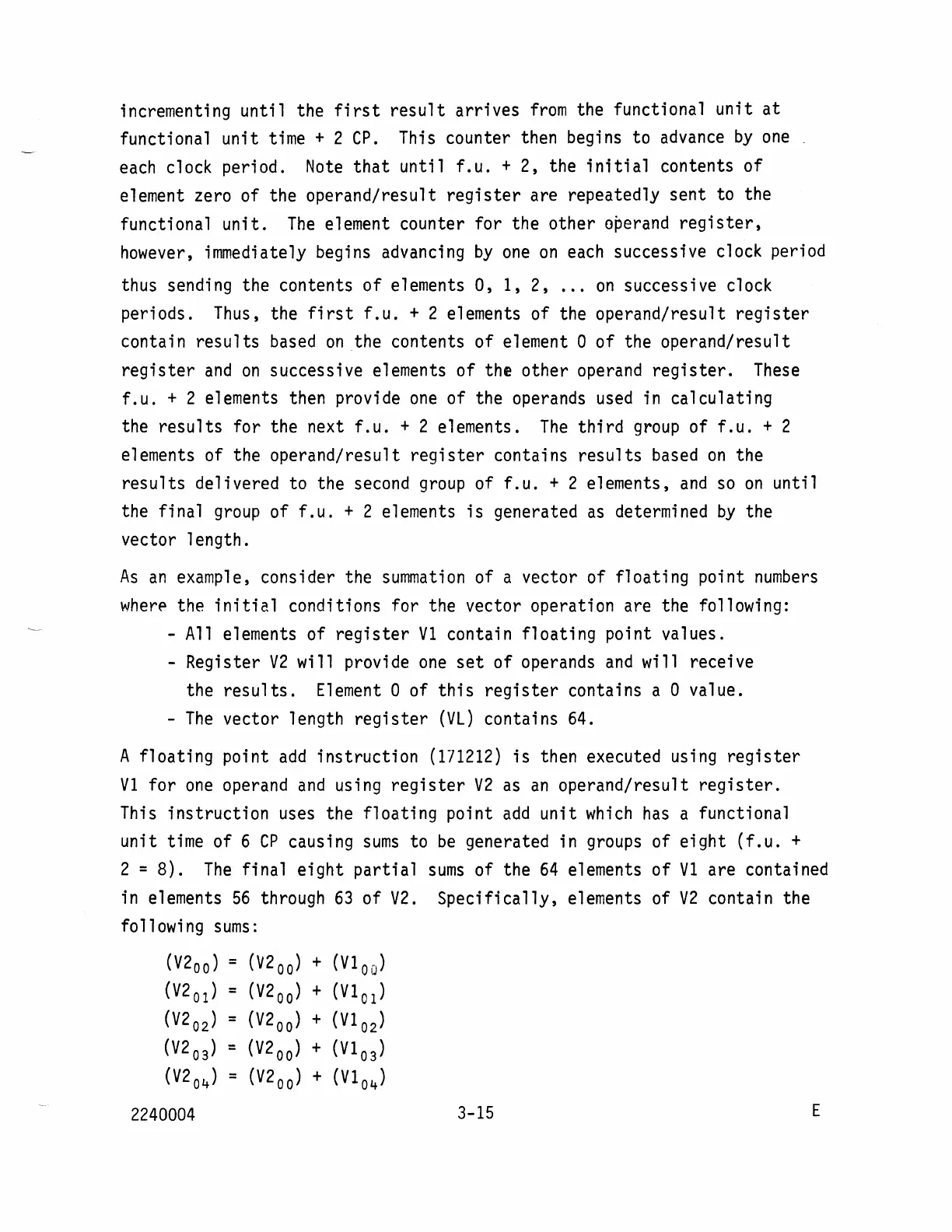
(V2
00
)
=
(V2
00
)
+
(Vl
oa
)
(V2
01
)
=
(V2
oo
)
+
(VIOl)
(V2
02
)
=
(V2
00
)
+
(Vl
o2
)
(V2
03
)
=
(V2
00
)
+
(VI
03
)
(V2
04
)
=
(V2
00
)
+
(Vl
o4
)
2240004
3-15
E



 To Next Page