OPERATION MICRO-TEMP
®
LT, Model 749
OPERATION AND TECHNICAL MANUAL
Page 21 of 75
C. Examine the power cord for cuts or exposed wires and check the power cord for bent
or missing prongs.
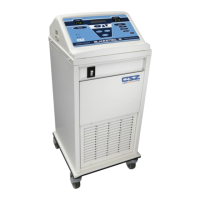
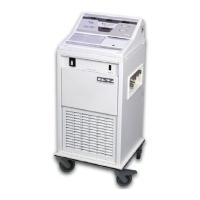
D. Review Section 1-3.1, 1-3.2, and 1-3.3 to identify the features of the MICRO-TEMP
®
LT unit.
E. Collect and arrange a localized heat therapy pad described in Section 1-4.
F. Twist off the cap on the water fill opening and gradually pour approximately .9 liters of
distilled water and two (2) ounces of Propylene Glycol into the reservoir. Stop pouring
when the water reaches the strainer and is visible at the bottom of the water fill
opening.
G. Connect the pad to the MICRO-TEMP
®
LT unit by attaching the pad to the couplings at
the end of the connecting hose. The pad must be connected to the outlet and the
return.
H. Check that the pad is lying flat and that the hose permanently attached to the unit is
not twisted or pinched.
I. Check that the power switch of the unit is OFF.
J. Connect the detachable power cord to the unit.
NOTE: If pad is placed above unit, disconnect pad prior to turning off unit. This could
cause backflow if pad is not disconnected.
Do not by-pass ground on power cord plug. Electrical Hazards may result.
K. Insert the plug into a properly grounded receptacle.
2-3.2. COMPLETING A SYSTEM TEST ROUTINE
After arranging the equipment described in Section 2-3.1, complete the System Test Routine
describing which switches to press and the changes to observe.
NOTE: If power is supplied to the unit and is removed without actuating the power switch (I/O
switch) a power fail indicator is activated. To stop the indicator, restore power to the unit or turn the
power switch to the “O” (OFF) position.
Use distilled water only. Do Not Use De-Ionized water. Failure to use distilled water may
result in poor performance and damage to the Micro-Temp
®
LT.
Do not use alcohol. Alcohol may cause pad and unit deterioration.
Do NOT fill the reservoir to the bottom of the strainer if there is water in the pad. This
could cause an overflow when the unit is turned on.



 To Next Page