Practical tips
checked by a Technical Service where it will
be r
e-char
ged or replaced.
Charging the battery
The vehicle battery should be charged by a
specialised workshop only, as batteries using
special technology have been installed and
they must be charged in a controlled envi-
ronment.
Replacing a vehicle battery
The battery has been developed to suit the
conditions of its location and has special
safety features. If the battery must be re-
placed, consult a technical service for infor-
mation on electromagnetic compatibility,
the size and maintenance, performance and
safety requirements of the new battery in
your vehicle before you purchase one. CU-
PRA recommends you have the battery re-
placed by a technical service.
Start-Stop systems (
›››
page 230) are equip-
ped with a special battery. Therefore, it must
only be replaced with a battery of the same
specifications.
Your vehicle is equipped with an intelligent
power management system to control the
distribution of electrical energy
›››
page 328.
The power management function ensures
that the battery is charged much more effi-
ciently than on vehicles without a power
management system. To maintain this func-
tion after replacing the battery, we recom-
mend that the replacement battery used is
of the same make and type as the original fit-
ted battery. To make proper use of the power
management function after the battery has
been changed, have the battery coded to
the power management mode at a special-
ised workshop.
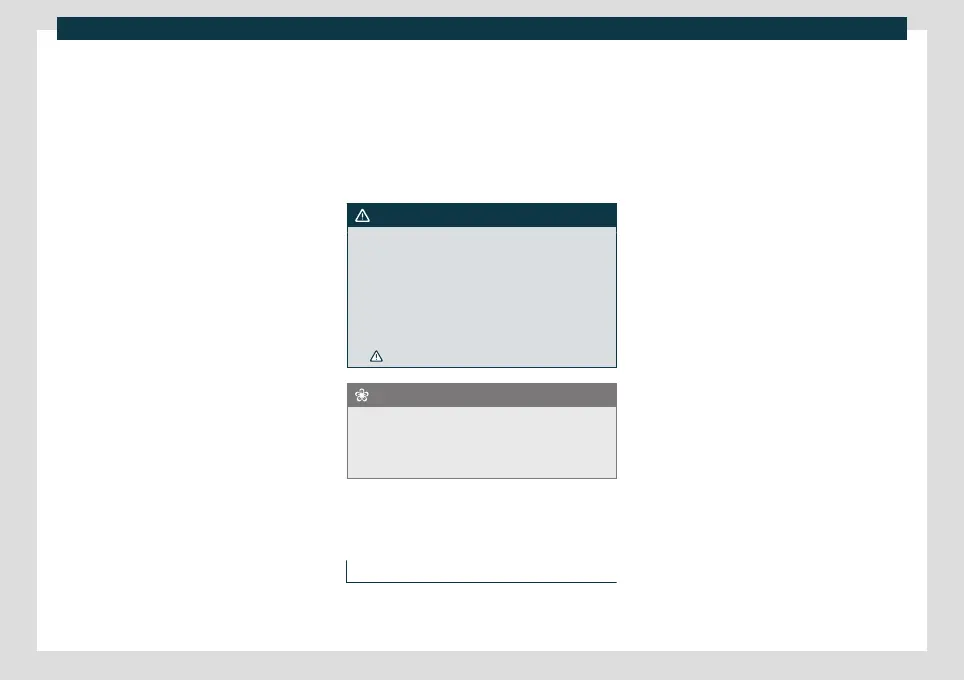
WARNING
●
Always use only maintenance free batter-
ies that do not run flat alone and whose
properties, specifications and size corre-
spond to the standard battery. The specifi-
cations are indicated on the battery case.
●
Before starting any work on the batteries,
you must read and observe the warnings
›››
in General information on page 326.
For the sake of the environment
Batteries contain toxic substances such
as sulphuric acid and lead. They must be
disposed of appropriately and must not be
disposed of with ordinary household waste.
Energy management
Optimisation of the starting capacity
The power management controls the distri-
bution of electrical ener
gy and thus help
s to
ensure that there is always enough power
available to start the engine.
If a vehicle with a conventional electrical sys-
tem is left parked for a long time, the battery
will gradually lose its charge because certain
electrical devices, such as the electronic
gearbox lock continues to draw current even
when the ignition is off. In some cases there
may not be enough power available to start
the engine.
Your vehicle is equipped with an intelligent
power management system to control the
distribution of electrical energy. This signifi-
cantly improves reliability when starting the
engine, and also prolongs the useful life of
the battery.
The main functions incorporated in the pow-
er management system are battery diagno-
sis, residual current management and dy-
namic power management.
Battery diagnosis
The battery diagnosis function constantly
registers the condition of the battery. Sen-
sors detect the battery voltage, battery cur-
rent and battery temperature. This enables
the system to calculate the current power
level and charge condition of the battery.
Residual current management
The residual current management reduces
power consumption while the vehicle is
328



 To Next Page