G424F(FE) Service Manual Chapter 4. Engine Electrical System 103
MISFIRES
DIS problems can include many of the same
ailments as other ignition systems such as misfiring,
hard starting, or a no start. Spark plugs can still be
fouled by oil or fuel deposits, as well as pre-ignition
and detonation.
If the crankshaft position sensor fails, the loss of the
basic timing signal will prevent the system from
generating a spark and the engine will not start or
run. A failed driver circuit within the SECM can kill
individual coils and prevent two cylinders from firing.
It is important to remember that ignition misfire can
also be caused by other factors such as worn or
fouled spark plugs, loose or damaged coil connector
or terminals, dirty fuel injectors, low fuel pressure,
intake vacuum leaks, loss of compression in a
cylinder, even contaminated fuel. These other
possibilities should all be ruled out before a DIS unit
is replaced.
A DIS engine that cranks but fails to start, in many
cases, will often have a problem in the crankshaft or
camshaft position sensor circuits. Loss of sensor
signals may prevent the SECM from properly
synchronizing, thereby preventing the engine from
starting and running.
DIS CHECKS
Individual ignition coils can be tested with an
ohmmeter the same as those on a conventional
distributor system. Measure primary and secondary
resistance and compare to specifications. If
resistance is out of specifications, the coil is bad and
needs to be replaced.
Also, pay close attention to the tube that wraps
around the spark pug. Cracks can allow voltage to
jump to ground causing a misfire. The spark plug
terminal should also fit tightly.
If a coil tests bad and is replaced, cleaning the
connector and wiring harness terminals can often
avoid future problems. Corrosion at either place can
cause intermittent operation and loss of continuity,
which may contribute to component failure. Applying
dielectric grease to these connections can help
prevent corrosion and assure a good electrical
connection.
Magnetic crankshaft position sensors can be tested
with an ohmmeter, and the sensor output voltage
and waveform can be read with an oscilloscope. The
output voltage of a Hall Effect crankshaft position
sensor can be checked with a voltmeter. On most
vehicles, a defective crank position sensor will
usually set a fault code that can be read with the
Service Tool.
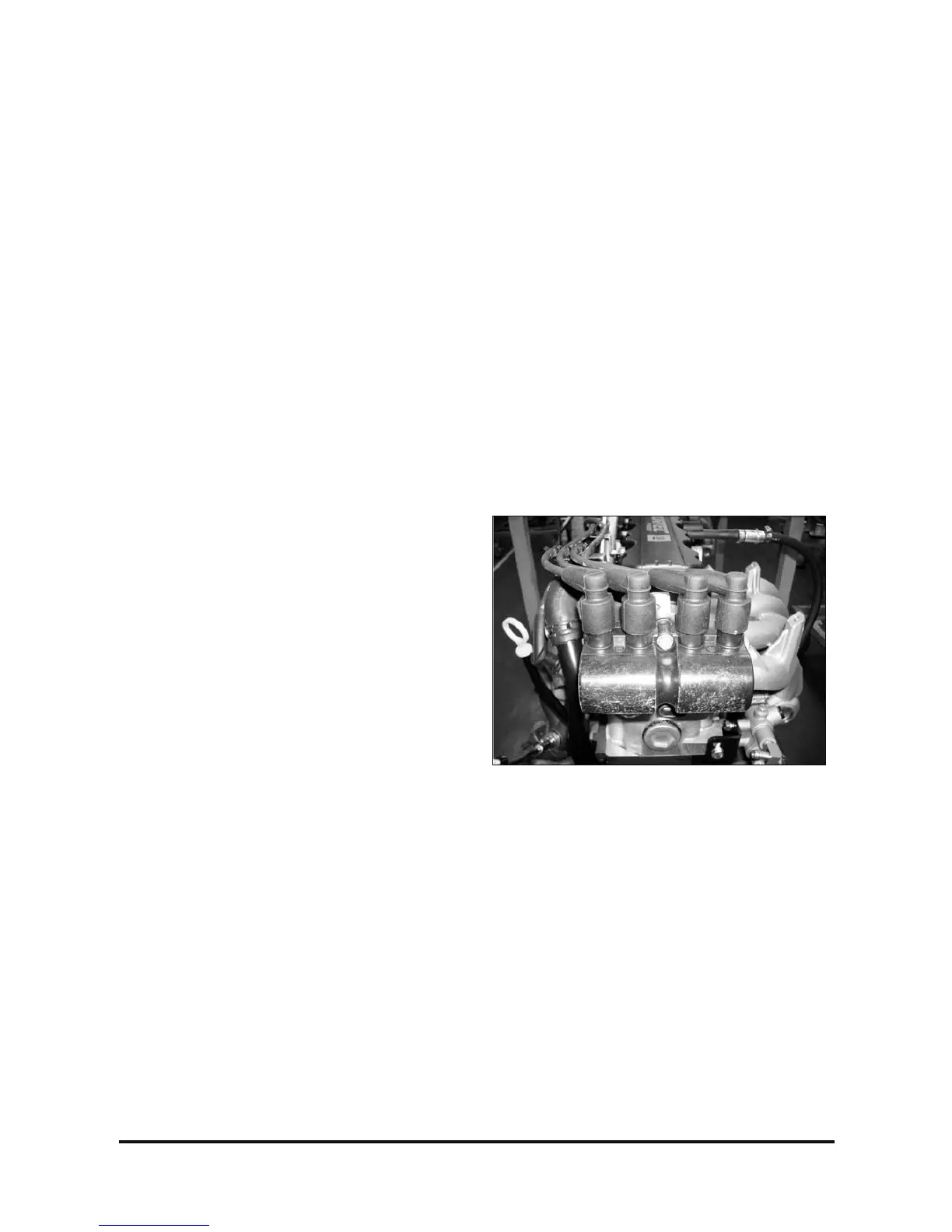
Inspection of Ignition Coil
The operation of the ignition system is essentially
the same as any other ignition system. Each coil has
a low primary resistance (0.4 to 0.6 ohms) and steps
up the primary system voltage from 12 volts to as
much as 40,000 volts to produce a spark for the
spark plug.
It is a direct connection that delivers the hottest
spark possible. Resistor plugs are generally used to
suppress electromagnetic interference (EMI).
Terminal A : EST 2 (Fires 2 & 3)
Terminal B : EST 1 (Fires 1& 4)
Terminal C : Ground
Terminal D : B+
Primary Resistance: 0.15 ohms
Secondary Load Resistance: 2,500 ohms



 To Next Page