G424F(FE) Service Manual Chapter 4. Engine Electrical System 106
b. Best for a loose terminal post by twisting and
pulling the post. The terminal post should NOT
move.
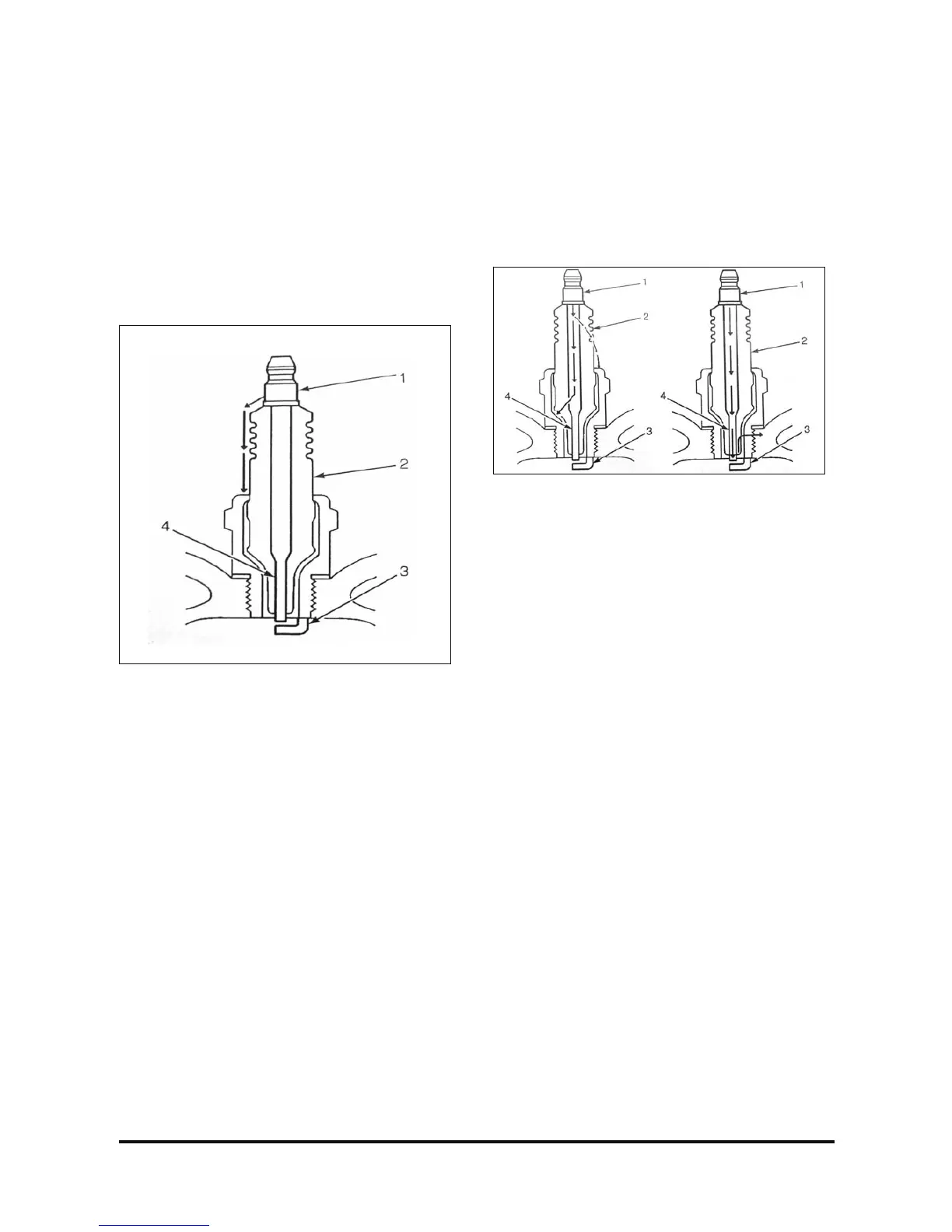
2. Inspect the insulator for flashover or carbon
tracking soot. See Figure 84. This is caused by
the electrical charge traveling across the insulator
between the terminal post and ground. Inspect for
the following conditions:
a. Inspect the spark plug boot for damage.
b. Inspect the spark plug recess area of the
cylinder head for moisture, such as oil, coolant,
or water. A spark plug boot that is saturated
causes arcing to ground.
3. Inspect the cylinder for cracks. All or part of the
electrical charge may arc through the crack
instead of the electrodes. See Figure 85.
4. Inspect for evidence of improper arcing. See
Figure 86.
a. Measure the gap between the center electrode
(4) and the side electrode (3) terminals. An
excessively wide electrode gap can prevent
correct spark plug operation. Refer to Engine
Speculations for the proper gap. Adjust as
necessary.
b. Inspect for the correct spark plug torque. The
correct torque is 20 N•m (15 lbf ft). Insufficient
torque can prevent correct spark plug
operation. An over-torqued spark plug causes
the insulator to crack.
c. Inspect for sign of tracking that occurred near
the insulator tip instead of the center electrode
(4).
d. Inspect for a broken or worn side electrode (3).
e. Inspect for a broken, worm, or loose center
electrode (4) by shaking the spark plug.
(1) A rattling sound indicates internal damage.
(2) A loose center electrode (4) reduces the spark intensity.
f. Inspect for bridged electrodes (3, 4). Despites
in the electrode (3, 4) reduce or eliminate the
gap.
g. Inspect for worn of missing platinum pads on
the electrodes (3, 4), if equipped.
h. Inspect for excessive fouling.
5. Inspect the spark plug recess area of the cylinder
head for debris. Dirty or damaged threads can
cause the spark plug not to seat correctly during
installation.
Visual Inspection
1. Normal operation – Brown to grayish-tan with
small amounts of white powdery deposits are
normal combustion by-products from fuels with
additives.
2. Carbon fouled – Dry, fluffy, black carbon or soot
caused by the following conditions:
• Rich fuel injectiors
- Leaking fuel injectiors
- Excessive fuel pressure
- Restricted air filter element
- Incorrect combustion



 To Next Page