Need help?
Do you have a question about the ECGMAC EM-301 and is the answer not in the manual?
Guidelines for safe installation and storage of the ECG unit to prevent damage and ensure proper function.
Essential checks to perform before operating the ECG machine for patient safety and accurate readings.
Safety measures and monitoring guidelines to follow while the ECG machine is in use with a patient.
Steps to take after completing an ECG operation, including shutdown and cleaning.
Information on electromagnetic compatibility and potential interference sources affecting ECG performance.
Details on the ECG device's classification regarding protection against electric shock and hazardous liquids.
Recommendations for periodic verification and calibration of the ECG instrument.
Instructions on how to properly discard electronic materials and waste according to local regulations.
Explanation of various symbols used on the ECG machine and in the manual for clear communication.
Recommendations for using the correct thermal paper to ensure high-quality ECG waveform recording.
Critical safety warnings for operating the ECG, including electrical safety and environmental hazards.
Precautions and dangers associated with the rechargeable lithium battery, including explosion risks.
Important general notes for optimal ECG operation, including environmental and handling precautions.
Procedures for cleaning, disinfecting, and maintaining the ECG unit and its accessories.
Defines the specific purpose and application of the ECG machine for diagnosing heart disease.
Lists absolute and relative contraindications for using the ECG machine on patients.
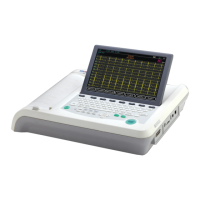
Detailed description of the ECG machine's physical components, including top, bottom, side views, and keyboard.
Instructions on correctly connecting limb and chest electrodes, and identifying lead wire colors.
Guidance on how to properly connect the patient cable to the ECG machine and its socket.
Instructions for connecting the ECG machine to AC power or using its DC battery.
Explanation of the ECG machine's internal working principle and a schematic diagram of its system.
Highlights the main features and capabilities of the ECG machine, such as operating modes and display.
Specifies the environments and situations where the ECG machine can be used.
Defines the required temperature and humidity levels for optimal ECG operation.
Checks to perform on the instrument, cables, and patient before starting an ECG recording.
Explains how the ECG machine indicates lead connection status and troubleshooting for lead off.
Step-by-step guide on how to install the rechargeable battery into the ECG unit.
Information on the types of recording paper compatible with the ECG machine.
Instructions on how to load the thermal paper roll into the ECG's paper compartment.
Detailed steps for powering the ECG machine on and off using mains or battery supply.
Description of the main display interface, including status indicators and function keys.
Explanation of the three operating modes: Manual, Rhythm, and Auto, and how to select them.
Guide to selecting different lead systems and lead rhythms for ECG acquisition.
Instructions for configuring display formats and order (sequential/simultaneous) of ECG waveforms.
Configuration settings for device management and print options.
Settings for auto analysis functions and network communication setup.
Configuration of patient information fields and administrator settings.
Options for applying filters to improve ECG signal quality.
Procedure for setting the device's date, time, and format.
Settings for lead selection and miscellaneous device preferences.
Detailed steps for cleaning the main unit, patient cable, electrodes, and printing head.
Recommendations and restrictions for disinfecting the ECG machine and its components.
Instructions for battery charging, capacity indication, and replacement.
Procedures for maintaining the ECG unit, patient cable, and electrodes.
Steps for safely exchanging a blown fuse in the ECG machine.
Troubleshooting steps for when no ECG waveform is printed, covering cable and signal issues.
Diagnosing and resolving issues causing vertical breaks in printed ECG waveforms, likely printer head related.
Solutions for unresponsive buttons on the ECG control panel, potentially due to loose connections.
Identifying and mitigating AC interference affecting ECG signals, focusing on grounding and environment.
Addressing EMG interference causing baseline vibration, suggesting patient relaxation and filter use.
Methods to correct baseline drift in ECG waveforms, including electrode checks and filter application.
Details on the warranty period, coverage, and exclusions for the ECG machine and its accessories.
Contact information for customer support, including address, phone, fax, and email.
List of all accessories included in the ECG machine package upon shipment.
Important precautions to follow when unpacking and checking the ECG machine and its accessories.
Technical specifications related to the external output capabilities of the ECG machine.
Technical specifications for the external DC signal input functionality of the ECG.
Detailed technical specifications of the main ECG machine, including leads, sampling, and filters.
Physical dimensions and weight specifications for the ECG machine and its packaging.
Environmental requirements for transportation, storage, and usage of the ECG machine.
Guidance on electromagnetic emissions and compliance for the ECG machine in various environments.
Information on electromagnetic immunity and recommended separation distances for RF communications.
 General
| Printing | Built-in thermal printer |
|---|---|
| Display | LCD |
| ECG Cable | 10-lead |
| Power Supply | AC |
| Connectivity | USB |

 To Next Page