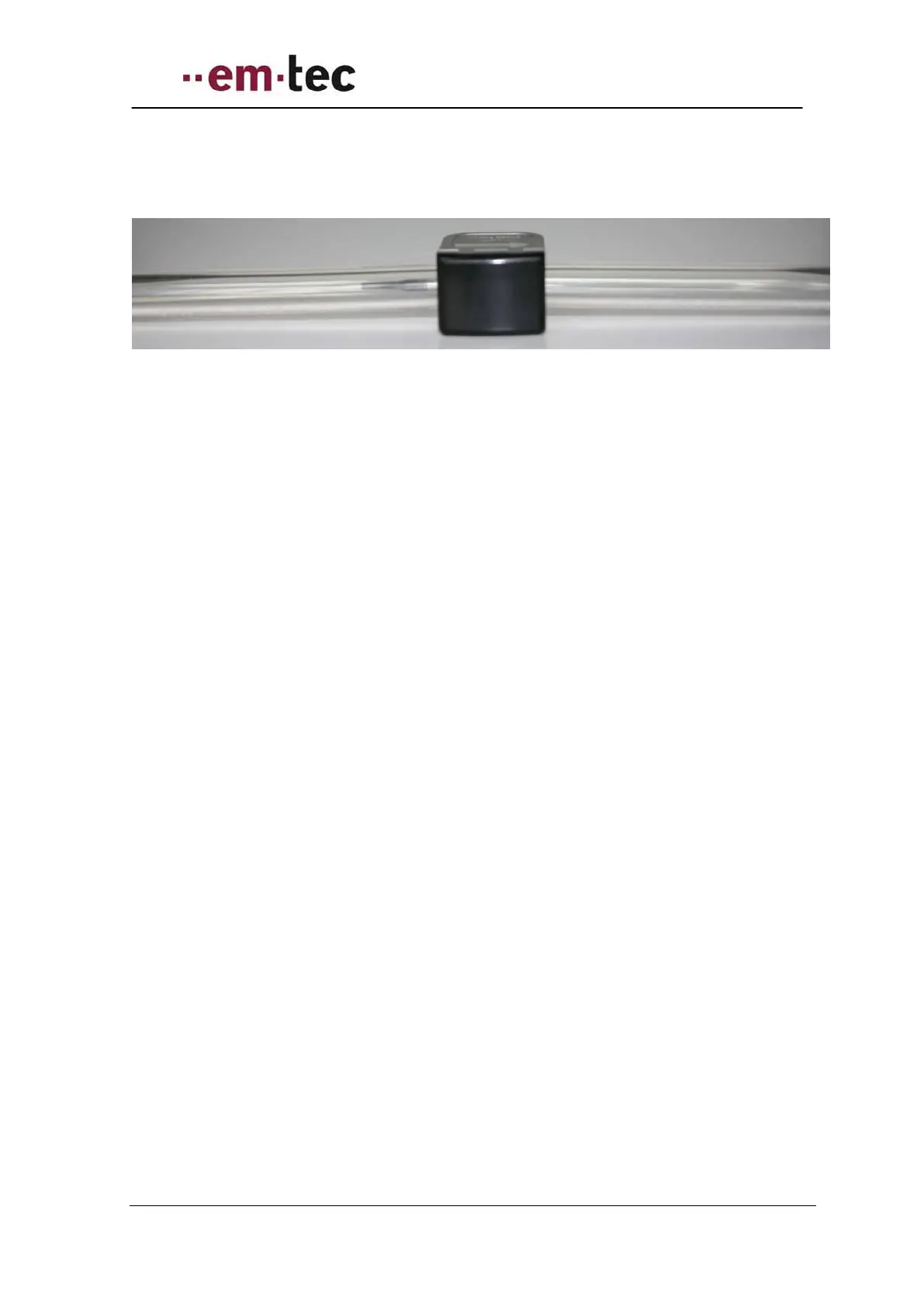
BioProTT
TM
Flow Measurement System Version 1.00 page 33 of 75
Notes on measurement accuracy:
Place the sensor on straight part of the tubing to avoid measurement in areas of
recirculation ,vortices or spin (preferably 6 inches before and behind the sensor.)
Allow the sensor to reach a stable temperature profile before pressing the offset adjust
button; e.g. if the sensor has ambient temperature and the liquid has 35°C, it usually
takes a few minutes until a stable temperature profile is reached.
Use only the specified tubing.
Keep to the specified temperature range of the liquid: calibration temperature
± 5 degrees K.
Make sure that there is sufficient acoustic coupling (see next chapter).
7.4 Received Signal Strength (RSS / Acoustic Coupling)
The received signal strength (RSS) of the ultrasound beam is an information about the
signal transmission quality through liquid, tube and sensor. In this context the RSS value is
an indication for acoustic coupling. A sufficient acoustic coupling is a pre-requisite for
accurate measurements.
Sufficient acoustic coupling is reached when the RSS value is greater than 60% upon first
connection of a new flow sensor. To account for small variations of the acoustic coupling a
hysteresis is built into the systems, which works as follows:
Upon first connection the RSS value needs to be > 60% to show a flow value.
If the RSS value decreases during a measurement flow values are still be shown until
an RSS value of 50% is reached.
Below 50% the flow measurement result is considered to inaccurate and is no longer
shown on the different interfaces.
Once below 50% RSS, the RSS value has to increase again to be greater then 60% to
have a flow value shown.
Note: the RSS value shall be shown always when a sensor is connected
7.5 Use of Acoustic Couplant
In order to ensure a good repeatability of the flow measurement , acoustic couplant should
be applied to the tube before use. This is especially important when soft tubing (like
e.g.silicone) with a low wall thickness is used. Fitting this tubing into the measurement
channel might lead to concave folding of the tubing wall and a misalignment (low


 To Next Page