38
Propulsion System
replaced as necessary. For locations and mainte-
nance, please refer to the engine owner’s manual.
When leaving the boat in the water, tilt the motors
as high as possible. This will decrease the risk of
marine growth around the cooling inlets, propel-
ler and exhaust ports and damage from galvanic
corrosion.
DO NOT PAINT THE OUTBOARD MOTOR WITH ANTIFOULING
PAINTS DESIGNED FOR BOAT HULLS. MANY OF THESE
PAINTS CAN CAUSE SEVERE DAMAGE TO THE ENGINE.
CONTACT YOUR EVERGLADES DEALER OR ENGINE
MANUFACTURER FOR INFORMATION ON THE PROPER
PAINTING PROCEDURES.
3.3 Engine Lubrication
4-cycle outboard engines incorporate a pressure-
type lubrication system with an oil sump in the
crankcase that must be kept full of the type and
grade of oil recommended by the engine manufac-
turer. It is normal for 4-cycle engines to consume
a small amount of oil. Therefore, the oil must be
checked before each use and changed at regular in-
tervals as instructed by the engine owner’s manual.
Notice:
Always monitor the oil level in the crank-
case and only use the type of oil specied by
the engine manufacturer. Yamaha engines
specify Yamalube engine oil.
3.4 Engine Cooling System
Outboard engines are raw water (seawater) cooled.
Water is pumped through the water inlets, circu-
lated through the engine block and relinquished
with the exhaust gases through the propeller hub.
The water pump uses a small impeller made of syn-
thetic rubber. The impeller and water pump can-
not run dry for more than a few seconds. In most
outboard motors, some cooling water is diverted
through ports below the engine cowling. This al-
lows the operator to visually check the operation
of the cooling system. When the engine is started,
always check for a steady stream of water coming
out of those ports.
Notice:
If the boat is used in salt or badly polluted wa-
ter, the engines should be ushed after each
use. Refer to the engine owner’s manual for
the proper engine ushing procedure.
NEVER RUN AN OUTBOARD MOTOR WITHOUT WATER
FLOWING TO THE WATER PUMP. SERIOUS DAMAGE TO THE
WATER IMPELLER OR ENGINE COULD RESULT.
3.5 Engine Flushing System
Your boat could be equipped with an optional au-
tomatic engine ushing system that allows you
to ush both engines in sequence from one hose
connection. The following is an overview of the
ushing process. Your boat may be slightly dier-
ent, depending on the ush system, engine selec-
tion and other equipment selected. Always refer
to the ush system operation manual for specic
instructions for the system installed.
To ush the engines:
1. Shutdown the engines.
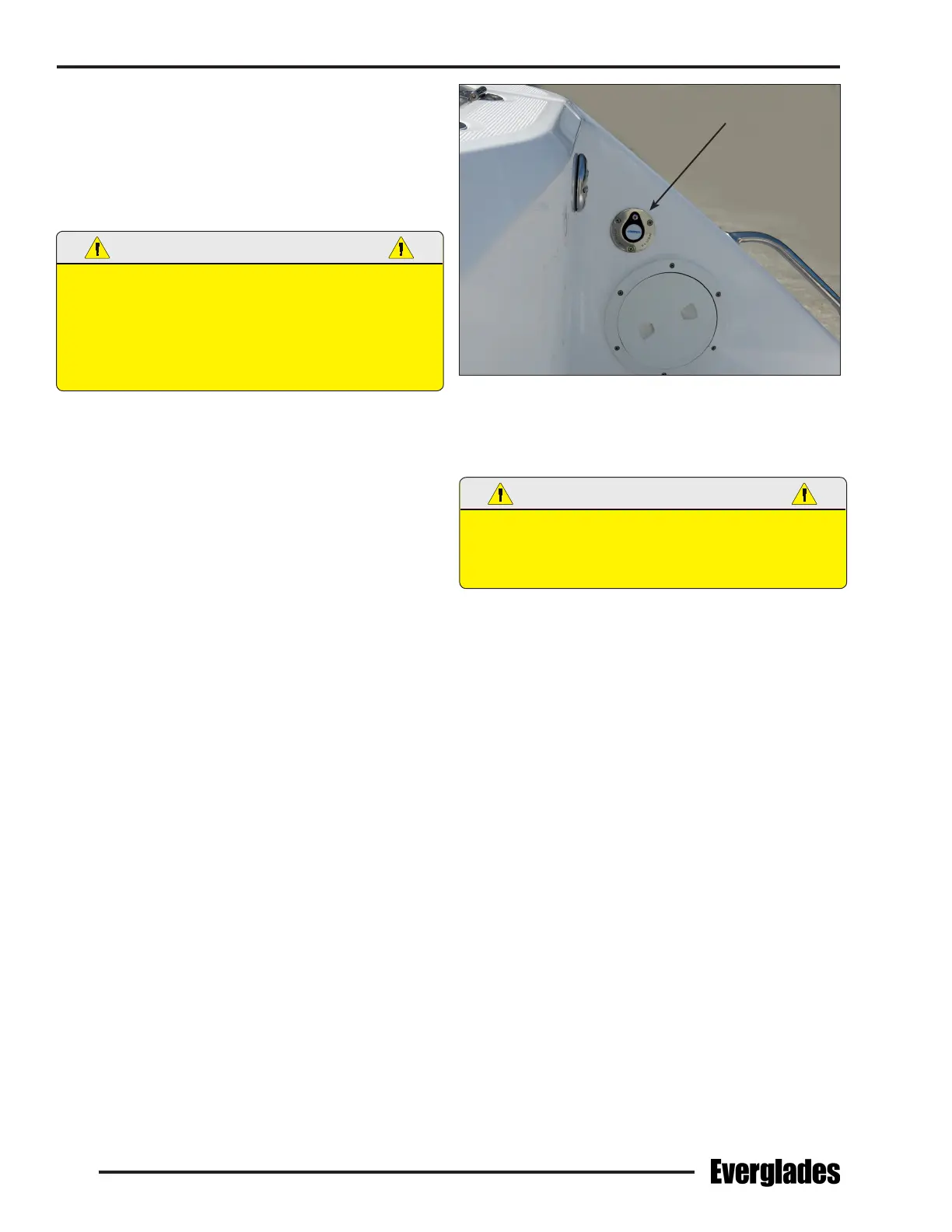
2. Connect a shore side freshwater hose to the
quick connection on the starboard side of the
swim platform and turn on the water.
Notice:
The hose connection tting has an automatic
valve that is always closed until the shore
supply hose is connected. The hose requires
a special tting that snaps into the connector
and activates the automatic valve. The cover
on the connector should always be closed to
keep the connector clean when the hose is
not attached.
Engine Flushing System Shore Side Hose Connection


 To Next Page