8. Deploying & Operating Robots
8.1. Roles & Training
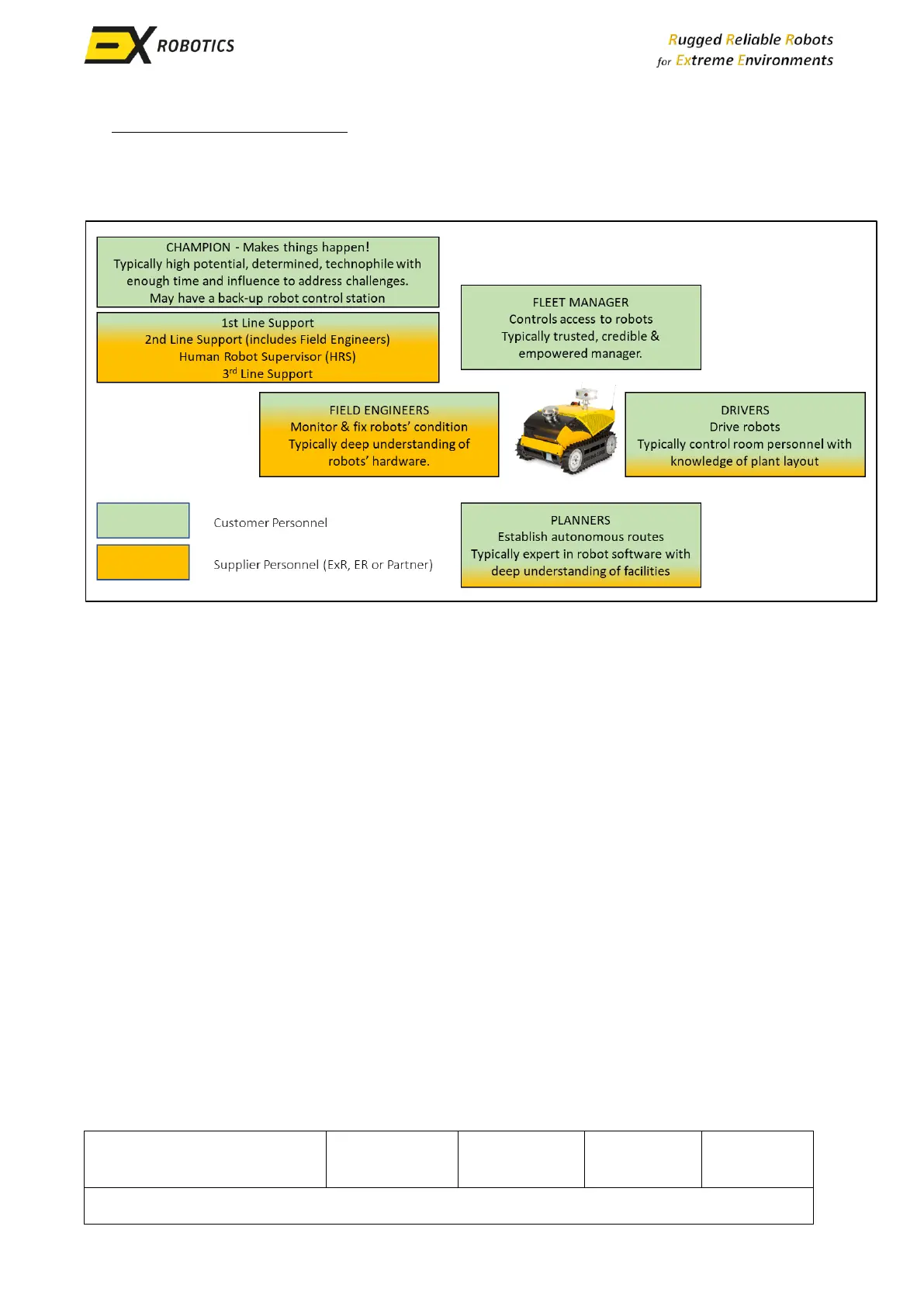
For robots to be used effectively, the roles in this diagram are required.
From the customer perspective the key roles are:
▪ The champion, these are essential until a site’s operations personnel are familiar with the use
and benefits of robots.
▪ The fleet manager. More information is provided in Section 8.2.
▪ Drivers. Site operators and/or control room personnel can quickly be trained to perform this
role as described below. Although they may only seldom drive robots we recommend that the
fleet manager maintains a register of trained drivers and that their competence is periodically
tested and refreshed by driving around a typical route.
▪ Planners. This is a critical role. Planning and programming new missions, routes, POIs and
tasks is time-consuming and doesn’t fall naturally within any existing operational role. They’ll
usually need to drive the robot so they need the same training as drivers.
▪ Some customers will also appoint their own 1
st
line support, field engineers, and/or human
robot supervisors (HRS). An HRS can monitor multiple autonomous missions and intervene if
anything unexpected occurs. (see Section 7).
Customers may contract ExRobotics or one of its partners to perform some of these roles, e.g. HRS
and planning. However, because of safety, environmental, security and confidentiality reasons we
will only drive the robot within constraints that have been agreed in writing with the customer.



 To Next Page