Quantum Series Videowall Processing Systems • Introduction 8
Rectangulation Limit (RAPT Source Layer)
There is no limit to the number of source windows that can be placed on the PCI source
layer. However, the maximum number of windows that can be displayed at one time on
the RAPT source layer is dependent on a rectangulation limit, which is the maximum
number of rectangles needed to draw the display layout.
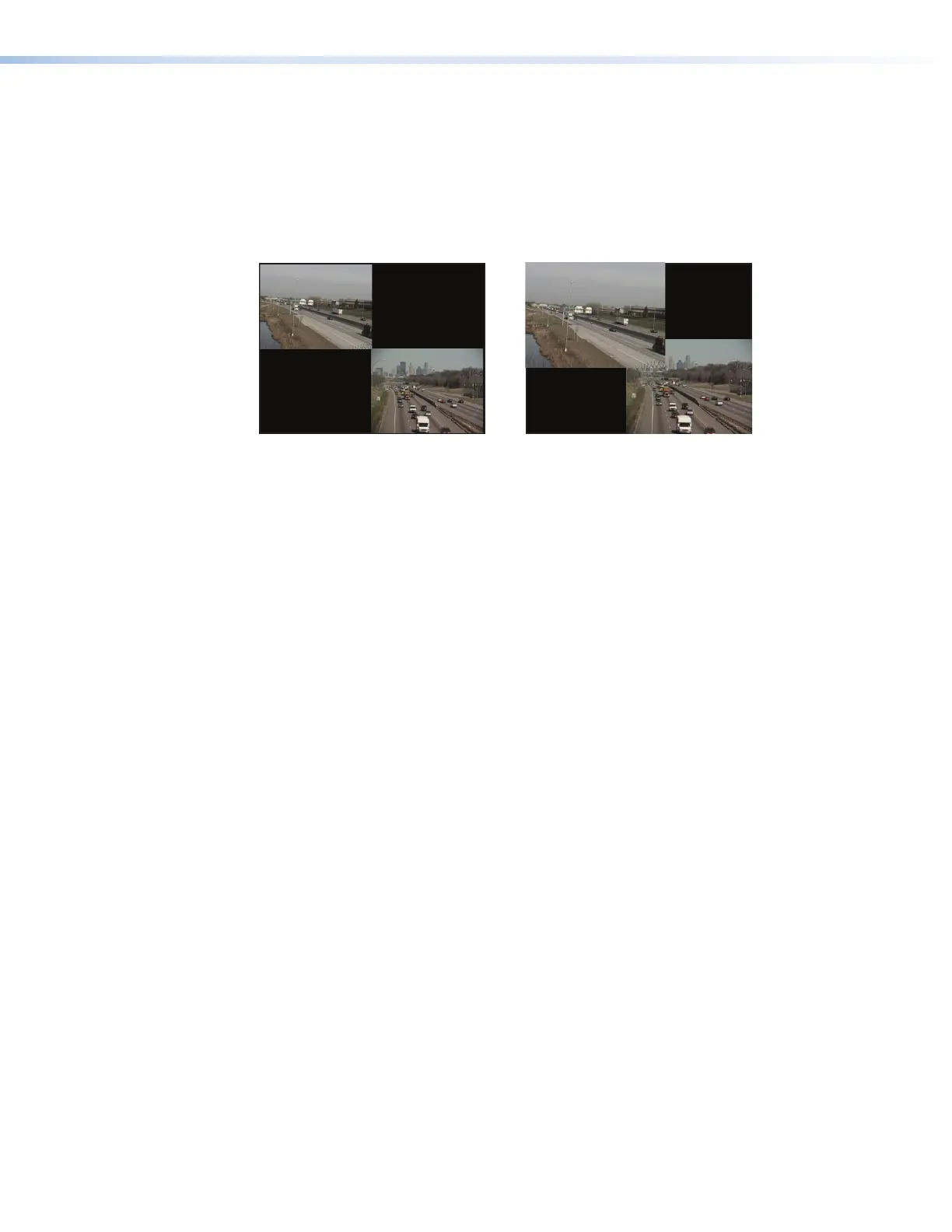
For example, the following display layouts both use two windows, but note the different
number of rectangles used to draw each layout:
2
3
1
Figure 1. Rectangulation Example
In the example above, you can see that the most efficient display layout (using the
fewest rectangles) is for the source windows to be displayed as an array, with no gaps or
overlaps.
The output card supports layouts that require a maximum of 128 rectangles in total,
shared between both output channels; for example, 64 on each channel or 128 on one
channel.
Therefore, up to 128 video, RGB, DVI, HDMI, and QGE 100 sources can be displayed on
a single screen if the rectangulation limit is not exceeded.
Scenario Examples
The following scenario examples illustrate various applications that might be required on a
site. For each scenario, the effect on the number of card slots, the RAPT bandwidth, and
the rectangulation limit is shown using three bar graphs.
Wherever possible, the layout examples show source windows at their normal aspect
ratio. Some windows are shown stretched horizontally or vertically to make optimum
use of the display space. RAPT bandwidth and rectangulation usage are based on the
window layout shown. Window layouts can be changed to suit specific applications, but
different layouts alter the given usage values.


 To Next Page