EPACO USER’S MANUAL
Page: 8 P/N E06-091 (Rev 0) Release Date: January, 2010
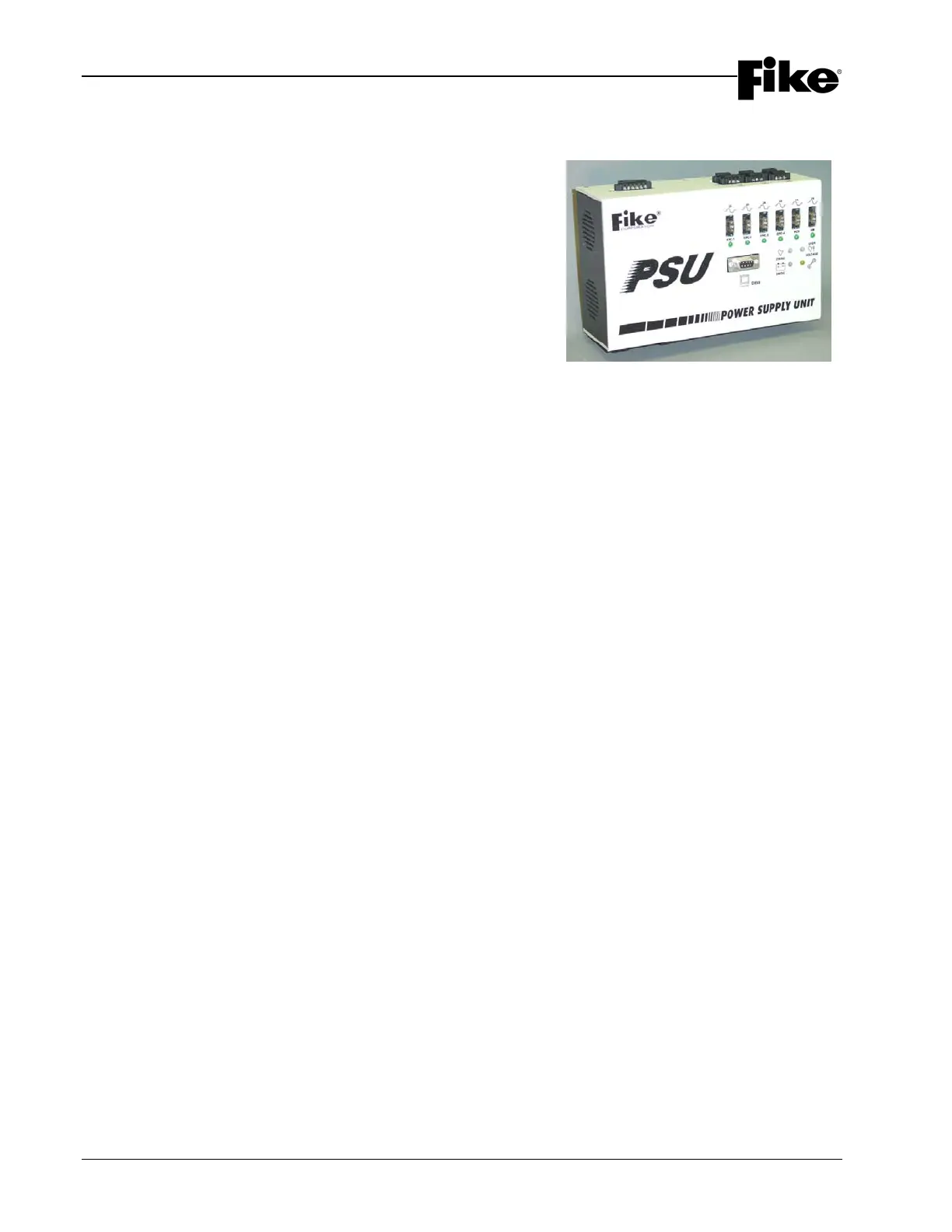
2.2 POWER SUPPLY UNIT
The Power Supply Unit (PSU) is the primary power source for
the EPACO system. The PSU can operate with AC power
using selected transformers with 100V, 120V, or 240V 50/60Hz
input (ordered separately).
The PSU has six (6) separate fused 24 VDC, 1 amp power
output circuits capable of powering up to four EPCs in addition to
an Annunciator Module (AM) and four (4) Relay Card Modules
(RC8). Each output is protected with a 2 Amp fuse and
supervised for high and low voltage. Power to the Annunciator
Module can not be shut off; all other power circuits can be shut
off for service on the various system components.
The PSU has the flexibility of containing its own battery backup
supply or the customer has the option of supplying a backup
power source. The PSU has an imbedded power shutdown
procedure in the event of AC power failure, which prevents the
backup batteries from being completely depleted. The PSU may
be eliminated if battery backed, uninterrupted 24VDC, 2 amps
power can be provided by others.
The PSU is equipped with an internal cooling fan that is supervised for normal operation.
2.2.1 OPERATION
Startup
Upon startup, the AC power is measured for a normal level. If the AC power is too high or too low, the PSU is
held until a normal level is reached. The AC LED is updated accordingly. Once normal AC power is verified,
the output voltage is measured. Output voltage must be within normal boundaries to enable the PSU to
continue.
The PSU then detects if batteries are connected with an appropriate voltage level for battery backup
operation. When the battery level is found normal or low, the battery charging circuit is enabled. In cases
where the back-up battery voltage exceeds 29.5 VDC, the charging circuit is switched off and the battery will
not be switched in line with the output power.
The five switch-able output circuits are measured (while in the OFF state) through a supervision circuit to
determine the load connected to the lines. In case the load is too high, the corresponding output is left
disabled. If the load is found to be appropriate, the output circuit is switched ON to power up the connected
devices. The output lines are routinely measured for high loads or excessive voltages. The normal output
voltage must be between 18VDC and 30VDC.
The complete startup sequence typically is completed within 10 seconds; otherwise a problem has occurred
and should be resolved prior restarting the PSU
Normal Operation
After the startup sequence, normal operation is entered. During this operation, the AC and DC power LED’s
are both Green; the output voltage and trouble LED’s are OFF. This operation can only be stopped in case of
total shutdown of the PSU or when a PC is connected and PC mode becomes active. In this mode of
operation, AC power, output voltage, charge power, output lines and battery are continuously measured.
Upon meeting these systems’ parameters, the LED’s are updated and history is created. When the
parameters are not met, the trouble relay de-energizes and the trouble LED is lit.



 To Next Page