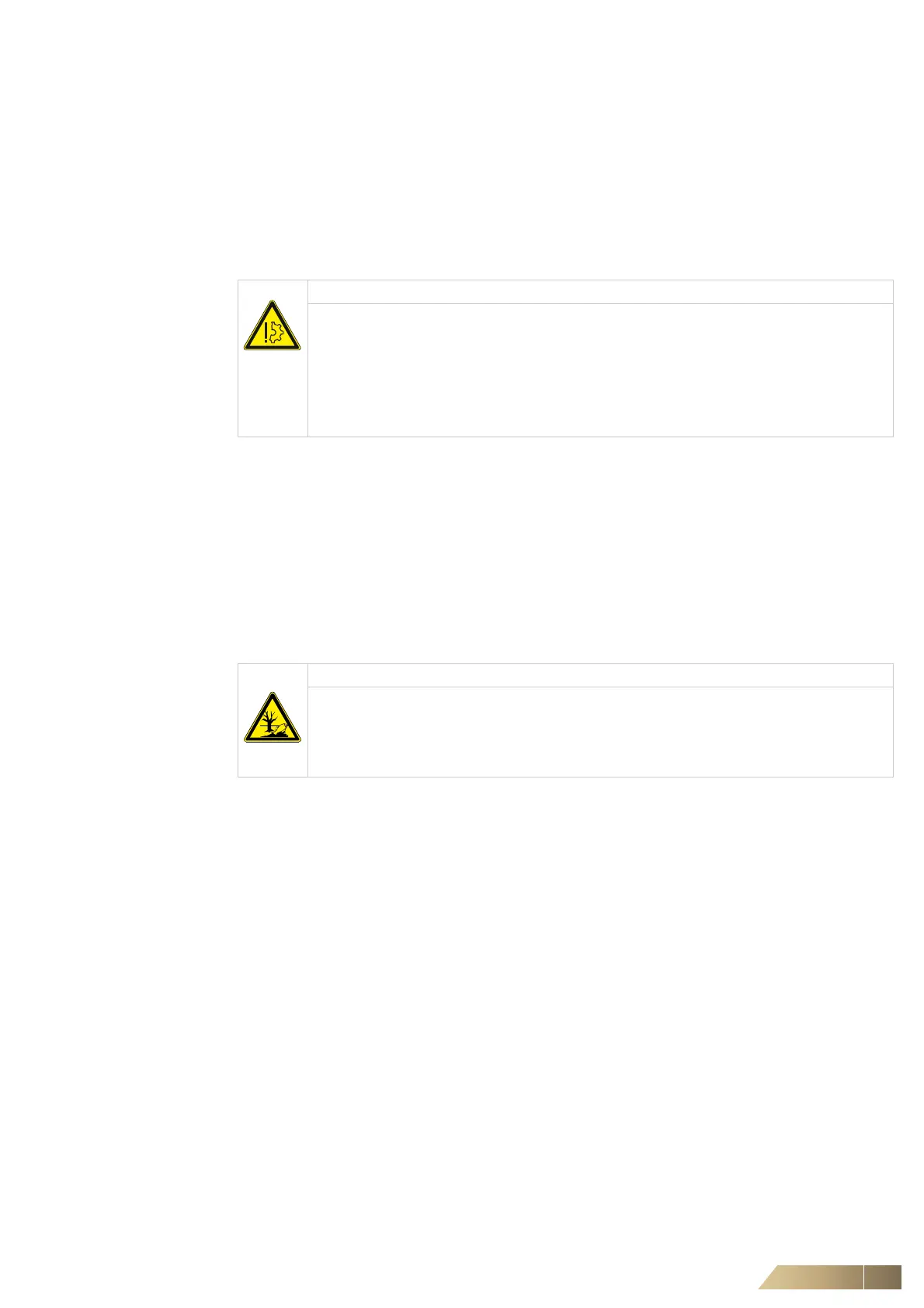
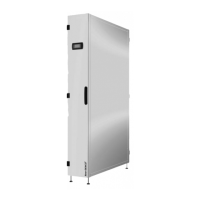
Multi-DENCO Commissioning
FläktGroup DC-2013-0101-GB • Subject to modifications • R5-08/2020 105
Procedure
With a stable system, additional refrigerant can be progressively added to the circuit to
bring the system to the required charge. When adding refrigerant, the following proce-
dure and advice applies:
• Refrigerant should be added to the suction line as liquid
• Ensure at all times the compressor is running during this procedure
• A metering valve on a set of manifold gauges should be used
• Any refrigerant should be added as lightly/slowly as possible
• To stop the charging, close the LP manifold valve
• Observe the state of the liquid in the Electronic Expansion Valve (EEV) sight
glass
• Wait several minutes for the system to settle before proceeding further
• Observe the system to see if the unit charge is suitable and effective
• Observe superheat, sub-cooling and discharge superheat against targets listed
earlier in this chapter
• If fitted/required, adjust the fan speed controller settings to modify the sub cooling
settings
• If overcharge, remove refrigerant from system
• If refrigerant circuit charge is to your satisfaction, re-perform the 'Calibration of
refrigeration devices' (chapter 8.3.2) to ensure proper operation of control devices.
• If good operation is observed, record the total charge of the system, check the oil
and perform the safety procedure as detailed in the next sections.
NOTICE
Large concentration of liquid refrigerant entering the compressor can cause
'hydraulic lock' and permanently damage the compressor.
• Add refrigerant in no more than 0.5 kg additions.
• Allow the system to stabilise after each addition.
– It may take several minutes for the system to stabilise.
– Adding refrigerant too quickly can cause an 'over-charged' condition.
NOTICE
Refrigerant is damaging to the environment.
• Never discharge refrigerant to the atmosphere.
• Recover any refrigerant and dispose of according to national/regional
requirements.


 To Next Page