Multi-DENCO Technical Description
FläktGroup DC-2013-0101-GB • Subject to modifications • R5-08/2020 27
3.4 Operating strategies
Multi-DENCO's inbuilt advance software combined with the latest EC variable technol-
ogy and networking capability, enables the unit to operate with intelligent control strat-
egies to increase performance or maximise energy savings. In most instances we
would recommend using a Running Redundancy strategy to help maximise the energy
savings possible.
Duty/standby operation Within a room there may be additional units installed as a backup to maintain cooling
performance in case there is an alarm or failure on a unit. A common description is an
'N+1' setup, where N describes the number of units required to cool a room. By using
the network capability of the unit, upon failure, a signal can be sent to start the standby
unit.
The network of units can be configured so that the unit designated as 'standby' is
changed over after a pre-set period to ensure even wear over their lifetimes.
Running redundancy Instead of the standby unit(s) remaining off, running redundancy allows all units to
operate at the same time, reducing their cooling requirements. This is can be referred
to as 'Hot/Cold Standby'.
Each unit will operate on 'part load', reducing the speed of the fans and other variable
components. The network would still have backup capability: if a unit developed a fault
the other units would use their spare capacity to meet the cooling requirements.
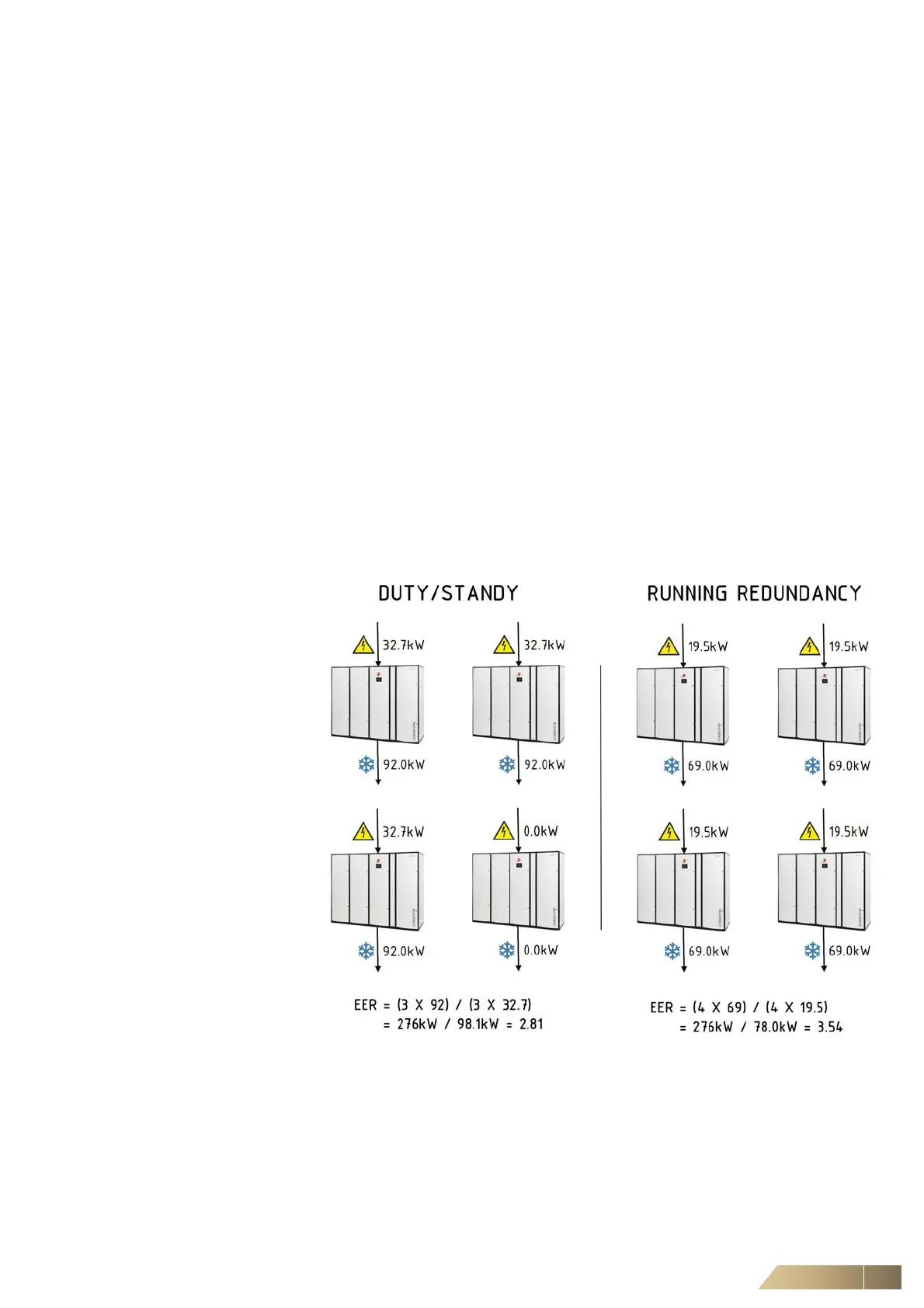
By operating in part load, there are significant energy savings when compared to a tra-
ditional 'Duty/Standby' operation. The diagram shows an example of savings available:
Fig. 3-2: Running Redundancy Example


 To Next Page