Flowserve Pump Division - 19
SECTION IV: Operation
The following procedures outline the most important steps involved in pump operation. Any procedure
modification due to particular installation peculiarities should conform to good engineering practices.
MOTOR COOLING
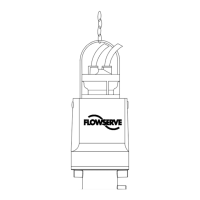
Flowserve Pump Division MSX Series 2 non-clog submersible pump is driven directly by a motor.
Flowserve Pump Division MSX Series 2 pumps have an internal cooling system, which makes them suitable
for use in either wet or dry pit applications.
MINIMUM SUBMERGENCE
The recommended minimum submergence for wet pit applications is to the top of the casing. This is to
prevent air entrapment through the hydraulic end of the pump, which will affect performance and could
damage the unit.
REDUCED CAPACITY OPERATION
In general, Flowserve Pump Division MSX Series 2 non-clog pumps are designed for continuous operation
within 65% to 130% of the best efficiency point at maximum RPM and impeller diameter. They are suitable
for occasional or intermittent operation at capacities outside these limits; however, pump operation may be
noisy and component life may be reduced.
These limitations are placed because the impellers have wide discharges and at other capacities, large
radial reactions are encountered and flow recirculation may occur. This is an inherent design characteristic
for pumps of this type.
In many cases, particularly in sewage pumping applications, reduced capacities are met by a reduction in
pump speed and no throttling is used. Under these circumstances, the low-capacity applications are not
nearly as critical because of lower pump speed and relatively lower pump operating heads.
For applications where pump operation at other capacities is anticipated contact the nearest Flowserve
Pump Division Sales Representative.
PRELIMINARY TO STARTING
Read this instruction manual thoroughly before starting the unit. Make sure the following items are checked
before starting:
1. Ensure that the motor is filled with cooling fluid and that the moisture detection sensor and
thermal disconnects are functioning properly; see Section III: Moisture Detection Sensor,
Section III: Motor Thermal Protection, and Section III: Cooling System Filling.
2. Check that all plugs (three in the bearing housing and two in the cooling jacket) are secure
and that no fluid is leaking from the unit.
3. Check the direction of rotation of the driver. The arrow on the pump casing will show the
correct rotation; see Section III: Checking Rotation.
STARTING
The procedure for starting the unit will vary somewhat with each installation; however, the following steps
generally apply:
1. Verify that the pump rotor turns freely. If it is bound, do not operate the pump until the
cause of the trouble is located.
2. If the pump is in a wet pit application, make sure the pump is submerged.
3. Start the driver.
4. If the discharge valve is closed, open the valve slowly as pressure is built up on the
discharge side of the pump.
5. Monitor noise and power consumption for several hours. When starting a unit and after
the starting current has faded, the ammeter may, for a short time, indicate a higher
current than given on the motor data sheet.



 To Next Page