Flowserve Pump Division - 8
SECTION II: Pre-Installation Instructions
Inspect the equipment and check it against the shipping manifest immediately upon receipt. EXAMINE
THE CRATE AND WRAPPING BEFORE DISCARDING. Parts or accessories are sometimes wrapped
individually or fastened to the crate. Report any damage or shortage to the transportation company's
local agent.
HANDLING
To prevent damage to the pumping unit, it is absolutely necessary that the unit be handled carefully.
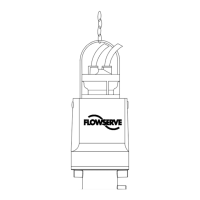
Lifting of the pumping unit must only be accomplished by using the lifting bail bolted to the motor. Check
the torque (refer to chart on page 25) on the lifting bail bolts prior to lifting the unit. Lifting must be done
slowly and continuously, avoiding jerks. When using cranes or lifting devices, take care to avoid
bumping, walls, floors, etc.
During handling of the motor, the bending radii of the motor power supply and signal cable leading out of
the motor cable junction box MUST NOT FALL BELOW 4 TIMES THE CABLE DIAMETER.
CAUTION: DO NOT LIFT THE MOTOR OR PUMPING UNIT BY THE POWER SUPPLY CABLES.
STORAGE
General
Submersible pump units need special preparations for storage. The power cable must be protected from
direct exposure to sunlight and the open ends must be sealed against moisture.
The lower mechanical seal may leak a small amount of the cooling fluid onto the top shroud of the
impeller during long periods of storage. This can be expected until the pump has been operated, giving
the seals an opportunity to wear in. Excessive leaking (more than a few drops) should be reported to
your local Flowserve Pump Division Service Center, as it may indicate a problem with the mechanical
seals. If there is excessive leaking, the situation should be resolved prior to installing your pump.
Short Term (Less Than 6 Months)
When it is necessary to store a pump for a short time before it can be installed, place it in a dry location
and protect it from moisture. When protective flanges are bolted to suction and discharge flanges at the
factory, they should not be removed until the unit is ready for installation. Rotate the shaft a minimum of
5 revolutions every two weeks to keep the bearings coated and to minimize the effects of brinelling.
Long Term (More Than 6 Months)
More thorough precautions are required if the pump is scheduled to be stored for an extended period of
time. The following is the procedure:
1. The storage area should be a clean, dry location not subject to rapid changes in
temperature, light (no direct light) or humidity, and relatively free of ground transmitted
vibration due to heavy construction and/or machinery. A temperature range of 40° to
120° F (5° to 50° C) with non-condensing humidity is recommended.
2. Drain water from the pump casing, rotate the pump rotor once in the proper direction and
blow the liquid end dry with air.
3. Coat the interior surfaces of the liquid end with rust inhibitor by brushing, spraying or
fogging. Rotate the pump shaft one turn in the proper direction while coating.
4. Coat all threaded openings with rust inhibitor and plug. Coat machined surfaces of
exposed flanges with rust inhibitor and then cover with fiberboard or wood flange covers.
Desiccant bags should be secured to the covers prior to putting them in place and must
not contact metal surfaces.
5. Coat exposed, unpainted, machined surfaces with a rust inhibitor.
6. Cover the entire pump with a clear plastic sheet for protection from dust, dirt, moisture,
etc. and to allow for visual inspection. The cover should be open near the top to allow for
ventilation.



 To Next Page