Theory of Operation
732B Circuit Description
4
4-9
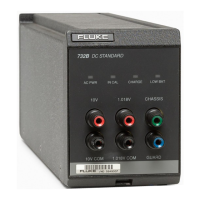
The LED Circuitry includes the LEDs and the drive circuitry for the following front
panel indicators:
• AC PWR: When lit, this indicates that ac line power is applied to the 732B.
• CHARGE: When lit, this indicates that the battery charger is in the constant current
mode (high level charging) as opposed to the float charge mode.
• IN CAL: Normally lit. This indicator tells the user that the standard oven
temperature is within the limits of 35°C to 55°C and that operating power has not
been interrupted.
• LOW BAT: Normally off. It blinks at a 1 Hz rate when the battery voltage drops
below +11.4V, indicating that the user should immediately plug the standard into ac
line power to begin recharging the battery.
The overvoltage protection circuitry consists of power diode CR104 and "Transzorb"
transient suppressor device VR101. These components are connected between the 10V
and 10V COM terminals and protect the 732B internal circuitry from external
application of voltages higher than 12V. Another layer of protection is provided by a
spark gap from the 10V COM binding post to chassis ground.
The LED circuitry is composed of CR100 through CR103, R100 through R103, U100,
Q100, C100 through C101, and R104 through R106. CR100 through CR103 are the front
panel LEDs. R100 through R103 serve to limit the current through the LEDs. U100,
C100 through C101, and R104 are a 1-Hz oscillator for blinking CR103 (LOW BAT).
Resistors R105 through R106 and Transistor Q100 are used as an inverting switch to
start and stop the oscillator.
Power Supplies and Battery Charger Assembly A5 4-13.
Refer to Figure 4-3 and the A5 schematic diagram in Section 7 for the following
discussion. The Power Supply Module (A5) contains several functional circuit groups as
listed below:
1. Overvoltage Protection Circuitry
2. Raw DC Power Supply
3. Battery Charger
4. +11.5V Preregulator
5. +11.5V Low-Dropout Regulator
6. -6V Power Supply
7. IN-CAL Logic
8. LED Drive Circuitry
9. AC to Battery Switching Circuit
10. Battery Circuit
11. Rear Panel Connections
Overvoltage Protection Circuitry 4-14.
The 732B has overvoltage protection circuitry in the event that the user has the ac
voltage select switch set for 100V ac or 120V ac and connects the ac input lines to 180V
ac or greater. In this case, there is circuitry to short the secondary of the transformer and
blow the main fuse in the Line Filter assembly, FL1.
The transformer secondary voltage is first rectified by diodes CR513 through CR516,
and the rectified ac is applied to both CR500 and the series divider composed of VR501,
R500 and R501. If the voltage applied is greater than 43V, then VR501 conducts and the
resulting current causes a voltage across R501 which then gates CR500 to the conducting
state. This shorts out the secondary and blows the primary fuse in the ac filter assembly
FL1. R500, R501, and C500 act as a noise filter to prevent inadvertent gating of CR500.
R500 also acts as a current limiter for VR501.
www.valuetronics.com


 To Next Page