MPS450
Operators Manual
2-14
3. Scroll to the LCD screen SUPRAVENT TACH.
4. Select RUN. The supraventricular-tachycardia simulation runs continuously (repeats)
until another arrhythmia selection is made.
Alternatively, in the Numeric-Control Mode, press the number keys 019, and select
RUN.
Premature Atrial Contraction (PAC)
A beat that is 25 % premature but otherwise normal.
Any part of the heart can depolarize earlier than it should; the accompanying heartbeat is
called extrasystole. This type of depolarization is called a premature contraction; a
premature contraction that originates in the SA node is referred to as a PAC. An isolated
PAC is relatively unimportant. However, frequent PACs are a concern, because they
could be the precursor of more serious and potentially life-threatening conditions,
including atrial flutter, atrial fibrillation, and atrial tachycardia.
The MPS450 simulates a PAC as a one-time event within an otherwise-normal rhythm at
80 BPM.
Action in the Menu-Control Mode
1. Press the top-menu key labeled ARRHY.
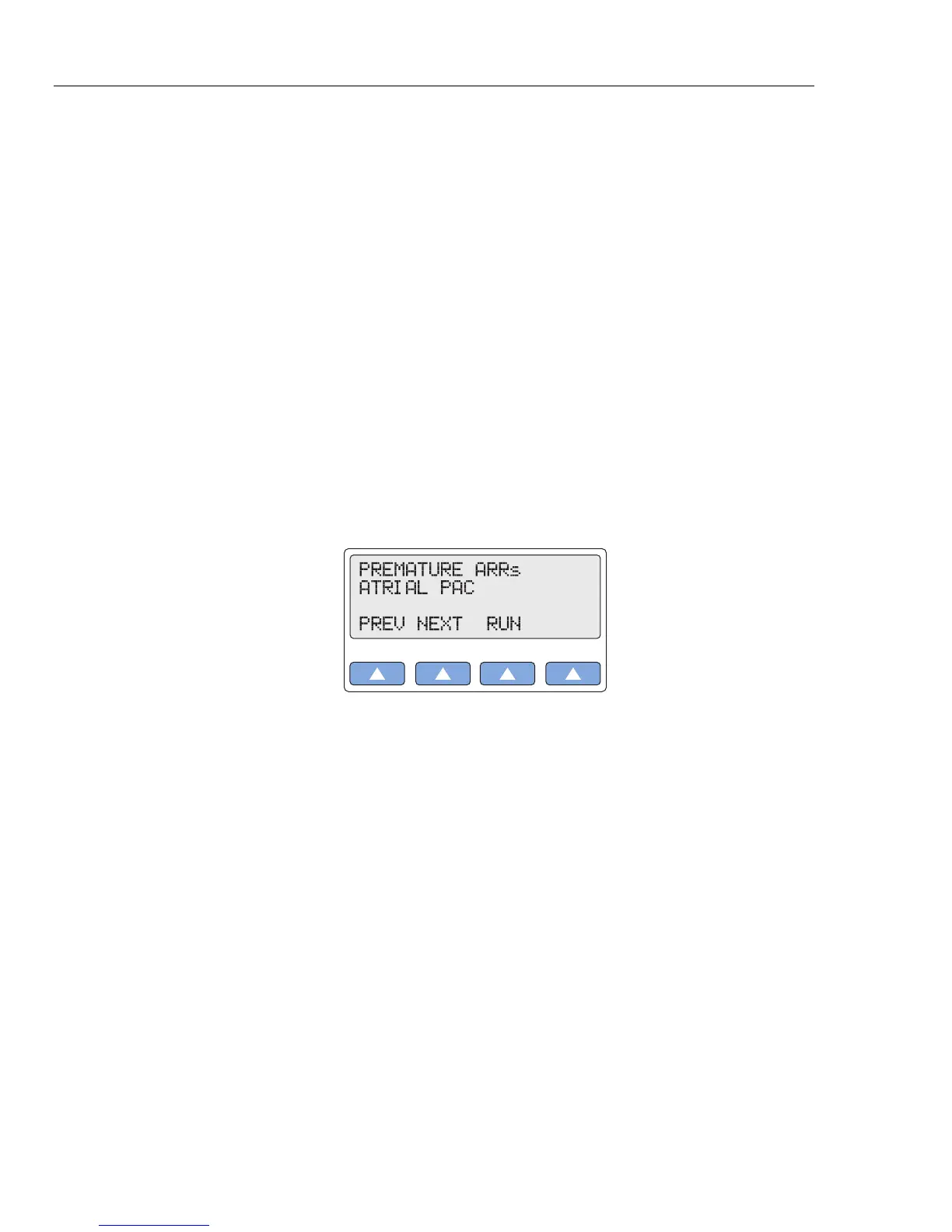
2. Select PREM to display the following LCD screen:
gje017.eps
3. Select RUN. On the LCD screen, RUN flashes to indicate that the PAC simulation is
running as a one-time event. When the simulation completes, the command INSRT
displays on the screen.
4. To send another PAC simulation, select INSRT.
Alternatively, in the Numeric-Control Mode, press the number keys 035, and select
RUN. (To repeat a PAC, select RUN again.)
Premature Nodal Contraction (PNC)
A nodal beat that is 25 % premature, followed by a nodal rhythm at 80 BPM.
A premature nodal contraction—also called a premature junctional contraction, a PNC, or
a PJC—is an extra beat that occurs as a result of an electrical impulse sent from the
atrioventricular (junctional) node. The P-R interval is shorter than normal. PNCs, which
may occur in isolation or in groups, can appear sporadically for no obvious reason in an
otherwise-healthy person.
The MPS450 simulates a PNC as a one-time event, followed by a normal sinus rhythm at
80 BPM.
Action in the Menu-Control Mode
1. Press the top-menu key labeled ARRHY.
2. Select PREM.



 To Next Page