EasyManua.ls Logo

Frick RWB II - User Manual

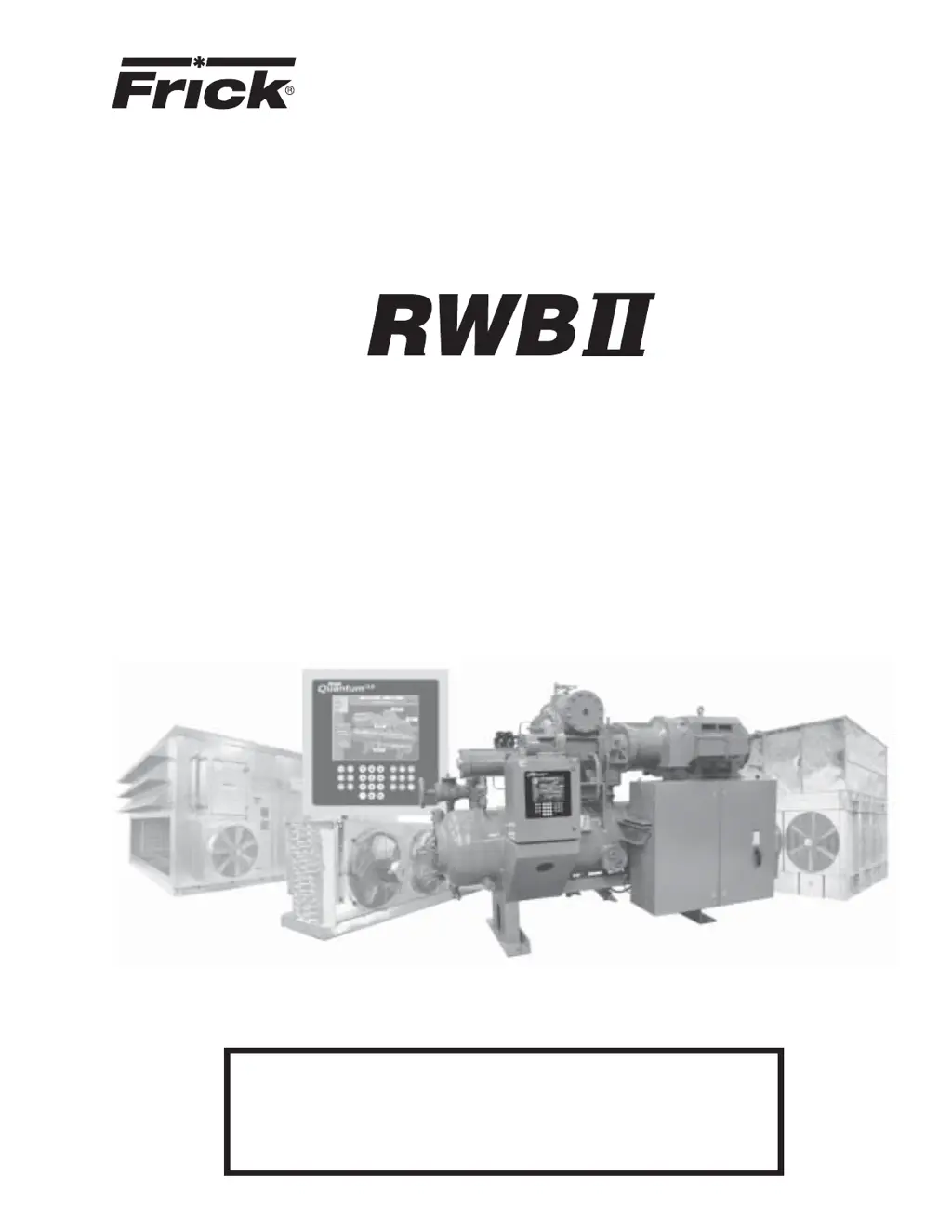
Frick RWB II
56 pages
Print Icon
To Next Page IconTo Next Page
Loading...
Installation - Operation - Maintenance
ROTARY SCREW COMPRESSOR UNITS
ALL REFRIGERANTS
MODELS
60 through 480
THIS MANUAL CONTAINS RIGGING, ASSEMBLY, START-UP, AND
MAINTENANCE INSTRUCTIONS. READ THOROUGHLY BE FORE BE-
GINNING INSTALLATION. FAILURE TO FOLLOW THESE IN STRUC -
TIONS COULD RESULT IN DAMAGE OR IM PROP ER OP ER A TION
OF THE UNIT.
S70-200 IOM/OCT 2004
File: SERVICE MANUAL - Section 70
Replaces: S70-200 IOM/AUG 2001
Dist: 3, 3a, 3b, 3c

Table of Contents

Other manuals for Frick RWB II

Questions and Answers

  • M
    Mary NguyenAug 16, 2025
    What to do if my Frick Air Compressor pump does not pump?
    • C
      Christina SantanaAug 16, 2025
      If your Frick Air Compressor pump isn't pumping, there could be several reasons. You might have lost its prime due to an air leak or a low level in the tank. Ensure the pump is rotating in the correct direction and that the motor is running at the appropriate speed. Also, check that both suction and discharge valves are open and the strainer isn't clogged. A relief valve set too low or stuck open could also be the culprit. In some cases, the pump itself might be worn out. It's also wise to consider if there have been any recent changes to the liquid system or its operation. Finally, check and adjust the end clearance and ensure the head position is correct.
  • L
    lpowellAug 19, 2025
    Why does my Frick Air Compressor pump start then lose prime?
    • R
      Ronald White DVMAug 19, 2025
      If your Frick Air Compressor pump starts but then loses its prime, it could be due to a low liquid level in the tank. Another cause might be liquid vaporizing in the suction line. Also, check for air leaks or air pockets in the suction line, including leaks through packing or the mechanical seal. Finally, worn components could be the cause, so consider replacing them.
  • C
    catherineacostaAug 22, 2025
    Why is the vacuum gauge reading high on my Frick Air Compressor?
    • K
      Kathleen ReedAug 22, 2025
      A high reading on the vacuum gauge in the suction port of your Frick Air Compressor may be due to a blocked suction line. Check for a stuck foot valve, closed gate valve, or plugged strainer. The liquid might be too viscous to flow properly, or the lift might be too high. Also, the suction line might be too small, restricting flow.
  • C
    Christine MuellerAug 26, 2025
    What causes a low pressure reading on the discharge port of my Frick Air Compressor?
    • J
      Jennifer StephensAug 26, 2025
      A low reading on the pressure gauge in the discharge port of your Frick Air Compressor can occur if the relief valve is set too low, or if the relief valve poppet isn't seating properly. It could also indicate too much extra clearance or a worn pump. Inspect and adjust the relief valve setting, inspect and fix the relief valve poppet, inspect for extra clearance and make adjustments, and check and replace worn pump components to resolve these issues.
  • J
    Joan LawsonAug 28, 2025
    Why is my Frick Air Compressor pump so noisy?
    • G
      Gregory PierceAug 28, 2025
      A Frick Air Compressor pump might be noisy for several reasons. It could be starved, meaning heavy liquid can't reach the pump quickly enough. The pump might also be cavitating, which happens when liquid vaporizes in the suction line. Check the alignment of the pump components. A bent shaft or rotor tooth could also cause noise. Lastly, a foreign object might be trying to enter the pump through the suction port.
  • J
    johnsonrichardAug 31, 2025
    What causes a high pressure reading on the discharge port of my Frick Air Compressor?
    • A
      andrew75Aug 31, 2025
      A high reading on the pressure gauge in the discharge port of your Frick Air Compressor may be due to high viscosity, a small or long discharge line, or a partially closed gate valve. A plugged filter, a vertical head not considering a high specific gravity liquid, or a line partially plugged from buildup inside the pipe could also be the cause. The liquid in the pipe might not be up to temperature, or it might have undergone a chemical reaction and solidified. Finally, the relief valve might be set too high.
  • G
    Gloria FlowersSep 3, 2025
    Why is my Frick Air Compressor pump not up to capacity?
    • X
      xjenningsSep 3, 2025
      If your Frick Air Compressor pump isn't reaching its full capacity, several factors could be at play. It might be starving or cavitating due to issues in the suction line. The strainer could be partially clogged, restricting flow. An air leak in the suction piping or along the pump shaft could also reduce capacity. Ensure the motor is running at the correct speed and is wired correctly. The relief valve might be set too low or stuck open. In some cases, the pump might be worn out. Finally, check and adjust the end clearance and ensure the head position is correct.
  • B
    Brandon LittleSep 6, 2025
    Why is the vacuum gauge reading erratically on my Frick Air Compressor?
    • J
      Joshua AndersonSep 6, 2025
      If the vacuum gauge in the suction port of your Frick Air Compressor is fluttering, jumping, or reading erratically, it could be due to liquid vaporizing. The liquid might also be coming to the pump in slugs, potentially caused by an air leak or insufficient liquid above the suction pipe's end. Vibrations from cavitation, misalignment, or damaged parts could also lead to erratic readings.
  • A
    andrew11Sep 9, 2025
    Why is the vacuum gauge reading low on my Frick Air Compressor?
    • E
      erica77Sep 9, 2025
      A low reading on the vacuum gauge in the suction port of your Frick Air Compressor could be caused by an air leak in the suction line. It's also possible that the end of the pipe isn't submerged in the liquid. A worn pump or a pump that needs priming could also lead to this issue.
  • A
    angelicaholdenSep 12, 2025
    Why does my Frick Air Compressor pump take too much power?
    • X
      xmeyersSep 12, 2025
      If your Frick Air Compressor pump is consuming too much power, it could be running too fast. Verify the motor speed and specifications to ensure they are correct. The liquid might be more viscous than the unit is designed to handle. The discharge pressure might be higher than calculated, so inspect the discharge pressure and piping. Misalignment of the pump can also increase power consumption. Finally, the extra clearance on the pumping elements might not be sufficient for the operating conditions.

Summary

GENERAL INFORMATION

COMPRESSOR and UNIT IDENTIFICATION

Identifies compressor and unit models, serial numbers, and Frick sales order numbers.

FOUNDATION

RIGGING and HANDLING

Guidelines for safely moving and handling the compressor package.

COMPRESSOR;MOTOR COUPLINGS INSTALLATION

COUPLING ALIGNMENT PROCEDURE

ANGULAR ALIGNMENT

Procedure for checking and correcting angular shaft misalignment using dial indicators.

PARALLEL ALIGNMENT

Procedure for checking and correcting parallel shaft misalignment using dial indicators.

HOT ALIGNMENT OF COMPRESSOR;MOTOR

COMPRESSOR UNIT OIL

OIL CHARGE

Information on the correct type and quantity of oil for charging the compressor unit.

THERMOSYPHON OIL COOLING

LIQUID INJECTION OIL COOLING (OPTIONAL)

ECONOMIZER - HIGH STAGE (OPTIONAL)

ECONOMIZER LOAD BALANCING

ELECTRICAL

VOLTAGE SOURCE

Importance of selecting a clean, isolated voltage source for electronic controls.

OPERATION and START-UP INSTRUCTIONS

TDSH COMPRESSOR

Overview of the TDSH compressor features and design.

COMPRESSOR ROTATION

Warning regarding correct compressor rotation direction to prevent bearing damage.

COMPRESSOR LUBRICATION SYSTEM

Functions of the compressor lubrication system, including bearing lubrication and cooling.

COLD-START SYSTEM

Explanation of the cold-start discharge check valve for initial lubrication.

DEMAND PUMP OIL SYSTEM

COMPRESSOR OIL SEPARATION SYSTEM

COMPRESSOR HYDRAULIC SYSTEM

Compressor Loading

Mechanism by which the compressor loads via the hydraulic system.

VOLUMIZER VOLUME RATIO CONTROL

Control of the compressor's volume ratio (Vi) via the hydraulic system.

COMPRESSOR OIL COOLING SYSTEMS

LIQUID INJECTION ADJUSTMENT PROCEDURE

QUANTUMTM EZ-COOLTMTM LIQUID INJECTION ADJUSTMENT PROCEDURE

LOW AMBIENT OPERATION

INITIAL START-UP

INITIAL START-UP PROCEDURE

NORMAL START-UP PROCEDURE

GENERAL MAINTENANCE

COMPRESSOR SHUTDOWN and START-UP

GENERAL INSTRUCTIONS FOR REPLACING COMPRESSOR UNIT COMPONENTS.

OIL FILTER (OF-1) MAIN SINGLE;DUAL

COALESCER FILTER ELEMENT(S)

CHANGING OIL

DEMAND PUMP DISASSEMBLY

TROUBLESHOOTING THE DEMAND PUMP

PREVENTATIVE MAINTENANCE

RECOMMENDED MAINTENANCE PROGRAM

VIBRATION ANALYSIS

OIL QUALITY and ANALYSIS

LUBRICATION SCHEDULE; INSTRUCTIONS

MAINTENANCE SCHEDULE

TROUBLESHOOTING GUIDE

ABNORMAL OPERATION ANALYSIS and CORRECTION

PRESSURE TRANSDUCERS - TESTING

PRESSURE TRANSDUCERS - REPLACEMENT

SV POSITION POTENTIOMETER REPLACEMENT AND ADJUSTMENT

VOLUMIZER POTENTIOMETER REPLACEMENT AND ADJUSTMENT

OIL LEVEL TRANSMITTER REPLACEMENT

TROUBLESHOOTING THE RWB II COMPRESSOR

TROUBLESHOOTING THE OIL SEPARATION SYSTEM

Diagnosing and correcting issues related to the oil separation system.

TROUBLESHOOTING THE HYDRAULIC SYSTEM

Diagnosing and correcting issues with the compressor's hydraulic system.

TROUBLESHOOTING THE LIQUID INJECTION OIL COOLING SYSTEM

Diagnosing and correcting issues with the liquid injection oil cooling system.

TROUBLESHOOTING THE DEMAND PUMP SYSTEM

Diagnosing and correcting issues related to the demand pump system.

THERMAL EXPANSION VALVES

JORDAN TEMPERATURE REGULATOR VALVE

SHUTDOWN DUE TO IMPROPER OIL PRESSURE (HIGH STAGE and BOOSTER)

PROPER INSTALLATION OF ELECTRONIC EQUIPMENT IN AN INDUSTRIAL ENVIRONMENT

VOLTAGE SOURCE

Importance of selecting a clean, isolated voltage source for electronic controls.

GROUNDING

WIRING PRACTICES

COMPRESSOR PRESTART CHECKLIST

START-UP REPORT

Adjustable Safety Setpoints

Drive Train Alignment

RECOMMENDED SPARE PARTS - CURRENT DESIGN

Frick RWB II Specifications

General IconGeneral
BrandFrick
ModelRWB II
CategoryAir Compressor
LanguageEnglish

Related product manuals