15
Installation Requirements
: The normal sequence of events to complete the installation of an
AIM2™ fueling system entails software installation, FMU installation, then AIM2™ module installation
and programming. AIM2™ programming is required, but cannot be performed until the software is
installed and databases are developed, the FMU is installed, and the AIM2™ modules are installed in
the vehicles.
Although not absolutely required, Syn-Tech Systems recommends installation of the FMU-3500 and
Central Controller initially for use with a direct access device such as a Prokee
®
, Smartcard, credit
card, or Keyless entry. This permits the development of the required databases, and installation of
the AIM2™ modules in preparation for passive fueling. As the AIM2™ modules are installed, the
other interfaces will already be in place to bring passive fueling online.
Components of a Passive Fueling System
FMU-3500 and FMU Upgrades. The FMU-3500 is an FMU-2500 equipped for passive
fueling. FMUs of other configurations may be upgraded to FMU-3500 to gain passive fueling
capabilities. The FMU-3500 will have a backup function for user access with a Prokee
®
,
Smartcard, magstripe card, or through Keyless transaction entry. Features which make an FMU-
3500 compatible with passive fueling are:
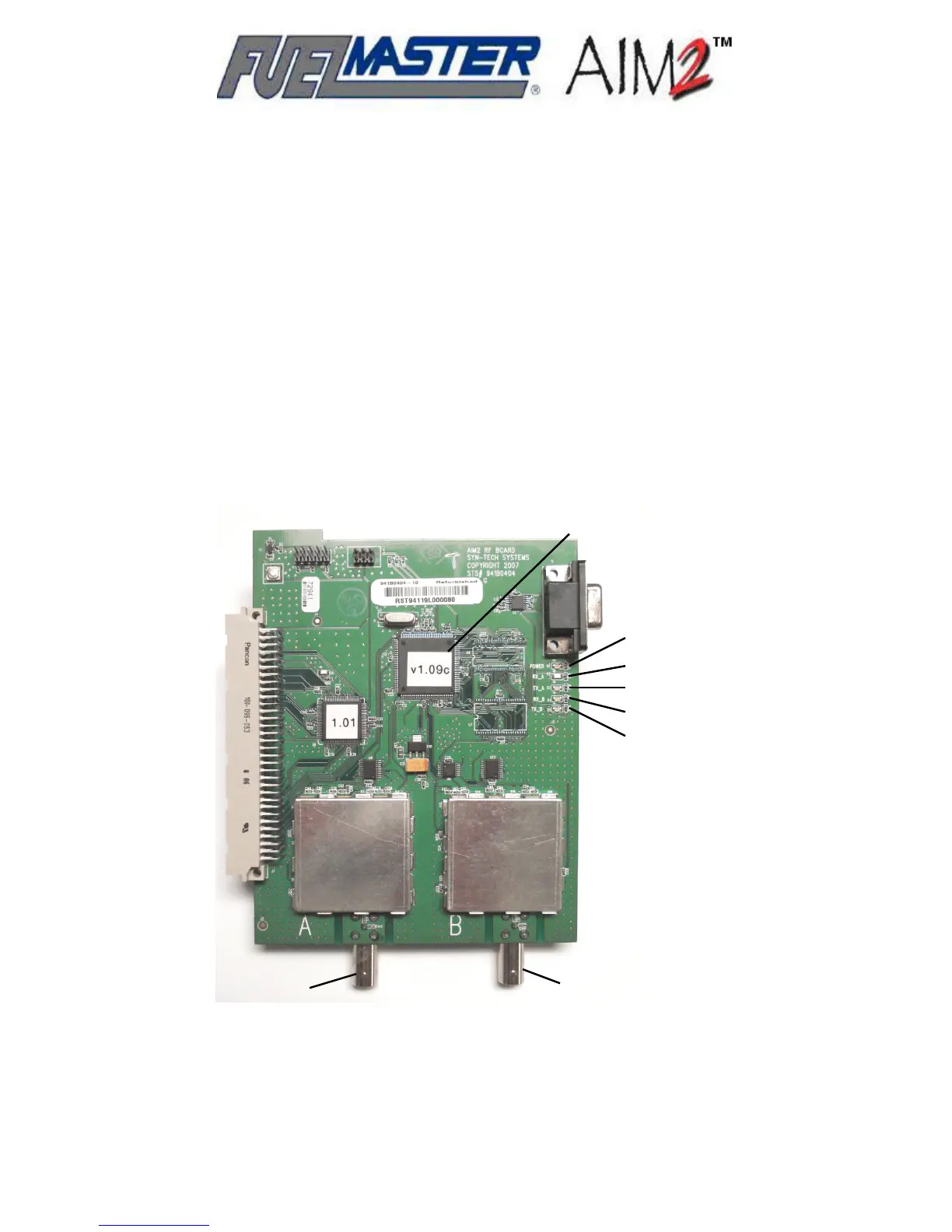
Power LED
Channel A Receive LED
Channel A Transmit LED
Firmware Version
Channel B Receive LED
Channel B Transmit LED
Channel A
Channel B
Figure 2-1. FMU Radio Board (FRB)
• An FMU Radio Board (FRB) which functions as a transceiver to receive inputs from, and send
programming information to AIM2™ equipped vehicles and equipment. The FRB includes A



 To Next Page