33
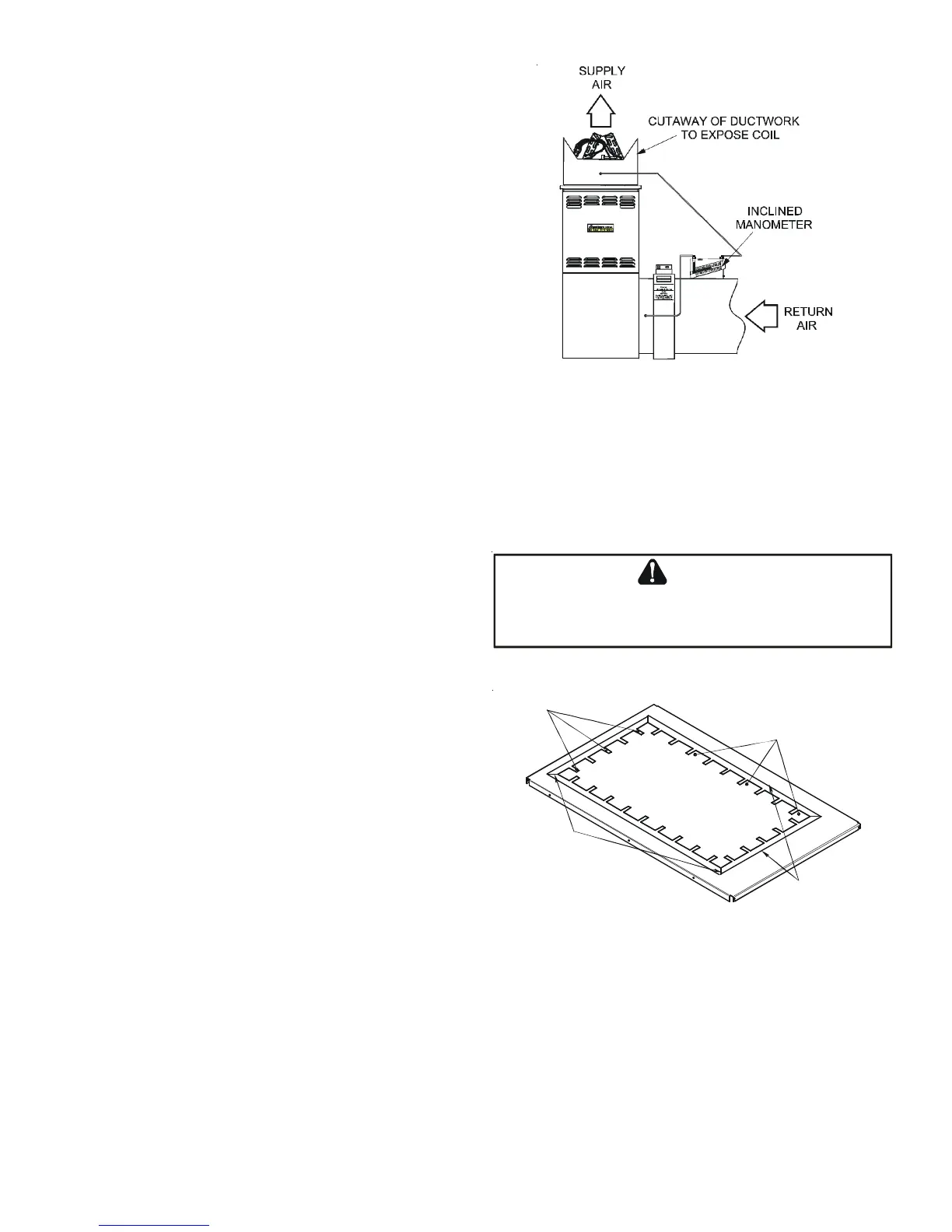
NOTE: Both readings may be taken simultaneously and read directly
on the manometer if so desired. If an air conditioner coil or Elec-
tronic Air Cleaner is used in conjunction with the furnace, the read-
ings must also include theses components, as shown in the following
drawing.
4. Consult proper tables for the quantity of air.
If the total external static pressure exceeds the maximum listed on
the furnace rating plate, check for closed dampers, registers, under-
sized and/or oversized poorly laid out duct work.
The temperature rise of the furnace must be within the temperature
rise range listed on the furnace rating plate.
BOTTOM RETURN AIR OPENING [UPFLOW MODELS]
The bottom return air opening on upflow models utilizes a “lance and cut”
method to remove sheet metal from the duct opening in the base pan. To
remove, simply press out the lanced sections by hand to expose the metal
strips retaining the sheet metal over the duct opening. Using tin snips,
cut the metal strips and remove the sheet metal covering the duct open-
ing. In the corners of the opening, cut the sheet metal along the scribe
lines to free the duct flanges. Using the scribe line along the duct flange as a guide, unfold the duct flanges around the perimeter of
the opening using a pair of seamer pliers or seamer tongs. NOTE: Airflow area will be reduced by approximately 18% if duct flanges
are not unfolded. This could cause performance issues and noise issues.
When the furnace is used in connection with a cooling unit, the
furnace should be installed in parallel with or on the upstream side
of the cooling unit to avoid condensation in the heating element.
With a parallel flow arrangement, the dampers or other means
used to control the flow of air must be adequate to prevent chilled
air from entering the furnace and, if manually operated, must be
equipped with means to prevent operation of either unit unless
the damper is in the full heat or cool position.
When the furnace is installed without a cooling coil, it is recom-
mended that a removable access panel be provided in the outlet
air duct. This opening shall be accessible when the furnace is
installed and shall be of such a size that the heat exchanger can be
viewed for visual light inspection or such that a sampling probe
can be inserted into the airstream. The access panel must be
made to prevent air leaks when the furnace is in operation.
When the furnace is heating, the temperature of the return air
entering the furnace must be between 55°F and 100°F.
FILTERS - READ THIS SECTION BEFORE INSTALLING THE RETURN
AIR DUCT WORK
Filters must be used with this furnace. Discuss filter maintenance
with the building owner. Filters do not ship with this furnace, but must be provided, sized and installed externally by the installer.
Filters must comply with UL900 or CAN/ULCS111 standards. If the furnace is installed without filters, the warranty will be voided.
On upflow units, guide dimples locate the side return cutout locations. Use a straight edge to scribe lines connecting the dimples. Cut
out the opening on these lines. NOTE: An undersized opening will cause reduced airflow.
Refer to the following table to determine filter area requirements.
Checking Static Pressure
(80% Furnace Shown, 90% Similar)
Figure 41
E
DGES
OF
SHEET
METAL
HOLES
MAY
BE
SHARP
. U
SE
GLOVES
AS
A
PRECAUTION
WHEN
REMOVING
SHEET
METAL
FROM
RETURN
AIR
OPENINGS
.
WARNING
CUT FOUR CORNERS
AFTER REMOVING SHEET
METAL
CUT USING TIN SNIPS
PRESS OUT BY HAND
SCRIBE LINES OUTLINING
DUCT FLANGES
Duct Flange Cut Outs
Figure 42






 To Next Page