46
THERMOSTAT MENU
If this furnace is installed with a communicating compatible heat pump, the system is recognized as a dual fuel system. The
balance point temperature should be set via the thermostat.
DIAGNOSTICS
Accessing the furnace’s diagnostics menu provides ready access to the last six faults detected by the furnace. Faults are stored
most recent to least recent. Any consecutively repeated fault is stored a maximum of three times. Example: A clogged return air
filter causes the furnace limit to trip repeatedly. The control will only store this fault the first three consecutive times the fault
occurs. Navigate to the diagnostics menu as described above in the thermostat installation manual.
NOTE: It is highly recommended that the fault history be cleared when performing maintenance or servicing the furnace.
NETWORK TROUBLESHOOTING
Communications is achieved by taking the difference between two dc signals. The signals and transmission lines are referred to
as “data 1” and “data 2”. Each transmission line is biased to approximately 2.5Vdc. During data reception/transmission, the
data lines vary between +5V and ground. (When data 1 is increasing towards +5V, data 2 is decreasing towards ground and when
data 1 is decreasing towards ground, data 2 is increasing towards +5V. Typically, the data 1 line is approximately 2.6Vdc and the
data 2 transmission line is approximately 2.3Vdc. The voltage difference between data 1 and data 2 is typically 0.2 to 0.6 Vdc.
The ComfortNet™ system is a fully communicating system, and thus, constitutes a network. Occasionally the need to troubleshoot
the network may arise. The integrated furnace control has some on-board tools that may be used to troubleshoot the network.
These tools are: red communications LED, green receive (Rx) LED, and learn button.
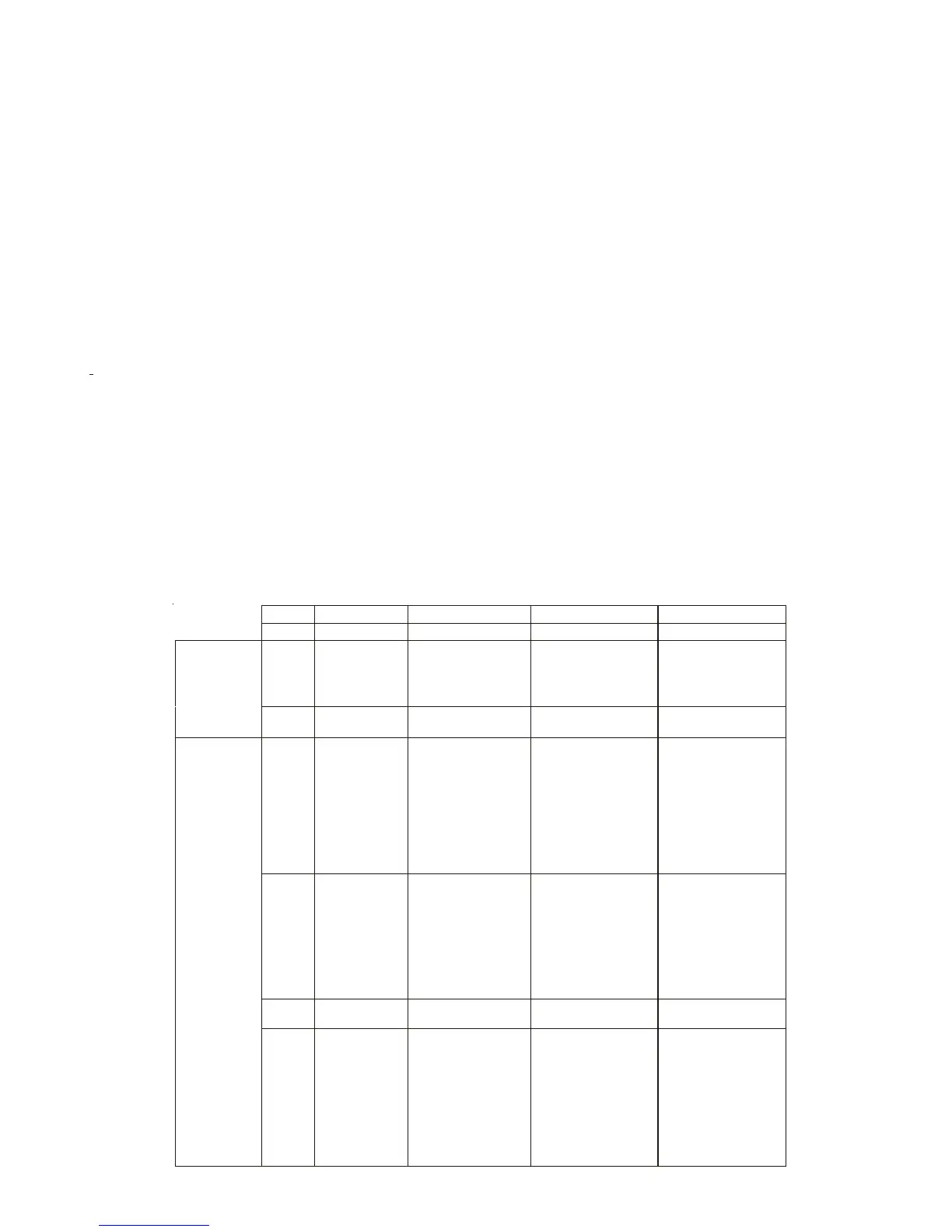
• Red communications LED – Indicates the status of the network. The table below indicates the LED status and the
corresponding potential problem.
• Green receive LED – Indicates network traffic. The table below indicates the LED status and the corresponding potential
problem.
• Learn button – Used to reset the network. Depress the button for approximately 2 seconds to reset the network.
LED Description
Off Normal condition
Red
Communications
LED
1 Flash Communications
Failure
2 Flashes Out-of-box reset
Green Receive
LED
Off •Nopower
•Communications
error
1 Steady
Flash
No network
found
Rapid
Flashing
Normal network
traffc
On Solid Data 1/ Data 2
miss-wire
Possible Cause Corrective Action Comments
None None None
Communications
Failure
•Depress Learn Button
•Verify that bus BIAS and
TERM dipswitches are in
the ON position.
•Depress once quickly for
a power-up reset
•Depress and hold for 2
seconds for an out-of-box
reset
•Control power up
•Learn button depressed
None None
•No power to furnace
•Open fuse
•Communications error
•Check fuses and circuit
breakers; replace/reset
•Replace blown fuse
•Check for shorts in low
voltage wiring in furnace/
system
•Reset network by
depressing learn button
•Check data 1/ data 2
voltages
•Turn power OFF prior to
repair
•Broken/ disconnected
data wire(s)
•Furnace is installed
as a legacy/ traditional
system
•Check communications
wiring (data 1/ data 2
wires)
•Check wire connections
at terminal block
•Verify furnace installation
type (legacy/ traditional
or communicating) Check
data 1/ data 2 voltages
•Turn power OFF prior to
repair
•Verify wires at terminal
blocks are securely
twisted together prior to
inserting into terminal
block
•Verify data1 and data
voltages as described
above
Control is “talking” on
network as expected
None None
•Data 1 and data 2 wires
reversed at furnace,
thermostat, or CT™
compatible outdoor AC/
HP
•Short between data 1
and data 2 wires
•Short between data 1
or data 2 wires and R
(24VAC) or C (24VAC
common)
•Check communications
wiring (data 1/ data 2
wires)
•Check wire connections
at terminal block
•Check data 1/ data 2
voltages
•Turn power OFF prior to
repair
•Verify wires at terminal
blocks are securely
twisted together prior to
inserting into terminal
block
•Verify data1 and data
voltages as described
above






 To Next Page