EasyManua.ls Logo

Grundig TK 847 - Tonbandzubehér; Accessories

Grundig TK 847
42 pages
Print Icon
To Next Page IconTo Next Page
To Previous Page IconTo Previous Page
Loading...
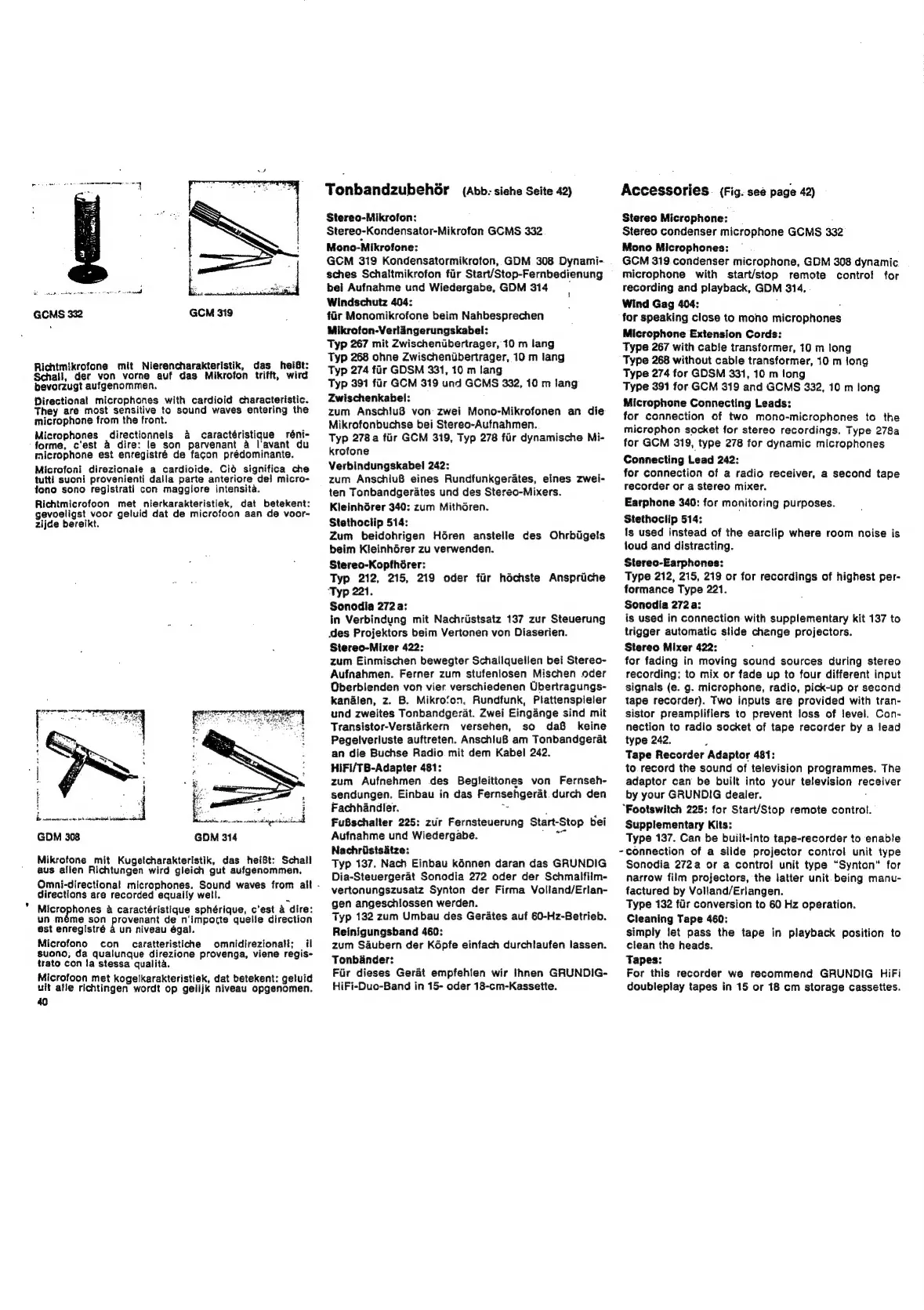
Richtmikrofone
mit
Nierencharakteristik,
das
heiGt:
Schall,
der
von
vorne
auf
das
Mikrofon
trifft,
wird
bevorzugt
aufgenommen.
Directional
microphones
with
cardioid
characteristic.
They
are
most
sensitive
to
sound
waves
entering
the
microphone
from
the
front.
Microphones
directionnels
&
caractéristique
réni-
forme,
c'est
a
dire:
le
son
parvenant
a
l’avant
du
taicrophone
est
enregistré
de
fagon
predominante.
Microfoni
direzionale
a
cardioide.
Cid
significa
che
tutti
suoni
provenienti
dalla
parte
anteriore
del
micro-
tono
sono
registrati
con
maggiore
intensita.
Richtmicrofoon
met
nierkarakteristiek,
dat
betekent:
gevoeligst
voor
geluid
dat
de
microfoon
aan
de
voor-
zijde
bereikt.
i
GDM
308
2
Ore
ad
se
now
ning
aoa
GDM
314
Mikrofone
mit
Kugelcharakteristik,
das
heiBt:
Schall
aus
allen
Richtungen
wird
gleich
gut
aufgenommen.
Omni-directional
microphones.
Sound
waves
from
alt
-
directions
are
recorded
equaily
well.
pucropnanes
a
caractéristique
sphérique,
c’est
a
dire:
un
méme
son
provenant
de
n'importe
quelle
direction
est
enregistré
a
un
niveau
égai.
Microfono
con
caratteristiche
omnidirezionall;
il
suono,
da
qualunque
direzione
provenga,
viene
regis-
trato
con
la
stessa
qualita.
Microfoon
met
kogelkarakteristiek,
dat
betekent:
geluid
uit
alle
richtingen
wordt
op
geiijk
niveau
opgenomen.
40
TonbandzubehGr
(Abb:
siehe
Seite
42)
Stereo-Mikrofon:
Stereo-Kondensator-Mikrofon
GCMS
332
Mono-Mikrofone:
GCM
319
Kondensatormikroton,
GDM
308
Dynami-
sches
Schaltmikrofon
fir
Start/Stop-Fernbedienung
bei
Aufnahme
und
Wiedergabe,
GDM
314.
Windschutz
404:
fir
Monomikrofone
beim
Nahbesprechen
Mikrofon-Verlangerungskabei:
Typ
267
mit
Zwischentbertrager,
10
m
lang
Typ
268
ohne
Zwischenibertrager,
10
m
lang
Typ
274
fir
GDSM
331,
10
m
Jang
Typ
391
fiir
GCM
319
und
GCMS
392,
10
m
fang
Zwischenkabel:
zum
Anschiu8
von:
zwei
Mono-Mikrofonen
an
die
Mikrofonbuchse
bei
Stereo-Aufnahmen.
Typ
278
a
fir
GCM
319,
Typ
278
fiir
dynamische
Mi-
krofone
Verbindungskabel
242:
zum
Anschiu8
eines
Rundfunkgerates,
eines
zwei-
ten
Tonbandgerates
und
des
Stereo-Mixers.
Kleinhdrer
340:
zum
Mithdren.
Stethoclip
514:
Zum
beidohrigen
Héren
anstelle
des
Ohrbigels
beim
KleinhGrer
zu
verwenden.
Stereo-Kopfhérer:
Typ
212, 215,
219
oder
fiir
hdchste
Anspriche
‘Typ
221.
Sonodia
272
a:
in
Verbindung
mit
Nachristsatz
137
zur
Steuerung
des
Projektors
beim
Vertonen
von
Diaserien.
Stereo-Mixer
422:
zum
Einmischen
bewegter
Schallquellen
bei
Stereo-
Aufnahmen.
Ferner
zum
stufeniosen
Mischen
oder
Gberblenden
von
vier
verschiedenen
Ubertragungs-
kanalen,
z.
B.
Mikrofon,
Rundfunk,
Plattenspieler
und
zweites
Tonbandgerat.
Zwei
Eingange
sind
mit
Transistor-Verstarkern
versehen,
so
da8
keine
Pegelverluste
auftreten.
AnschluB
am
Tonbandgerat
an
die
Buchse
Radio
mit
dem
Kabel
242.
HIFI/TB-Adapter
481:
zum
Aufnehmen
des
Begleittones
von
Fernseh-
sendungen.
Einbau
in
das
Fernsehgerat.durch
den
Fachhandler.
-
FuBschalter
225:
zur
Fernsteuerung
Start-Stop
bei
Aufnahme
und
Wiedergabe.
Ss
Nachristsatze:
Typ
137.
Nach
Einbau
kénnen
daran
das
GRUNDIG
Dia-Steuergerat
Sonodia
272
oder
der
Schmalfilm-
vertonungszusatz
Synton
der
Firma
Volland/Erlan-
gen
angeschlossen
werden.
Typ
132
zum
Umbau
des
Gerates
auf
60-Hz-Betrieb.
Reinigungsband
460:
zum
Saubern
der
Képfe
einfach
durchlaufen
lassen.
Tonbiander:
Fir
dieses
Gerat
empfehlen
wir
Ihnen
GRUNDIG-
HiFi-Duo-Band
in
15-
oder
18-cm-Kassette.
Accessories.
(Fig.
seé
page
42)
Stereo
Microphone:
Stereo
condenser
microphone
GCMS
332
Mono
Microphones:
GCM
319.condenser
microphone,
GDM
308
dynamic
microphone
with
start/stop
remote
control
for
recording
and
playback,
GDM
314.
Wind
Gag
404:
.
for
speaking
close
to
mono
microphones
Microphone
Extension
Cords:
Type
267
with
cable
transformer,
10
m
tong
Type
268
without
cable
transformer,
10
m
long
Type
274
for
GDSM
331,
10
m
long
Type
391
for
GCM
319
and
GCMS
332,
10
m
long
Microphone
Connecting
Leads:
for
connection
of
two
mono-microphones
to
the
microphon
socket
for
stereo
recordings.
Type
278a
for
GCM
319,
type
278
for
dynamic
microphones
Connecting
Lead
242:
for
connection
of
a
radio
receiver,
a
second
tape
recorder
or
a
stereo
mixer.
Earphone
340:
for
monitoring
purposes.
Stethoclip
514:
Is
used
instead
of
the
earclip
where
room
noise
is
loud
and
distracting.
Stereo-Earphones:
Type
212,
215,
219
or
for
recordings
of
highest
per-
formance
Type
221.
Sonodia
272
a:
is
used
in
connection
with
supplementary
kit
137
to
trigger
automatic
slide
change
projectors.
Stereo
Mixer
422:
for
fading
in
moving
sound
sources
during
stereo
recording;
to
mix
or
fade
up
to
four
different
input
signals
(e.
g.
microphone,
radio,
pick-up
or
second
tape
recorder).
Two
inputs
ere
provided
with
tran-
sistor
preamplifiers
to
prevent
loss
of
level.
Con-
nection
to
radio
socket
of
tape
recorder
by
a
lead
type
242.
.
Tape
Recorder
Adaptor
481:
to.
record
the
sound
of
television
programmes.
The
adaptor
can
be
built
into
your
television
receiver
by
your
GRUNDIG
dealer.
:
‘Footswitch
225:
for
Start/Stop
remote
control.
Supplementary
Kits:
Type
137.
Can
be
built-into
tape-recorder
to
enable
-connection
of
a
slide
projector
control
unit
type
Sonodia
272a
or
a
control
unit
type
“Synton"
for
narrow
film
projectors,
the
latter
unit.
being
manu-
factured
by
Volland/Erlangen.
Type
132
fir
conversion
to
60
Hz
operation.
Cleaning
Tape
460:
simply
let
pass
the
tape
in
playback
position
to
clean
the
heads.
Tapes:
For
this
recorder
we
recommend
GRUNDIG
HiFi
doubleplay
tapes
in
15
or
18
cm
storage
cassettes.

Related product manuals