*#1 :-Owner’s Manual
32
DRAWBARS™
The 9 Drawbars (plus 2 for the Pedal) on this keyboard are used to make the basic sounds.
Each Drawbar is marked with the numbers 1 - 8. If you push back the Drawbar until you can
not see any number at all, the sound of the Drawbar is not heard. If you pull it out to the
fullest position THE SOUND LEVEL is maximum.
Except when the Preset Key is B, the actual Drawbar Registration is the value displayed in the
(display-)window. The “Drawbar Registraion” shows the length of the pulled-out Drawbar(s).
The display shows only the Drawbar(s) you operate.
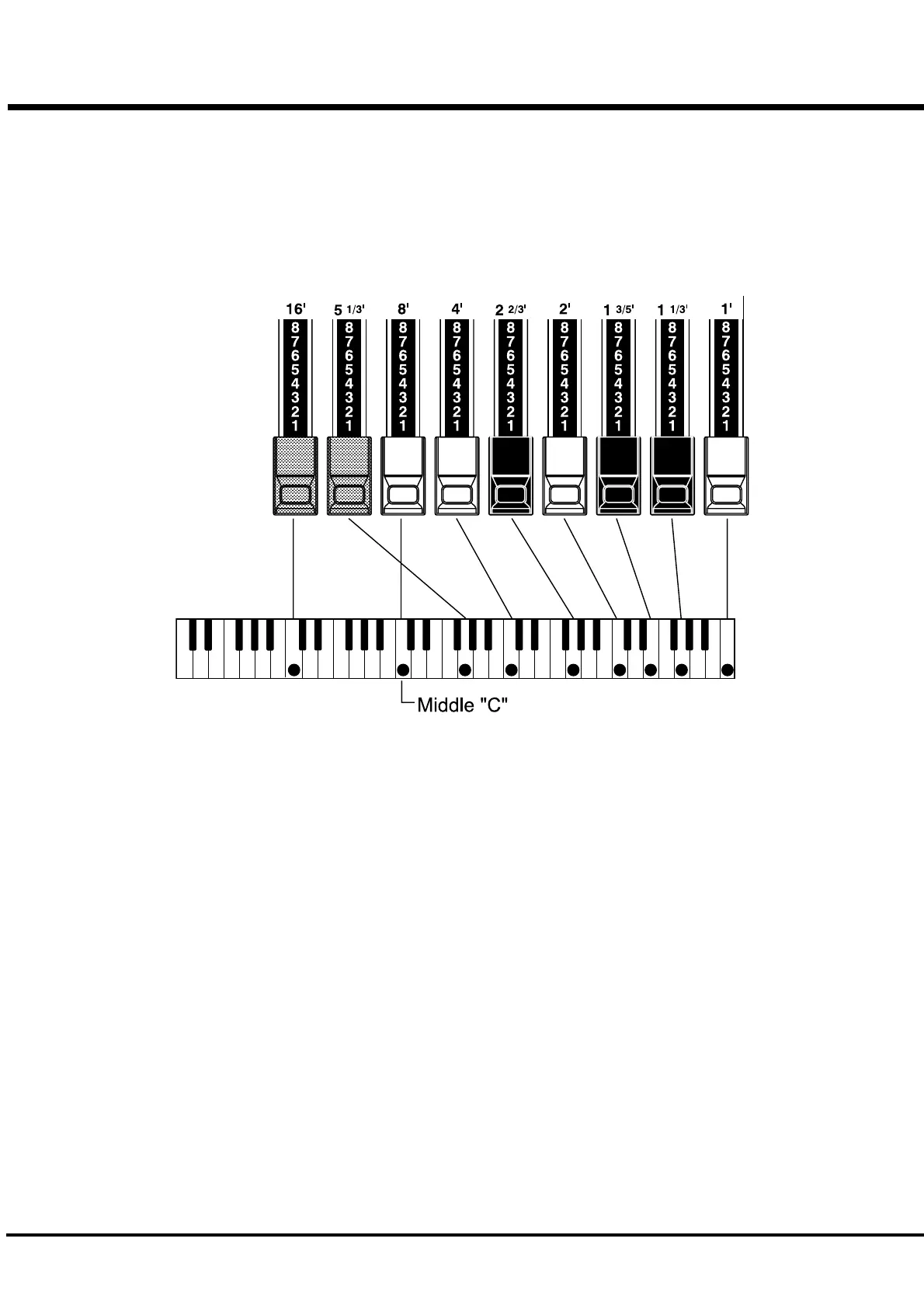
The pitch of each Drawbar is as shown above, when the middle C is depressed. The footage
marked (') on each Drawbar is originated from the length of the pipes of the pipe organ.
The numbers 1 - 8 on each Drawbar indicate the volume of the sound to be produced as well
as the guide to simply set the Drawbar.
For example, when you blow clarinet, the internal air vibrates, and the fundamental (8') and
the third harmonic (2 2/3') plus the fifth harmonic (1 3/5') come out at the same time. On this
keyboard, if you pull out 3 Drawbars, you can get the clarinet sound. If you pull out the right
hand side one of the 3 Drawbars a little longer and the left hand side one a little shorter, the
element/component of the high pitch increases and a hard sound comes out. If you pull out the
left hand one a little longer, on the contrary, the sound gets mellow.
Thus, you can make delicate changes to the sound, depending on the flow of the tune/music
or your choice/preference, by fully utilizing the Drawbars.
NOTE: You can change the characters of the Drawbars. (P. 54)


 To Next Page