Operational Guide
34
Recalibrating a pH sensor or adding to an existing calibration is simple and
follows the PROCEDURE outlined on page 28.
Press CAL. Place sensor in desired buer and select buer from choices. When
sensor has equilibrated, the CFM tag will turn on and blink. Press the CFM key.
Press CAL to escape the calibration. Alternately continue calibrating in
additional buers. The latest calibration point will be added to the existing
data. GLP will reect the latest calibration data. Older calibration buers will
be seen as blinking buers.
Note: Each time a buer is conrmed, the new
calibration data replaces the old data for the
corresponding buer or for any near buer in a ±0.2
pH proximity. If the current buer has no previous
data stored and the calibration has not used ve
buers, the current buer is added to the existing
calibration. If the existing calibration is full, the
instrument asks which buer to replace.
Note: When using Standard mode (Basic mode O), the user has a choice if
they want the display to show the CONDITION and RESPONSE gauges on the
display. These are part of the Cal Check™ system and are selected in SETUP by
the parameter INFORMATION. The choice is ON or OFF.
Electrode Condition And Electrode Response Time
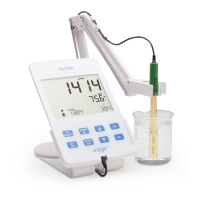
edge™ pH Calibration Check™ feature will assess electrode condition and
response time during each calibration and display it for the rest of the day.
The condition gauge shows the electrode’s condition that is based on the
oset and slope characteristics of the pH electrode at the time of calibration.
The response gauge is a function of the stabilization time between the rst
and second calibration buers, when calibration is performed between a pair
of 4.01, 7.01, or 10.01. These gauges reect the electrode’s performance and
should be expected to slowly decrease over the life of the electrode.
pH
Calibration





 To Next Page