EasyManua.ls Logo

HP 5300A - Page 26

HP 5300A
90 pages
Print Icon
To Next Page IconTo Next Page
To Previous Page IconTo Previous Page
Loading...
ne
anes
a
ee
Model
5300A
,
Theory
of
Operation
ae
ADE
4-LINE
eal
LATCH
viens
|
GATES
om
4-
eal
4-LINE
ca
TES
4
aE
TRANSFER
Oy
50—
7
5v
_|
MULTIPLEXER’
GATES
BINARY
CODED
OIGIT
SELECT
CODE
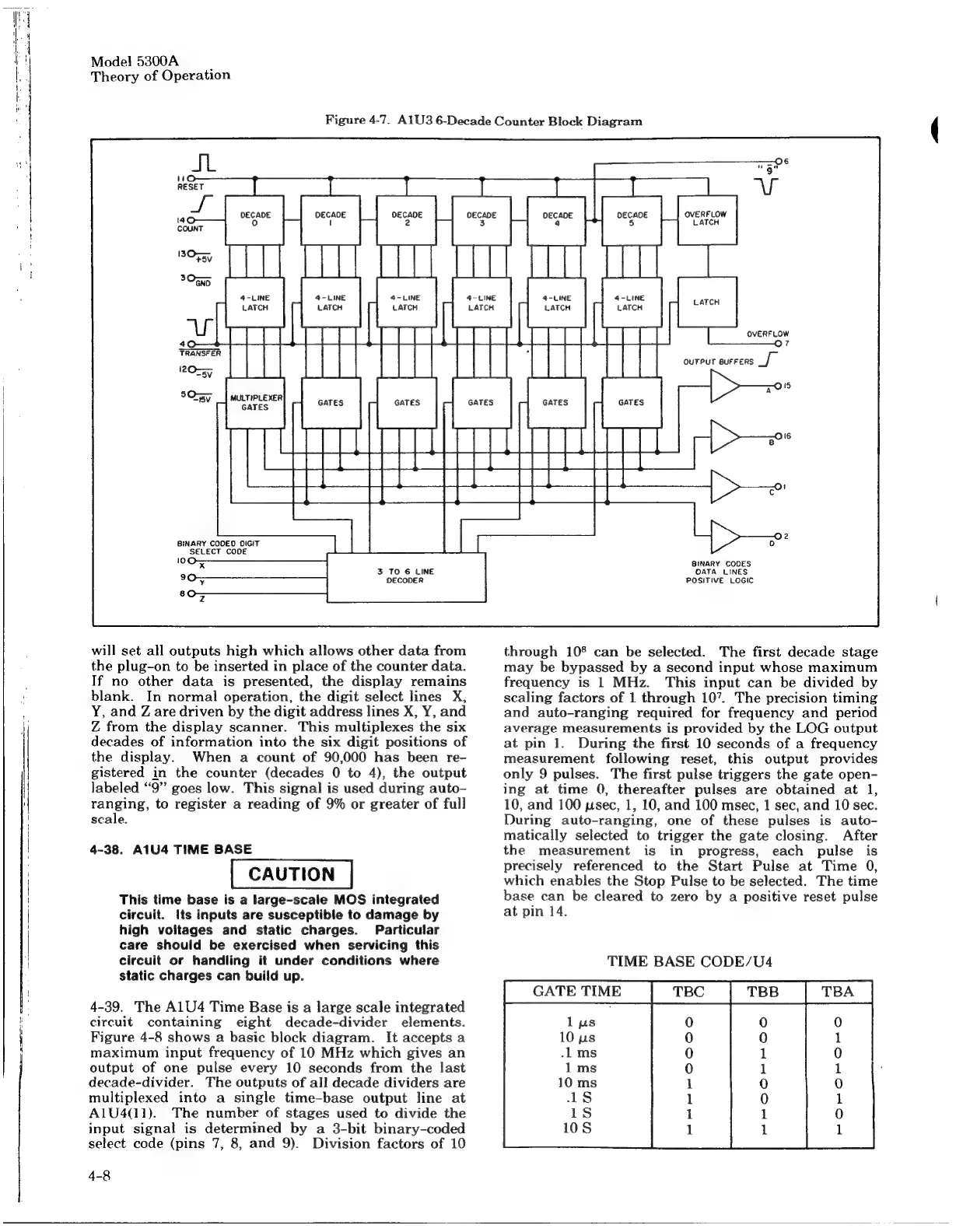
will
set
all
outputs
high
which
allows
other
data
from
the
plug-on
to
be
inserted
in
place
of
the
counter
data.
If
no
other
data
is
presented,
the
display
remains
blank.
In
normal
operation,
the
digit
select
lines
X,
Y,
and
Z
are
driven
by
the
digit
address
lines
X, Y,
and
Z
from
the
display
scanner.
This
multiplexes
the
six
decades
of
information
into
the
six
digit
positions
of
the
display.
When
a
count
of
90,000
has
been
re-
gistered
in
the
counter
(decades
0
to
4),
the
output
labeled
“9”
goes
low.
This
signal
is
used
during
auto-
ranging,
to
register
a
reading
of
9%
or
greater
of
full
scale.
4-38.
A1U4 TIME
BASE
CAUTION
This
time
base
is
a
large-scale
MOS
integrated
circuit.
Its
inputs
are
susceptible
to
damage
by
high
voitages
and
static
charges.
Particular
care
should
be
exercised
when
servicing
this
circuit
or
handling
it
under
conditions
where
static
charges
can
build
up.
4-39.
The
A1U4
Time
Base
is
a
large
scale
integrated
circuit
containing
eight
decade-divider
elements.
Figure
4-8
shows
a
basic
block
diagram.
It
accepts
a
maximum
input
frequency
of
10
MHz
which
gives
an
output
of
one
pulse
every
10
seconds
from
the
last
decade-divider.
The
outputs
of
all
decade
dividers
are
multiplexed
into
a
single
time-base
output
line
at
Al1U4(11).
The
number
of
stages
used
to
divide
the
input
signal
is
determined
by
a
3-bit
binary-coded
select
code
(pins
7,
8,
and
9).
Division
factors
of
10
4-8
4-
LINE
Figure
4-7.
A1U3
6-Decade
Counter
Block
Diagram
Een
=r
Hor
cee
les
DECADE
Hee
DEC
Rae
Ove
Rt
tow
a
la
4-LINE
Fal
4-LINE
Es
ea
OVERFLOW
GATES
BINARY
CODES
OATA
LINES
POSITIVE
LOGIC
through
108
can
be
selected.
The
first
decade
stage
may
be
bypassed
by
a
second
input
whose
maximum
frequency
is
1
MHz.
This
input
can
be
divided
by
scaling
factors
of
1
through
107.
The
precision
timing
and
auto-ranging
required
for
frequency
and
period
average
measurements
is
provided
by
the
LOG
output
at
pin
1.
During
the
first
10
seconds
of
a
frequency
measurement
following
reset,
this
output
provides
only
9
pulses.
The
first
pulse
triggers
the
gate
open-
ing
at
time
0,
thereafter
pulses
are
obtained
at
1,
10,
and
100
psec,
1,
10,
and
100
msec,
1
sec,
and
10
sec.
During
auto-ranging,
one
of
these
pulses
is
auto-
matically
selected
to
trigger
the
gate
closing.
After
the
measurement
is
in
progress,
each
pulse
is
precisely
referenced
to
the
Start
Pulse
at
Time
0,
which
enables
the
Stop
Pulse
to
be
selected.
The
time
base
can
be
cleared
to
zero
by
a
positive
reset
pulse
at
pin
14.
TIME
BASE
CODE/U4
GATE
TIME
TBC
4
ies]
ive]
0
0
0
0
1
1
1
1
He
OOrr
Oo
KH
On
OrOrO

Related product manuals