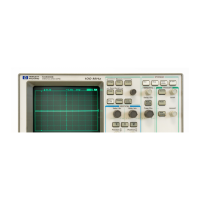
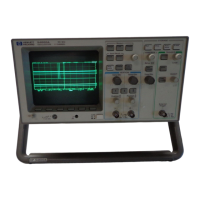
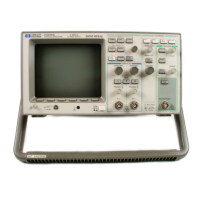
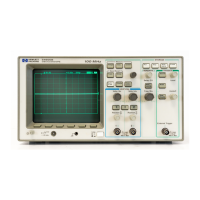
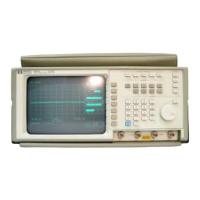
Triggering the HP 54645A Oscilloscope
The HP 54645A Oscilloscope allows you to synchronize the display to
the actions of the circuit under test by defining a trigger condition.
The triggering modes include Auto Lvl, Auto, and Normal. Triggering
types include Glitch, TV, and Slope/Edge and you can use channels 1
or 2, Line, or the External Trigger BNC for the source.
MegaZoom Technology Simplifies Triggering
With the built-in MegaZoom technology, you can simply Autoscale the
waveforms, then stop the scope to capture a waveform. You can then pan and
zoom through the data to find a stable trigger point. Autoscale often produces a
triggered display.
To use external triggering
The external trigger input is only available on the HP 54645A Oscilloscope.
1
Connect a signal to the BNC labeled “External Trigger”.
The external trigger input has an input impedance of 1 M
Ω
, and can accept a
maximum signal of
±
400 V (dc + peak ac) with a range of
±
18 V. You can
connect the trigger output of other instruments to this external trigger input,
or use an oscilloscope probe, such as the HP 10074A.
2
Press
Slope/Glitch
. Then select the rising or falling edge, or
Glitch
.
If TV is selected, you cannot use the external trigger, and you must select
either channel 1 or channel 2. If you select glitch, define the polarity and
duration qualifier for the glitch.
3
Press
Source
. Then select
Ext
.
The external trigger is always dc coupled. If you select ac coupling or
low-frequency reject, these functions are not active until you change the
trigger source to channel 1, channel 2, or line. Notice that the status line and
softkeys reflect this.
3-7


 To Next Page