2.16
STEP 3 - DETERMINE OPTIMUM BLADE PITCH - TEETH PER INCH (T.P.I.)
Selecting a blade with proper tooth pitch is important in order to achieve optimal cutting rates and good blade life.
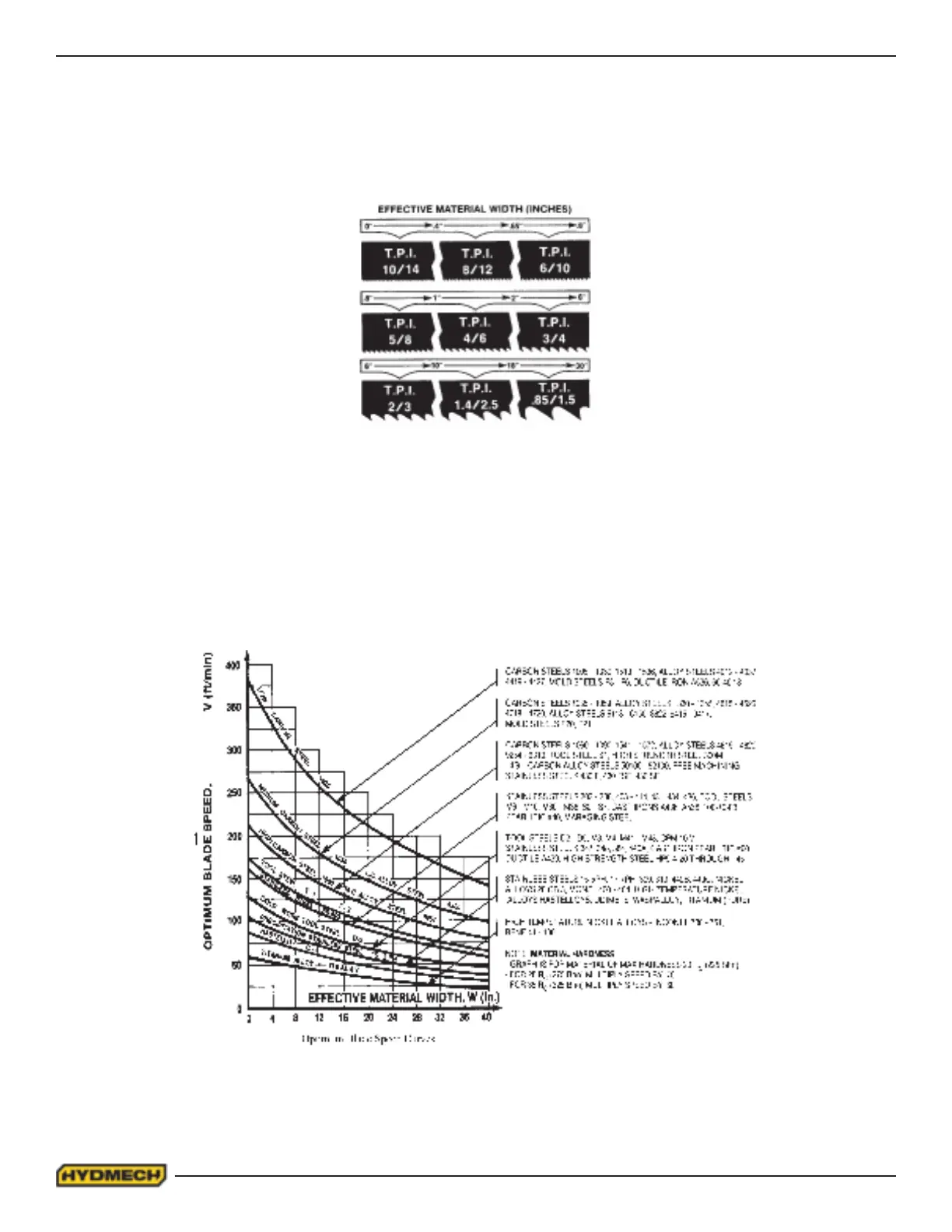
For cutting narrow or thin wall structural materials a ne blade with many teeth per inch (T.P.I.) is recommended. For wide
materials a blade with a coarse pitch should be used. The sketch can be referenced for the blade pitch changes for dier-
ing eective material widths.
It is impractical to change the blade to the proper pitch every time a dierent width of material is cut and it is not neces-
sary, but remember that the optimum blade will cut most eciently. Too ne a blade must be fed slower on wide mate-
rial because the small gullets between the teeth will get packed with chips before they get across and out of the cut. Too
coarse a blade must be fed slower because it has fewer teeth cutting and there is a limit to the depth of a cut taken by
each tooth. Allowance for the use of a non-optimum blade is made in STEP 5.
In our Example #1: Eective material width of 8” (200 mm) & Optimum blade has 2/3 teeth per inch.
STEP 4 - DETERMINE OPTIMUM BLADE SPEED, V (ft/min) (m/min)
The relationship between optimum blade speed and eective material width for various materials is represented on the
graph shown.
The graph shows that as eective material width gets wider or as material gets harder, lower blade speeds are recom-
mended. If material is narrow or soft, higher blades speeds should be selected.


 To Next Page