47
46
34
Pressure
increase.
No
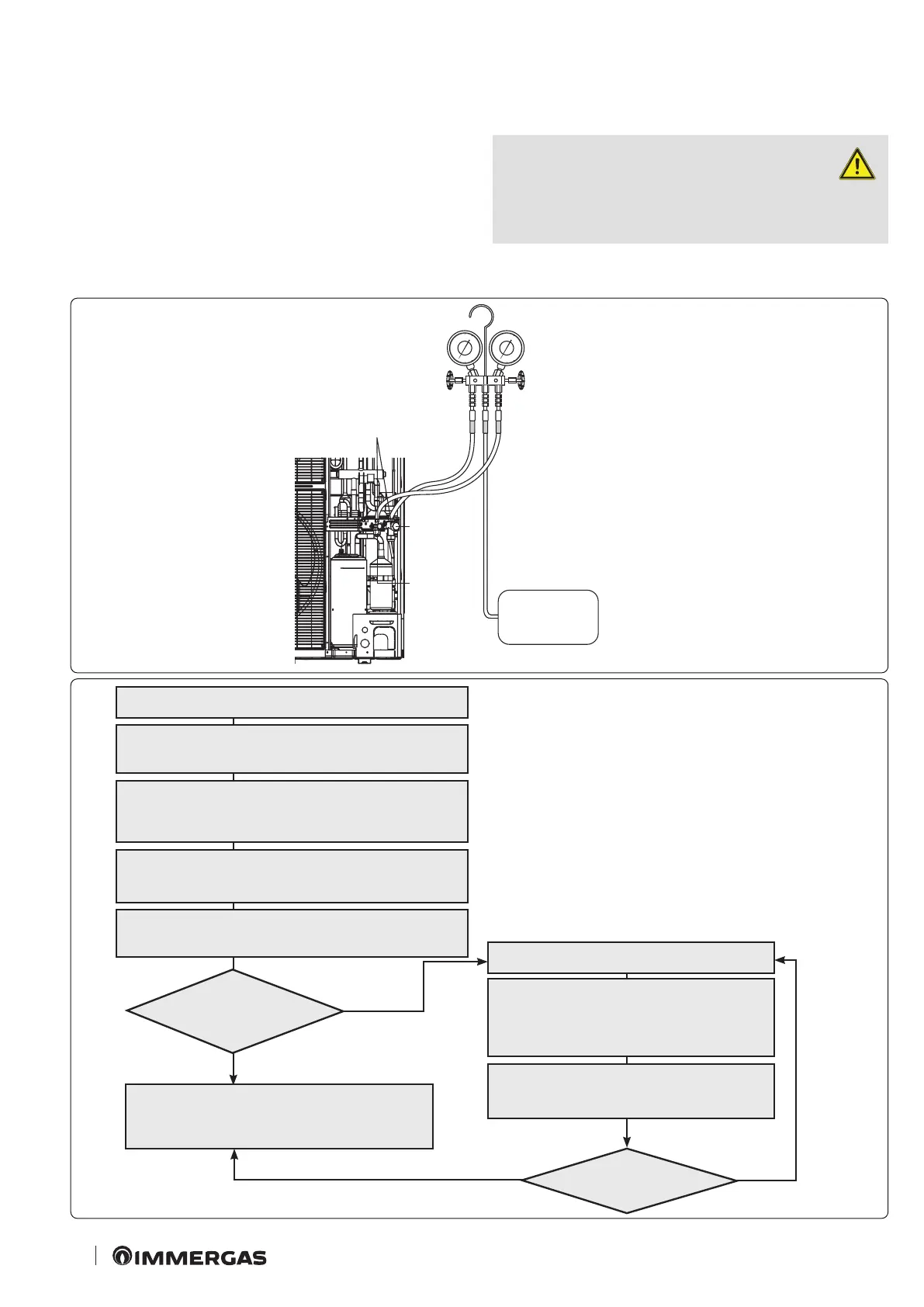
Connect the pressure gauge to the liquid pipe and to the gas pipe
Create vacuum using both the LIQUID door and GAS
door.
Make sure to install the non-return valve to prevent oil from
owing from the pump back into the pipe.
Suction these pipes for over 2 hours and 30 minutes.
e time for creating vacuum can dier depending on the length
o
f the pipe and the outside temperature.
Perform vacuum drying for at least 2 hours.
Close the valve aer having controlled that the pressure of
the vacuum gauge has reached a vacuum degree lower than
750 mTorr for at least one hour.
Check the degree of vacuum with the vacuum gauge
Check that the vacuum degree refers to a value less than or
equal to 70 mTorr for at least one hour.
Additional refrigerant charge depending on length
of the pipes.
Yes
Check for any gas leaks.
Destruction of vacuum due to humidity inside
the pipe.
• Apply pressure with nitrogen at 0.05 MPa
(relative pressure)
Create vacuum until the vacuum degree reaches
a value less than or equal to 750 mTorr for at least
two hours and reevaluate the degree of vacuum.
Pressure
increase.
Yes
No
8.9 CREATING VACUUM.
e following procedure refers to Audax Pro 9 V2.
In the other cases, the procedure is the same except for the fact
that there is only one service connection, instead of two.
- Use only the instruments for R-32 to prevent the inow of foreign
substances and to withstand the internal pressure.
- Use an intake pump with non return valve to prevent the pump
oil from owing back when the pump suddenly stops.
- Use the intake pump that can suction up to 666.6 Pa (5 mm Hg).
- Close the service valve of the pipe on the liquid side and on the
gas side completely while performing the pressure leak test or
creating vacuum.
ATTENTION:
- if pressure increases in one hour,
humidity remains inside the pipe or
there is a leak.
Manifold pressure gauge
High pressure side
Intake
pump
Low pressure side
Service coupling
Gas side
pipe
Liquid
side pipe




 To Next Page