Commissioning and operation
INTORQ | BA 14.0168 | 11/2018 60
1. Make sure that the motor and brake are de-energised.
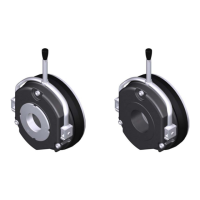
2. Pull (with some force) on the lever until the force increases sharply.
– The rotor must now rotate freely. A small residual torque is permissible.
NOTICE
¾
Make sure that the brake it not subject to excessive force.
¾
Do not use auxiliary tools (e.g. extension pipes) to facilitate the air release. Auxiliary
tools are not permitted and are not considered as proper and intended usage.
3. Release the lever.
– A sufficient torque must build up immediately!
Notice
If faults occur, refer to the error search table (Troubleshooting and fault elimina-
tion,Page71). If the fault cannot be fixed or eliminated, please contact the customer service
department.
7.3 Commissioning
1. Switch on your drive system.
2. Perform a test braking procedure; if necessary, reduce the braking torque (depending on your spe-
cifications and requirements)
7.4 Operation
DANGER
Danger: rotating parts!
¾
The running rotor must not be touched.
¾
Take structural design measures on your final product and implement organizational
safety rules to ensure that nobody can touch a rotor.
DANGER
There is a risk of injury by electrical shock!
¾
Live connections must not be touched.
¾
Take structural design measures on your final product and implement organizational
safety rules to ensure that nobody can touch a connection.
¾
Checks must be carried out regularly. Pay special attention to:
– unusual noises or temperatures
– loose fixing/attachment elements
– the condition of the electrical cables.


 To Next Page