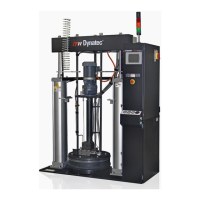
ITW Dynatec
D SERIES V6 DCL ASU Manuals
Troubleshooting Page 7-1
Revised 10/14
General Troubleshooting Notes
The DynaControl controller includes malfunction self-diagnostics, alerts and error indication
alarms. The error indication alarms (the alarms displayed on the DynaControl readout) are triggered
whenever there i s a sensor failure and whenever there is an over-temperature condition. The opera-
tion of the error indication alarms is described in Chapter 4 of this manual.
Preliminary Checks: Verify the following before proceeding:
1. The ASU is switched on.
2. The ASU is supplied with power.
3. The ASU is supplied with pneumatic air (if applicable).
4. Pneumatic and electrical connections are correct.
5. Adhesive is in the hopper.
Error Messages
The controller indicates an error by displaying the word FAULT or ALARM in either the System
Status or the Pump Status fields of the HMI.
Hose/ Applicator Troubleshooting Tip
Hose or applicator problems can be isolated by electrically connecting the applicator and hose to an
alternate socket on the ASU. If the malfunction goes with the applicator and hose, the problem will
usually be in the applicator or hose that was moved. If the malfunction does not move with the ap-
plicator and hose, the problem is probably in the ASU.
Before disconnecting a hose or applicator, always turn its temperature zone OFF at the controller.
This will avoid controller alarms and possible system shutdown.
DANGER
HIGH VOLTAGE
WARNING
HOT SURFACE
ITW Dynatec systems use electrical power that can be life threatening and hot-melt adhesives
that can cause serious burns. Re-read Chapter 1 “Safety Precautions” before performing any
troubleshooting or repair procedures. All troubleshooting and repair procedures must be per-
formed by qualified, trained technicians.
CAUTION: Printed circuit boards (PCBs) are prone to damage from static electrical
charges during handling. Read the section on “Handling Printed CIrcuit Boards”
before handling or attempting service on Dynamelt’s PCBs.
Chapter 7
TROUBLESHOOTING



 To Next Page
 Loading...