Use
of
controls
21
Vehicles equipped
with
rear
air
suspension
As soon
as
the engine
is
started, the electronic control unit carries
out
a self-diagnosis.
The relevant dashboard warning lamp lights up and remains on
for
2 seconds and then goes
out.
In
the event
of
a system failure,
the
lamp remains on permanently.
In
this
case
refer
to
an
Authorised Dealer.
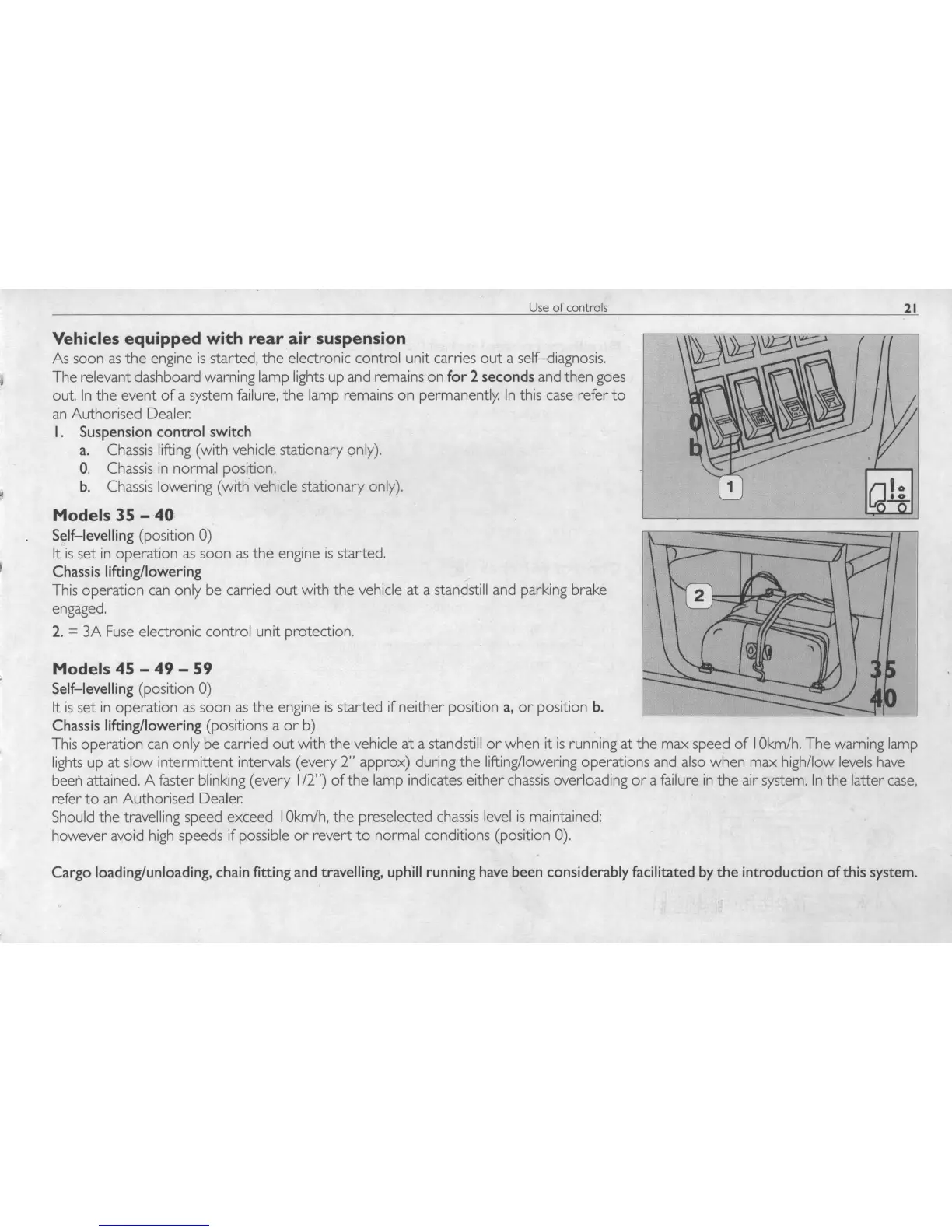
I.
Suspension
control
switch
a.
Chassis
lifting (with vehicle stationary only).
O.
Chassis
in
normal position.
b.
Chassis
lowering
(with
vehicle stationary only).
Models 35 - 40
Self-levelling (position 0)
It
is
set
in
operation
as
soon
as
the engine
is
started.
Chassis lifting/lowering
This operation
can
only be carried
out
with the vehicle at a standstill and parking brake
engaged.
2.
=3A
Fuse
electronic control unit protection.
Models 45 - 49 - 59
Self-levelling (position 0)
It
is
set
in
operation
as
soon
as
the engine
is
started
if
neither position
a,
or
position
b.
Chassis lifting/lowering (positions a
or
b)
This operation
can
only
be
carried
out
with the vehicle at a standstill
or
when it
is
running at the max speed
of
I
Okm/h.
The warning lamp
lights up at slow intermittent intervals (every
2"
approx) during the lifting/lowering operations and
also
when max high/Iow
levels
have
been attained. A faster blinking (every 1/2")
of
the
lamp indicates either
chassis
overloading
or
a failure
in
the air
system.
In
the latter
case,
refer
to
an
Authorised Dealer.
Should the travelling speed
exceed IOkm/h, the preselected
chassis
level
is
maintained:
however avoid high speeds
if
possible
or
revert
to
normal conditions (position 0).
Cargo loading/unloading. chain fitting and travelling, uphill running
have
been considerably facilitated
by
the
introduction
of
this system.


 To Next Page