Starting
and
driving
39
Use
of
the
transmission
Starting
the
vehicle
•
Fully
depress
the
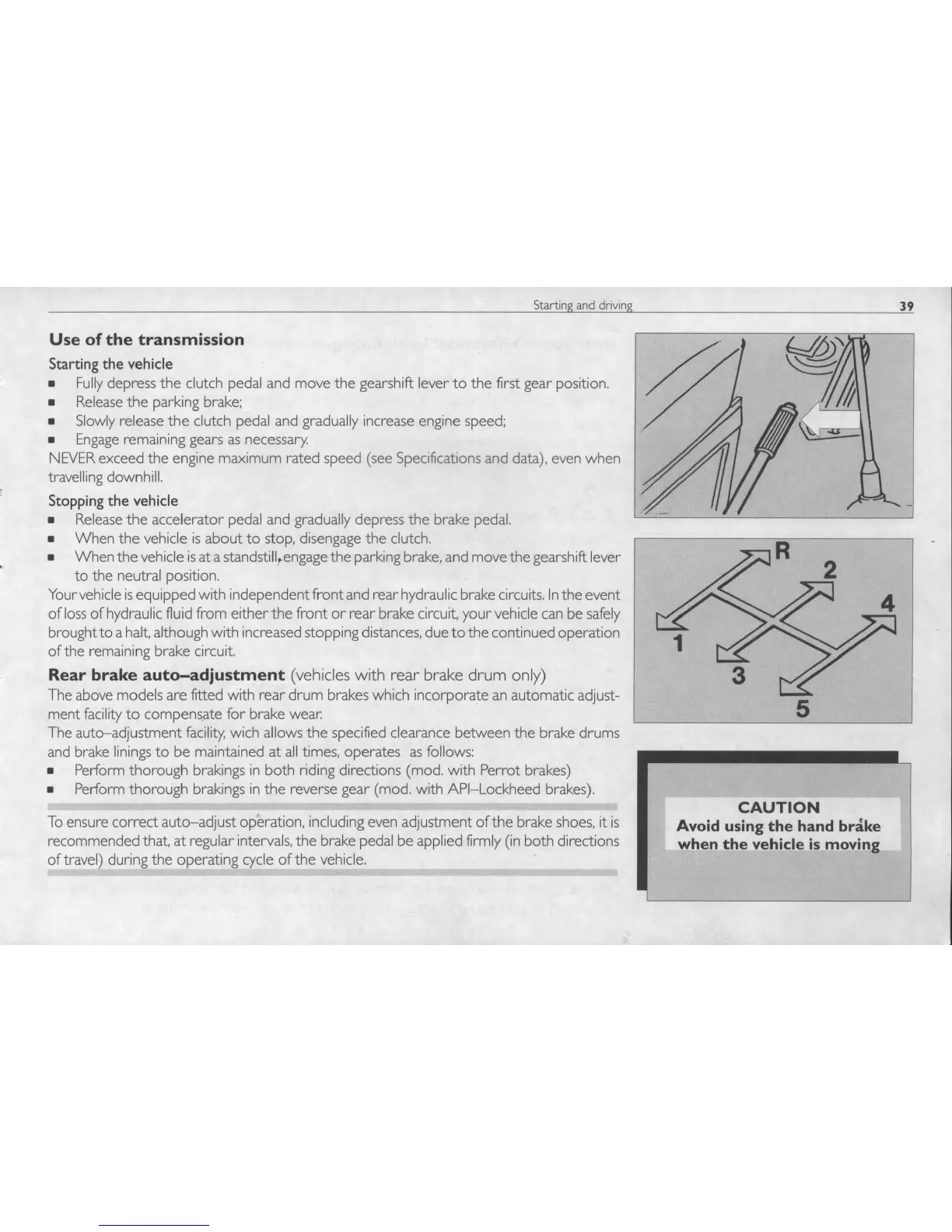
clutch pedal and move
the
gearshift lever
to
the
first gear position.
• Release
the
parking brake;
•
Slowly
release
the
clutch pedal and gradually increase engine speed;
• Engage remaining gears as necessary
NEVER
exceed
the
engine maximum rated
speed
(see Specifications and data), even
when
travelling downhill.
Stopping
the
vehicle
• Release
the
accelerator pedal and gradually depress
the
brake pedal.
•
When
the
vehicle
is
about
to
stop, disengage
the
clutch.
•
When
the
vehicle
is
at
a standstill.engage
the
parking brake, and move
the
gearshift lever
to
the
neutral position.
Your
vehicle
is
equipped with independentfront and
rear
hydraulic brake circuits.
In
the
event
of
loss
of
hydraulic
fluid
from
either
the
front
or
rear brake circuit, your vehicle can be safely
brought
to
a halt, although with increased stopping distances,
due
to
the
continued operation
of
the
remaining brake circuit.
Rear brake
auto-adjustment
(vehicles
with
rear
brake
drum
only)
The above models
are
fitted with rear
drum
brakes which incorporate an automatic adjust-
ment
facility
to
compensate
for brake wear.
The auto-adjustment
facility,
wich allows
the
specified clearance
between
the
brake drums
and brake
linings
to
be
maintained
at
all
times,
operates
as follows:
• Perform thorough brakings
in
both riding directions (mod. with Perrot brakes)
• Perform thorough brakings
in
the
reverse
gear
(mod. with API-Lockheed brakes).
To
ensure correct
auto-adjust
operation, including even adjustment
of
the
brake shoes,
it
is
recommended that,
at
regular intervals,
the
brake pedal
be
applied
firmly
(in
both directions
of
travel) during
the
operating cycle
of
the
vehicle.
5
CAUTION
Avoid using
the
hand brake
when
the
vehicle
is
moving


 To Next Page